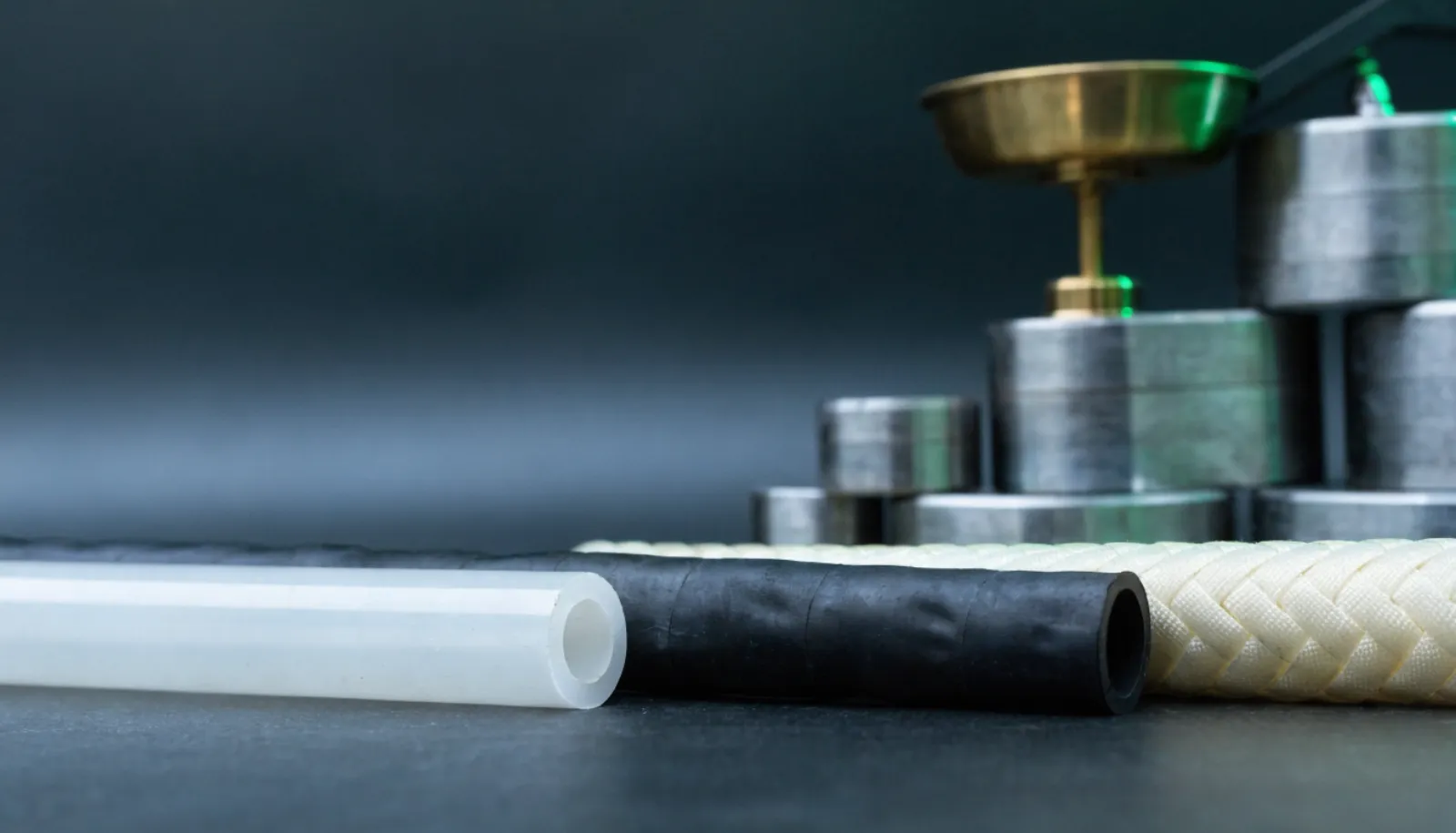
Industrial fluid transfer systems demand materials that withstand extreme temperatures, aggressive chemicals, and high pressures while maintaining regulatory compliance. When procurement teams evaluate fluoropolymer tubing options, the choice between PTFE, FEP, and PFA involves balancing performance requirements against total cost of ownership. Each material offers distinct advantages for specific applications, and understanding these differences prevents costly specification errors that lead to premature failure or unnecessary expense.
Material Properties & Temperature Capabilities
Polytetrafluoroethylene (PTFE) remains the benchmark fluoropolymer for industrial applications, offering continuous service temperatures from -200°C to +260°C. This temperature range covers the vast majority of chemical processing, pharmaceutical manufacturing, and fluid transfer requirements. PTFE's molecular structure provides exceptional thermal stability, maintaining mechanical properties across this entire spectrum without degradation.
Fluorinated ethylene propylene (FEP) shares PTFE's chemical backbone but incorporates perfluoropropylene units that enable melt processing. This modification reduces the maximum continuous operating temperature to +200°C. FEP tubing can be produced through conventional extrusion and injection molding, allowing complex geometries and tighter dimensional tolerances than compression-molded PTFE. The 60°C temperature reduction matters critically in applications approaching the upper limit—steam sterilization cycles, for example, may exceed FEP's capability while remaining well within PTFE's range.
Perfluoroalkoxy (PFA) bridges the performance gap between PTFE and FEP, offering melt processability while maintaining PTFE's 260°C maximum service temperature. PFA's copolymer structure provides superior mechanical stability at elevated temperatures compared to FEP, with greater tensile strength and creep resistance. PFA tubing maintains dimensional stability under thermal cycling better than FEP, reducing the risk of connection failures in systems experiencing frequent temperature fluctuations.
The optical properties of these materials create practical differences for process monitoring. PTFE is completely opaque, preventing visual inspection of fluid flow or contamination. FEP offers transparency to semi-transparency, enabling operators to verify flow conditions, detect air bubbles, or identify particulate contamination without system interruption. For pharmaceutical batch processing or chemical dosing systems where visual verification adds safety value, FEP's transparency justifies its selection despite temperature limitations.
Virgin vs Recycled PTFE: Quality & Compliance Impact
Virgin-grade PTFE, produced exclusively from pristine fluoropolymer resin, delivers predictable and consistent performance with maximum mechanical strength, purity, and chemical stability. This material exhibits 10-15% higher tensile strength and elongation at break compared to reprocessed grades, a difference that directly impacts pressure ratings and service life. Virgin PTFE maintains uniform molecular weight distribution, ensuring that every meter of extruded tubing meets the same performance specifications.
Mechanical-grade or recycled PTFE incorporates reground material from manufacturing scrap or post-consumer sources, significantly reducing raw material costs. This economic advantage comes with performance compromises that limit application suitability. Recycled PTFE may contain contaminants from previous uses, degraded polymer chains from thermal history, and inconsistent filler distribution if the source material included filled compounds.
Regulatory compliance creates an absolute requirement for virgin material in pharmaceutical, food-contact, and medical device applications. Virgin PTFE is the only grade meeting FDA 21 CFR 177.1550 for food-contact materials and USP Class VI biocompatibility standards for medical use. Pharmaceutical manufacturing under cGMP regulations demands documented material traceability and lot-specific testing, requirements that recycled PTFE cannot satisfy due to unknown source material history.
The extractables profile differs substantially between virgin and recycled grades. Virgin PTFE exhibits minimal leachable compounds, maintaining fluid purity in semiconductor processing, analytical chemistry, and parenteral drug manufacturing. Recycled material may release unknown contaminants accumulated during previous service, compromising product quality in sensitive applications. For chemical processing plants handling commodity chemicals, mechanical-grade PTFE may provide adequate performance at lower cost, but pharmaceutical and semiconductor facilities must specify virgin-grade material to protect product integrity.
Chemical Resistance & Application Matching
PTFE offers outstanding chemical resistance to virtually all industrial solvents, acids, bases, and corrosive materials, with notable exceptions including elemental fluorine, molten sodium hydroxide, and molten alkali metals. This near-universal inertness makes PTFE the default choice for chemical processing applications where fluid compatibility uncertainty exists or where a single tubing material must handle multiple chemicals in sequential batches.
FEP matches PTFE's chemical resistance profile across most applications, maintaining inertness to acids, bases, solvents, and oxidizers within its temperature range. The chemical resistance difference between PTFE and FEP becomes significant primarily at elevated temperatures approaching FEP's 200°C limit, where aggressive oxidizers or concentrated acids may attack FEP while PTFE remains stable. For room-temperature chemical transfer or applications below 150°C, FEP provides equivalent chemical protection with the added benefit of transparency for process monitoring.
PFA outperforms both PTFE and FEP in specific aggressive chemical environments, particularly strong oxidizers such as chlorine gas, evaporating nitric acid, and hot concentrated sulfuric acid. PFA's copolymer structure provides superior resistance to permeation and stress cracking in these demanding applications, extending service life beyond what PTFE achieves. The material's lower extractables profile compared to FEP makes PFA the preferred choice for high-purity chemical delivery in microelectronics fabrication.
Application matching requires considering secondary factors beyond basic chemical compatibility. Permeation rates vary among fluoropolymers, affecting applications where trace contamination or solvent loss matters. PTFE exhibits lower permeability to gases and organic solvents than FEP, making it preferable for vacuum systems or applications involving volatile organic compounds. For hydraulic brake systems using DOT 3/4 fluids, PTFE brake hose assemblies prevent moisture ingress that degrades brake performance.
Cost Analysis & Total Cost of Ownership
When evaluating PTFE tubing cost comparison alternatives, material cost positioning places PFA at the premium end, typically 40-60% more expensive than virgin PTFE per kilogram, with FEP falling 10-20% above PTFE pricing. These raw material differences translate directly to finished tubing costs, making PFA the highest-cost option and FEP moderately more expensive than PTFE for equivalent dimensions.
Processing efficiency impacts manufacturing costs significantly, favoring melt-processable FEP and PFA over compression-molded PTFE for complex geometries or tight tolerances. Custom PTFE tube dimensions requiring precision extrusion demand specialized equipment and slower production rates, increasing per-meter costs for non-standard sizes. FEP and PFA tubing can achieve tighter dimensional tolerances with less post-processing, reducing fitting costs and assembly labor in complex fluid systems.
Service life differences create substantial total cost of ownership variations when comparing PTFE tubing cost comparison alternatives. In aggressive chemical service at elevated temperatures, PFA tubing may deliver 2-3 times the service life of PTFE, reducing replacement frequency and maintenance downtime costs. For a chemical processing plant where tubing replacement requires production shutdown, the cost of lost production during maintenance far exceeds material savings from choosing lower-cost tubing.
Compliance costs add hidden expenses that favor virgin-grade materials despite higher purchase prices. Recycled PTFE's lower material cost becomes irrelevant when regulatory non-compliance forces product recalls, batch rejections, or facility shutdowns. Chemical resistance verification through proper material selection prevents costly failures that damage equipment, contaminate products, or create safety incidents.
How to Select the Right Fluoropolymer for Your Industry
Temperature requirements provide the primary decision criterion for fluoropolymer selection. Applications with continuous operating temperatures above 200°C eliminate FEP from consideration, leaving PTFE or PFA as the only suitable choices. For processes involving steam sterilization cycles at 121-134°C, all three materials function adequately. Cryogenic applications below -100°C favor PTFE's proven performance across the full temperature range.
Regulatory compliance requirements create absolute material specifications that override cost considerations. Pharmaceutical manufacturing, food processing, and medical device applications demand virgin-grade PTFE, FEP, or PFA with documented FDA compliance and material traceability. Semiconductor fabrication requires high-purity PFA meeting SEMI F-57 standards for extractables and particle generation. Verify that material certifications match your industry's regulatory framework before evaluating other selection criteria.
Chemical compatibility analysis should extend beyond simple resistance charts to consider concentration, temperature, and exposure duration. For mixed-chemical environments where a single tubing material must handle sequential exposure to different fluids, PTFE's universal resistance provides the safest specification. Applications involving visual flow monitoring gain operational value from FEP's transparency. Consider whether your PTFE tubing cost comparison alternatives benefit from smooth bore versus convoluted construction, as this structural choice affects cleaning validation and pressure drop.
Pressure ratings and mechanical stress requirements influence material selection when operating near performance limits. PTFE tubing cost comparison alternatives show that PTFE achieves higher pressure ratings than FEP at equivalent wall thickness due to superior tensile strength, making it preferable for high-pressure hydraulic systems or compressed gas service. For applications requiring flexibility and frequent flexing, conductive PTFE hoses with specialized formulations prevent electrostatic buildup in volatile media transfer.
System design considerations including fabrication requirements, installation constraints, and maintenance accessibility affect material selection beyond basic performance criteria. PFA's weldability enables complex manifold assemblies and eliminates mechanical fittings in space-constrained installations. For industries requiring static dissipative properties when handling flammable solvents, specialized conductive formulations provide safety features that standard materials cannot deliver.
Advanced Fluro Private Limited manufactures precision-extruded PTFE, FEP, and PFA tubing from virgin-grade fluoropolymer resin, providing technical guidance for material selection across chemical processing, pharmaceutical, and industrial applications. Our ISO 9001:2015 certified manufacturing facility in Vasai East, Mumbai produces custom dimensions with tight tolerances, meeting SAE 100R14, ASTM D3295, and SEMI F57 standards for demanding applications from -200°C to +260°C and pressures up to 300 bar. For detailed specifications and application-specific recommendations, explore our complete range of PTFE products or review our technical blog covering fluoropolymer selection, installation, and performance optimization.

Article by
AFTubes Team
Savio Pereira is a Chemical Engineer who has held leadership roles in companies like IBM. A passionate problem solver who thrives at finding solutions to engineering and business problems alike using simple innovative ideas. He believes in doing things differently rather than doing different things. His vision is to make Advanced Fluro (P) Ltd the most valuable company in the fluouro polymer industry.