
Article by
Savio Pereira
Savio Pereira is a Chemical Engineer who has held leadership roles in companies like IBM. A passionate problem solver who thrives at finding solutions to engineering and business problems alike using simple innovative ideas. He believes in doing things differently rather than doing different things. His vision is to make Advanced Fluro (P) Ltd the most valuable company in the fluouro polymer industry.
Most PTFE tube demand is met by a fairly small set of standard OD/ID combinations, and for good reason -- they cover the majority of instrumentation, laboratory, and general process applications. But retrofit projects, OEM equipment redesigns, and specialised instrumentation regularly need a dimension that simply isn't on a standard size chart. Understanding how custom-dimension PTFE tube is actually produced, and what's realistic to ask for, avoids both over-paying for unnecessary tolerance and under-specifying something that won't hold up in service.
Key Takeaways
- PTFE tube is produced by paste extrusion or ram extrusion, both of which are inherently more tooling-flexible than injection molding -- custom dimensions are a routine capability for a genuine manufacturer, not a special favour.
- Realistic OD range for custom PTFE tube runs from roughly 0.5 mm up past 100 mm, with wall thickness independently specifiable within manufacturing limits.
- Tolerance band, not just nominal dimension, is what actually matters for press-fit, sealing, or instrumentation applications.
- Minimum order quantity is the practical constraint on custom tube, not the dimension itself -- ask early, not after quoting.
- A manufacturer running its own extrusion line can typically turn around custom dimensions faster than a reseller routing the request to an overseas factory.
How PTFE Tube Dimensions Are Actually Set
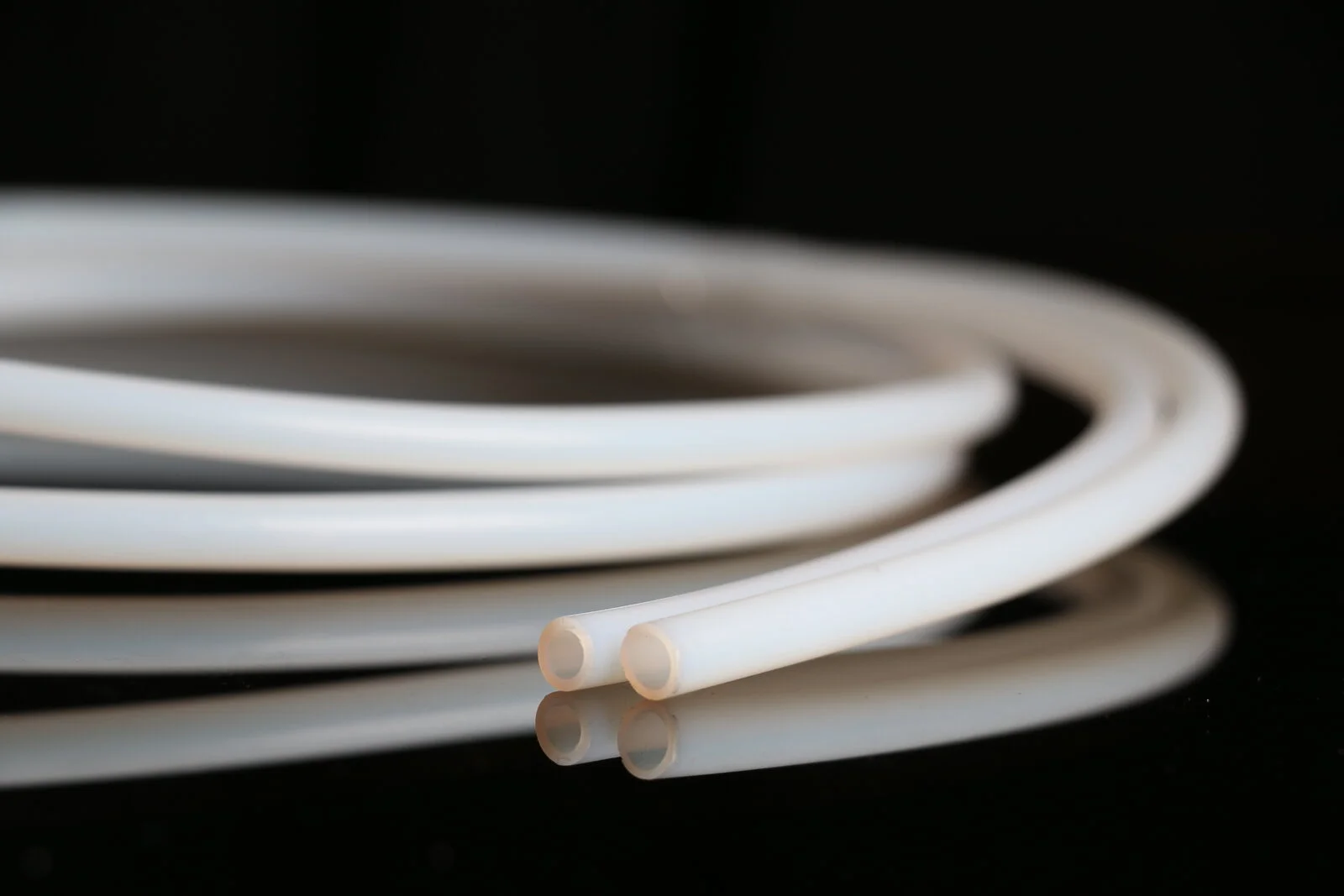
Unlike injection-molded plastic parts, where a new dimension usually means a new mold, PTFE tube is produced by paste extrusion (for smaller, thinner-wall tube) or ram extrusion (for larger or thicker-wall product), forcing PTFE resin paste or preform through a die at controlled pressure and temperature. The die and mandrel set the OD and ID respectively, and because these tooling elements are comparatively simple and inexpensive relative to injection molds, a genuine PTFE extruder can produce non-standard combinations without the tooling investment that would make a custom injection-molded part impractical for anything but very large volumes.
What's Realistically Available Outside Standard Sizes
OD can range from roughly 0.5 mm (fine spaghetti tubing for instrumentation and wire insulation) up past 100 mm for pipe-liner applications, with wall thickness independently specifiable from around 0.25 mm up to several millimetres. Because OD and wall thickness are set by separate tooling elements, a genuine custom order isn't limited to "closest standard OD" -- both dimensions can be specified together to hit a target ID that a standard catalogue combination doesn't cover.
Tolerance: The Detail That Actually Determines Fit
A quoted nominal dimension without a tolerance band is an incomplete specification for anything going into a press-fit, a sealing application, or precision instrumentation. Ask specifically for the OD and ID tolerance your supplier can hold on the custom size in question -- tighter tolerance is achievable on most PTFE tube dimensions, but it's a real manufacturing constraint that should be confirmed before committing to a design that depends on it, not assumed from a generic spec sheet.
| What to Specify | Why It's Not Optional for Custom Orders |
|---|---|
| Target OD and ID (not just one) | Wall thickness is derived from both -- specifying only one leaves the other to guesswork |
| Tolerance band on each dimension | Determines whether the tube will actually press-fit or seal as intended |
| Material grade (virgin, filled, conductive, coloured) | Custom dimension and custom grade are independent variables -- confirm both together |
| Straight length vs coil | Affects packaging, minimum order length, and handling during installation |
| Minimum order quantity | The real constraint on custom tube pricing, more than the dimension itself |
Minimum Order Quantity: The Actual Bottleneck
Dimension alone rarely makes a custom PTFE tube order impractical -- MOQ does. A short production run of a genuinely non-standard OD/ID combination still requires a die and mandrel changeover, and a supplier needs enough total metreage in the order to make that changeover economical. This is where the distinction between a manufacturer and a reseller matters most in practice: a reseller passing your request to a third-party factory is subject to that factory's MOQ and scheduling, while a domestic manufacturer running in-house extrusion has more flexibility to fit a smaller custom run into existing production capacity.
Common Mistakes in Custom Tube Specification
- Specifying only OD and assuming standard wall thickness. If ID matters for your application (flow rate, fit over a mandrel, sealing against a fitting), specify it explicitly rather than assuming a "standard" wall.
- Not asking about tolerance until after the tube arrives. Confirm the achievable tolerance band on your specific custom dimension before finalising the order, especially for press-fit or sealing applications.
- Requesting custom dimension without checking MOQ first. A quote request that leads with dimension and material, then asks for MOQ and lead time, gets a faster and more accurate answer than the reverse order.
- Assuming custom automatically means slower and more expensive. For a manufacturer with in-house extrusion, a custom dimension within normal production tolerances often isn't a significant lead-time or cost penalty versus a standard size.
Advanced Fluro: What We Actually Offer
Advanced Fluro Private Limited manufactures custom-dimension PTFE tube from our ISO 9001:2015 certified facility in Vasai East, Mumbai:
- OD range from 0.5 mm to 100+ mm on our standard PTFE tube range, wall thickness independently specifiable from 0.25 mm upward, custom OD/ID combinations engineered to your target dimension rather than the nearest catalogue size.
- In-house paste and ram extrusion, so custom dies and mandrels are set up on our own line, not routed through a third-party factory.
- All standard grades available in custom dimension: natural, coloured, antistatic/conductive, abrasion-resistant, and line-marked.
- Direct engineering discussion on tolerance, minimum order length, and lead time before you commit to a spec.
We regularly supply custom-dimension tube for retrofit, OEM equipment, and specialised instrumentation projects where a standard catalogue size doesn't fit the application.
Frequently Asked Questions
What's the smallest and largest PTFE tube OD available as a custom order?
OD can typically range from around 0.5 mm for fine instrumentation and wire-insulation tubing up past 100 mm for pipe-liner applications, though achievable tolerance and minimum order quantity vary across that range -- confirm both for your specific target dimension.
Does a custom dimension take significantly longer to produce than a standard size?
Not necessarily, for a manufacturer running in-house extrusion -- the main lead-time factor is die/mandrel changeover and production scheduling, not the dimension itself. Reseller-sourced custom tube routed through a third-party factory typically does take longer.
Can custom dimension tube also be produced in conductive or coloured grades?
Yes -- dimension and material grade are independent specifications. A custom OD/ID combination can be produced in any of the standard grade options (natural, coloured, antistatic, abrasion-resistant, line-marked).
What information should I provide when requesting a custom PTFE tube quote?
Target OD and ID (or OD and wall thickness) with your required tolerance band, material grade, straight-length or coil packaging preference, and your approximate total order length -- this is enough for a manufacturer to confirm feasibility, MOQ, and lead time in one pass.

Article by
AFTubes Team
Savio Pereira is a Chemical Engineer who has held leadership roles in companies like IBM. A passionate problem solver who thrives at finding solutions to engineering and business problems alike using simple innovative ideas. He believes in doing things differently rather than doing different things. His vision is to make Advanced Fluro (P) Ltd the most valuable company in the fluouro polymer industry.