
Article by
Savio Pereira
Savio Pereira is a Chemical Engineer who has held leadership roles in companies like IBM. A passionate problem solver who thrives at finding solutions to engineering and business problems alike using simple innovative ideas. He believes in doing things differently rather than doing different things. His vision is to make Advanced Fluro (P) Ltd the most valuable company in the fluouro polymer industry.
While rigid stainless steel piping is often viewed as the ultimate solution for durability, its lack of adaptability often leads to premature fatigue in high-vibration environments. You've likely dealt with the costly downtime that follows a hose failure, whether it's due to aggressive chemical corrosion or a liner that loses flexibility in extreme temperatures. It's a persistent challenge for engineers who require absolute reliability without compromising on safety or fluid purity.
Transitioning to a flexible SS braided PTFE pipe provides a unique material synergy that solves the mechanical limitations of rigid pipes and the chemical vulnerabilities of rubber. This article explores why these engineered assemblies are the superior choice for high-pressure systems, helping you reduce maintenance costs and ensure leak-proof transfers. We'll examine the technical engineering behind SS304 braiding and virgin-grade PTFE to demonstrate how they optimize system longevity across India's most demanding industrial sectors.
Key Takeaways
- Understand the multi-layered engineering of a flexible SS braided PTFE pipe and why its chemically inert liner is essential for high-purity fluid transfer.
- Learn how the mechanical synergy between SS304 braiding and the PTFE core manages internal pressure surges and prevents pipe deformation during temperature fluctuations.
- Discover why flexible hose assemblies offer superior installation efficiency compared to rigid piping by eliminating the need for complex elbow fittings and expansion joints.
- Identify critical selection criteria, such as chemical compatibility and ambient heat parameters, to ensure leak-proof performance and reduce maintenance downtime.
- Gain insight into the role of ISO 9001:2015 certified manufacturing and virgin-grade materials in optimizing the longevity of industrial fluid systems.
What is a Flexible SS Braided PTFE Pipe?
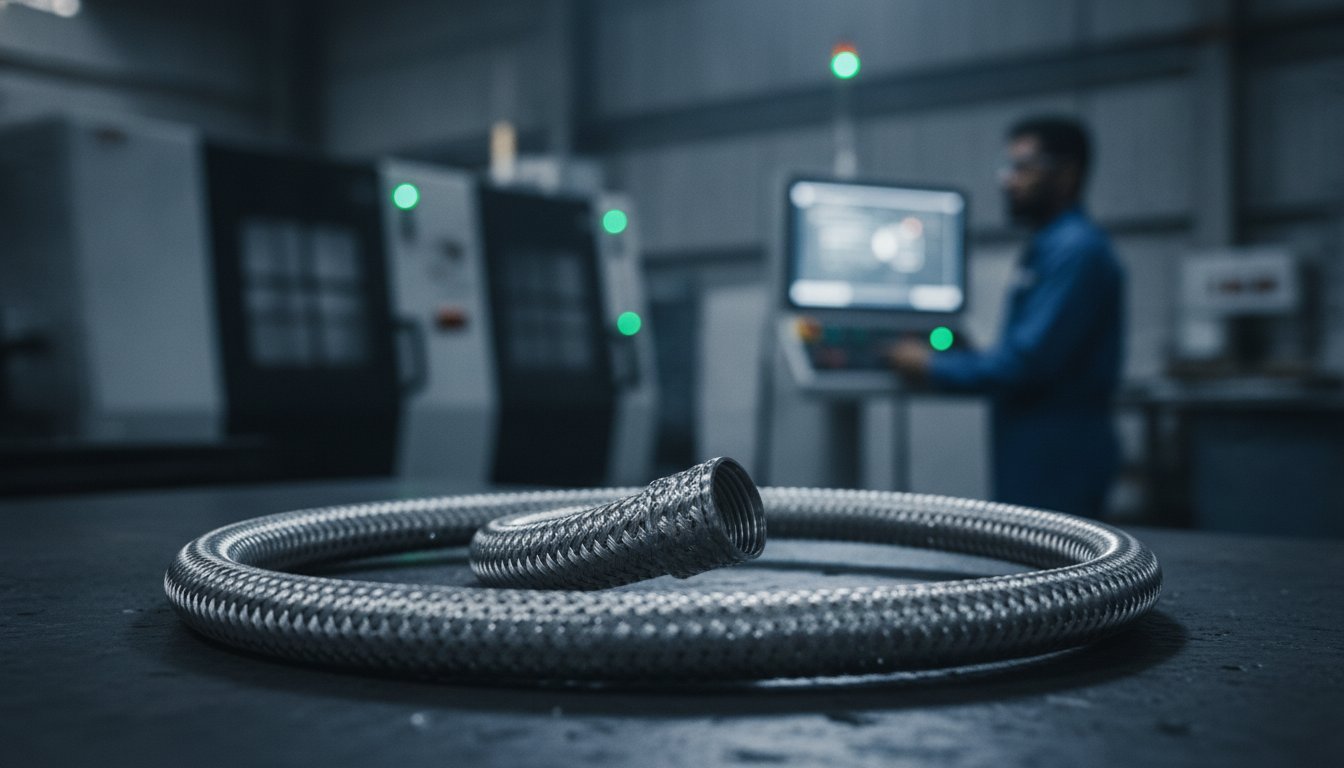
A flexible SS braided PTFE pipe is a high-performance fluid transfer assembly engineered for environments where conventional rubber, PVC, or rigid metal piping systems reach their operational limits. This component is defined by its multi-layered construction, featuring a primary inner liner made of Polytetrafluoroethylene (PTFE) and an external reinforcement layer of woven stainless steel wire. This design isn't merely a combination of materials; it's a technical synergy that allows the hose to remain flexible while withstanding extreme chemical aggression and high internal pressures. In India's industrial landscape, these assemblies are critical for maintaining safety and efficiency in high-stakes sectors.
The versatility of these pipes makes them indispensable across several key industries:
- Pharmaceuticals: Where material purity and ease of sterilization are non-negotiable requirements.
- Chemical Processing: For the safe conveyance of concentrated acids, bases, and volatile solvents.
- Oil & Gas: To handle high-temperature hydrocarbons and survive the mechanical rigors of refinery environments.
- Food & Beverage: Utilizing the non-toxic, FDA-compliant nature of PTFE for hygienic fluid transfer.
The Core Material: Why Virgin PTFE Matters
The performance of a flexible SS braided PTFE pipe starts with the quality of its liner. We utilize virgin-grade PTFE because it's free from the microscopic impurities often found in recycled or "reprocessed" resins. These impurities can lead to premature stress cracking or porosity under pressure. Virgin PTFE provides an almost universal chemical resistance, remaining stable across the entire pH scale (0-14). Its non-stick surface characteristics are equally vital. Because the material has an extremely low coefficient of friction, it prevents the accumulation of media residue. This ensures consistent flow rates and significantly reduces the risk of cross-contamination during batch changes.
The Reinforcement: SS304 vs SS316 Braiding
While the PTFE liner manages chemical compatibility, the stainless steel braid provides the necessary mechanical protection and pressure containment. The braid acts as an exoskeleton, preventing the liner from expanding or kinking under stress. SS304 braiding is the industry standard for most Indian manufacturing plants, offering robust durability and resistance to oxidation. For marine environments or facilities handling highly corrosive external atmospheres, SS316 braiding is often specified due to its higher molybdenum content, which provides superior resistance to pitting. The density and weave pattern of the braid are carefully calculated; a higher braid coverage increases the burst pressure rating while maintaining the flexibility required for high-vibration systems.
The Engineering Synergy: How Braiding Enhances PTFE
The performance of a flexible SS braided PTFE pipe relies on the precise mechanical interaction between its disparate layers. While the inner PTFE liner provides exceptional chemical resistance, its relatively low tensile strength makes it susceptible to "cold flow." This is a phenomenon where the polymer deforms permanently under constant pressure or temperature stress. The stainless steel braid functions as a high-tensile exoskeleton that constrains the liner. As internal pressure increases, the braid tension rises, providing a counter-force that maintains the structural integrity of the core. This synergy allows the assembly to handle pressures that would otherwise cause an unreinforced polymer tube to rupture or swell.
Thermal expansion management is another critical advantage of this design. PTFE has a high coefficient of thermal expansion, meaning it expands significantly when heated. The tightly woven braid limits this expansion to the longitudinal axis, preventing radial deformation and ensuring the pipe maintains its dimensional integrity. This makes the assembly ideal for steam lines or thermal oil transfer in Indian manufacturing facilities. Additionally, the braid provides a robust shield against external stressors:
- Abrasion Resistance: It protects the soft PTFE core from friction against machinery or other pipes.
- Vibration Dampening: In high-vibration applications, such as discharge lines for industrial compressors or pumps, the braid's woven structure acts as a natural dampener. It absorbs kinetic energy that'd otherwise lead to work-hardening and eventual failure in rigid metal tubes.
- Mechanical Protection: It guards against accidental impacts or kinking during installation and routine maintenance.
Pressure Ratings and Burst Safety Factors
The relationship between the hose diameter and the braid density determines the maximum working pressure. In industrial manufacturing, we adhere to a standard 4:1 safety factor. This means the assembly's engineered to withstand four times its rated working pressure before failure. Burst pressure is defined as the point of mechanical failure of the braid, where the wire strands can no longer contain the internal force, leading to a rupture of the PTFE liner. For engineers designing complex systems, consulting a technical partner for custom-dimension requests ensures that the braid density matches the specific pressure surges of your application.
Flexibility vs. Minimum Bend Radius
Achieving the correct minimum bend radius is vital to prevent kinking, which can restrict flow and damage the liner. Kink resistance is significantly enhanced by the braid, which keeps the PTFE core circular even when the pipe's routed through tight spaces. The radius is typically calculated as a multiple of the outside diameter. A thicker PTFE wall provides better vacuum resistance but may increase the force required to bend the hose. Balancing these factors is essential for dynamic applications where the hose is in constant motion, such as in automated chemical dosing skids or pharmaceutical filling lines.
Flexible SS Braided PTFE Pipe vs. Rigid Piping Systems
Choosing between rigid stainless steel piping and a flexible SS braided PTFE pipe involves more than just a comparison of material costs. While rigid systems are often the default for permanent infrastructure, they present significant engineering challenges in dynamic environments. Rigid piping requires precise alignment and a high volume of elbow fittings. Each fitting represents a potential leak path and a point of flow restriction. In contrast, a flexible assembly can be routed through complex geometries with minimal fittings, which drastically reduces installation time and labor costs. This is particularly valuable in crowded Indian processing plants where space is at a premium.
Managing thermal expansion is another area where flexible solutions outperform rigid alternatives. Rigid pipes expand and contract with temperature shifts. To manage this, engineers must integrate expansion joints or loops, which are costly and require regular inspection. Flexible PTFE pipes absorb this thermal movement through their inherent bendability. They eliminate the need for mechanical joints that often become the weakest link in the system. Beyond expansion, maintenance and replacement workflows are much simpler. Swapping a worn hose assembly takes minutes. Repairing a rigid pipe often requires specialized welding and "hot work" permits, leading to extended plant shutdowns.
Vibration isolation is perhaps the most critical differentiator. Rigid headers transmit vibration throughout the system, which can damage sensitive instrumentation or lead to stress fractures in the pipe itself. A flexible braided hose acts as a mechanical isolator, absorbing the energy from pumps and compressors before it reaches the rest of the manifold. This protection ensures the long-term integrity of the entire fluid transfer network.
Stress Distribution in Dynamic Systems
Rigid pipes are notoriously prone to fatigue, especially at weld points and threaded connections. In vibrating systems, these rigid points concentrate stress until a hairline fracture develops. Flexible SS braided pipes feature a self-dampening effect. The woven stainless steel jacket distributes mechanical loads evenly across the length of the hose. This makes them the ideal choice for connecting high-vibration pumps to fixed manifold systems, where they serve as a sacrificial, yet durable, buffer that prevents catastrophic system failure.
Total Cost of Ownership (TCO) Analysis
While the initial capital expenditure for high-quality PTFE hoses might be higher than some rigid components, the long-term savings are substantial. Total Cost of Ownership (TCO) in this context refers to the cumulative expenditure of a fluid transfer system, including initial procurement, installation labor, and the cost of operational downtime over the entire service life of the fluoropolymer pipe. By reducing the frequency of scheduled maintenance and eliminating the need for complex welding, these assemblies provide a superior return on investment. They ensure your system remains operational for longer intervals without the risk of leak-related losses.

Selection Criteria for Industrial Hose Assemblies
Selecting the correct flexible SS braided PTFE pipe requires a rigorous assessment of the operational environment. It isn't enough to simply match the pipe diameter; engineers must evaluate how the internal media interacts with the liner and how external conditions affect the braid. Chemical compatibility is the first hurdle. While PTFE is nearly universal in its resistance, certain high-temperature chemicals or specific concentrations can influence the permeation rate. You must ensure the liner grade is suited for the specific acidity or alkalinity of the fluid.
Temperature parameters must account for both the fluid's thermal profile and the ambient heat of the facility. PTFE typically maintains its mechanical properties from -60°C up to +260°C, but the pressure rating of the stainless steel braid decreases as temperatures rise. Pressure requirements also vary significantly between static systems and those with pulsating flow, such as discharge lines for reciprocating pumps. Pulsating pressure creates cyclical stress that can lead to wire fatigue in the braid if not properly accounted for in the safety factor. Static environments are more forgiving, but they still require a baseline safety margin of 4:1.
End connections are the final piece of the selection puzzle. Whether your system utilizes ANSI flanges, camlocks, or threaded fittings like NPT or BSP, the connection must be as chemically resistant as the hose itself. For most Indian industrial applications, SS316 fittings are preferred to prevent localized corrosion at the hose-to-coupling interface.
Smooth Bore vs. Convoluted (Corrugated) Inner Cores
The choice between a smooth bore and a convoluted core depends on the balance between flow efficiency and bendability. Smooth bore liners are the standard for the pharmaceutical and food industries because they eliminate entrapment zones where bacteria or residue could accumulate. They offer the lowest pressure drop and are easiest to clean. Conversely, corrugated PTFE hose designs are preferred when maximum flexibility is required in tight spaces or for larger pipe diameters where a smooth bore would be too rigid. The convolutions act like a bellows, allowing the pipe to bend without kinking, though they may require more intensive cleaning protocols.
Conductive vs. Non-Conductive Liners
Safety in volatile environments hinges on managing static electricity. When non-conductive fluids like fuels, solvents, or high-purity chemicals flow through a standard flexible SS braided PTFE pipe, static charges can build up on the inner surface. If this charge isn't dissipated, it can arc through the liner to the stainless steel braid, causing pinhole leaks or even ignition in explosive atmospheres. Conductive liners incorporate a thin layer of high-purity carbon black to provide a path to the ground. This feature is essential for compliance with safety standards in chemical plants and refineries handling flammable media where static discharge poses a catastrophic risk.
Advanced Fluro: Precision Manufacturing of Braided PTFE Solutions
Advanced Fluro Private Limited operates as a specialized manufacturer with a primary focus on high-stakes industrial fluid transfer. Since our establishment in 2011, we've maintained a disciplined approach to manufacturing that prioritizes material purity and mechanical precision. Our ISO 9001:2015 certified process ensures that every flexible SS braided PTFE pipe leaving our facility meets rigorous global benchmarks. We don't compromise on the core liner; we use only virgin-grade PTFE. This commitment is essential for pharmaceutical and chemical applications where even minor impurities in recycled materials can lead to batch contamination or premature mechanical failure.
Our facility is equipped to handle complex engineering requirements that go beyond off-the-shelf products. We provide custom dimension capabilities, allowing us to tailor the length, diameter, and braid density of our SS304 braided PTFE hose assemblies to your specific engineering drawings. Every batch undergoes comprehensive quality assurance, including hydrostatic pressure testing to verify burst safety factors and material certification to ensure absolute traceability for your quality control audits.
Custom Engineering and Technical Support
Advanced Fluro Private Limited functions as a technical partner rather than just a supplier. Our engineering team assists procurement specialists in selecting the optimal hose configuration for complex projects, ensuring compatibility with your existing manifold systems. With national supply capabilities across India, we manage bulk industrial orders with a focus on logistical efficiency. We understand the urgency of industrial maintenance schedules, which is why we've streamlined our quotation process to provide prompt, accurate technical proposals for custom-dimension requests.
The Advanced Fluro Private Limited Quality Guarantee
Reliability in high-pressure environments is non-negotiable. Our adherence to international standards for fluoropolymer products guarantees that our hoses perform consistently under the thermal and chemical stresses described throughout this article. By maintaining strict control over material purity and braiding techniques, we provide the stability required for long-term industrial operations. We ensure that every component is engineered for safety, durability, and exact performance in your most demanding environments.
Contact Advanced Fluro Private Limited for a Free Quote on Custom SS Braided PTFE Hoses
Optimising Industrial Fluid Systems with Engineered PTFE
Selecting a flexible SS braided PTFE pipe is a strategic decision that directly impacts the reliability and longevity of high-pressure industrial systems. We've explored how the mechanical synergy between the SS304 braid and the virgin-grade PTFE liner provides a superior alternative to rigid piping; this is especially true in environments prone to vibration and thermal expansion. By applying the correct selection criteria for core types and conductivity, engineers can significantly reduce maintenance downtime and eliminate the risk of leak-related losses.
Advanced Fluro Private Limited remains committed to providing precision-engineered solutions that meet rigorous international quality standards. As an ISO 9001:2015 certified manufacturer, we specialise in virgin-grade PTFE products tailored to your specific engineering requirements. Whether you need custom dimensions for a complex project or bulk supply across India, our team is ready to assist with technical expertise and prompt support. It's our goal to ensure your infrastructure operates with absolute precision and safety.
Request a Free Technical Quotation from Advanced Fluro Private Limited to secure the components your system requires for long-term success.
Frequently Asked Questions
What is the maximum temperature a flexible SS braided PTFE pipe can handle?
A flexible SS braided PTFE pipe maintains its mechanical integrity within a temperature range of -60°C to +260°C. While the PTFE liner remains stable at these extremes, the stainless steel braiding's pressure-carrying capacity decreases as temperatures rise toward the upper limit. Engineers must apply a temperature derating factor when calculating the safe working pressure for high-heat applications to ensure long-term system safety.
Can I use SS braided PTFE pipes for high-pressure hydraulic systems?
These hoses are frequently utilized in hydraulic systems where chemical resistance or high-temperature stability is required. They often meet the SAE 100R14 standard for hydraulic applications. Unlike standard rubber hydraulic hoses, the PTFE core doesn't degrade when exposed to synthetic hydraulic fluids or extreme heat. However, they're typically less flexible than rubber counterparts in high-pressure scenarios and require careful routing.
How does the SS304 braiding prevent the PTFE liner from kinking?
The stainless steel braiding acts as a mechanical exoskeleton that constrains the PTFE liner during bending. By maintaining the circular cross-section of the inner core, the braid prevents the liner from collapsing or kinking under mechanical stress. This reinforcement is especially critical in vacuum applications or when routing the pipe through tight radii where an unbraided polymer tube would otherwise fail or deform.
What are the main differences between SS304 and SS316 braiding for PTFE hoses?
SS304 is the industrial standard for most manufacturing environments, providing excellent strength and oxidation resistance. SS316 braiding is specified for applications in marine environments or facilities handling highly aggressive external chemicals. The addition of molybdenum in SS316 offers superior resistance to pitting and chloride-induced corrosion, which is vital for durability in coastal industrial zones across India where atmospheric salt is present.
Is a conductive PTFE liner necessary for all chemical transfer applications?
Conductive liners are only mandatory when transferring non-conductive fluids like certain fuels, solvents, or high-velocity gases. These fluids can generate static electricity as they rub against the PTFE surface. If the charge isn't dissipated through a conductive carbon-infused liner, it can arc through the hose wall. This causes pinhole leaks or catastrophic ignition in explosive environments, making conductivity a critical safety requirement.
How do I determine the correct length for a flexible hose assembly?
Determining the correct length requires calculating the "live length" of the hose plus the length of the end connections. You must account for the minimum bend radius to prevent stress at the coupling interface. It's essential to include enough slack to accommodate thermal expansion and any mechanical movement or vibration in the system. A hose installed too taut will suffer from premature fatigue at the fittings.
Can flexible SS braided PTFE pipes be used for food and pharmaceutical transfer?
Virgin-grade PTFE is inherently non-toxic and compliant with FDA 21 CFR 177.1550 regulations, making it ideal for food and pharmaceutical transfer. Its non-stick surface prevents bacterial growth and ensures that no taste or odor is imparted to the media. The stainless steel braiding provides the necessary mechanical protection for frequent high-pressure washdown procedures commonly required in these strictly regulated hygienic environments.
What end connections are compatible with braided PTFE pipes?
These assemblies are compatible with a wide array of industrial end connections, including ANSI or DIN flanges, NPT and BSP threaded fittings, and camlock couplings. For pharmaceutical applications, triclover sanitary fittings are the standard choice. We ensure that the fitting material, typically SS316, matches the chemical resistance of the hose to prevent localized corrosion at the critical hose-to-coupling interface points.

Article by
AFTubes Team
Savio Pereira is a Chemical Engineer who has held leadership roles in companies like IBM. A passionate problem solver who thrives at finding solutions to engineering and business problems alike using simple innovative ideas. He believes in doing things differently rather than doing different things. His vision is to make Advanced Fluro (P) Ltd the most valuable company in the fluouro polymer industry.