
Article by
Savio Pereira
Savio Pereira is a Chemical Engineer who has held leadership roles in companies like IBM. A passionate problem solver who thrives at finding solutions to engineering and business problems alike using simple innovative ideas. He believes in doing things differently rather than doing different things. His vision is to make Advanced Fluro (P) Ltd the most valuable company in the fluouro polymer industry.
In fuel transfer, solvent dispensing, and any process handling a flammable atmosphere, the hose isn't just a fluid-transfer component -- it's part of the ignition-prevention system. Conductive PTFE hose, built with a carbon-loaded inner liner over an SS304 braid reinforcement, exists to close a specific gap: standard PTFE's excellent insulating properties, which are a benefit for cable and electrical applications, become a liability when the same material is asked to move a low-conductivity flammable fluid at velocity.
Key Takeaways
- Conductive PTFE hose combines a carbon-black-filled PTFE inner liner (surface resistivity <10⁶ Ω) with standard SS304 braid reinforcement for pressure rating.
- ATEX/IEC 60079 is the relevant reference framework for equipment used in classified explosive-atmosphere areas.
- Bonding continuity through the fittings to grounded equipment on both ends is required for the conductive liner to actually function as intended.
- This is not a universal upgrade -- it's specifically for fuel, solvent, and other low-conductivity flammable fluid transfer in or near classified areas.
- Mechanical specs (temperature range, pressure rating per SAE 100R14) are essentially unchanged from standard PTFE hose; only the electrical property of the liner differs.
Construction: What's Actually Different
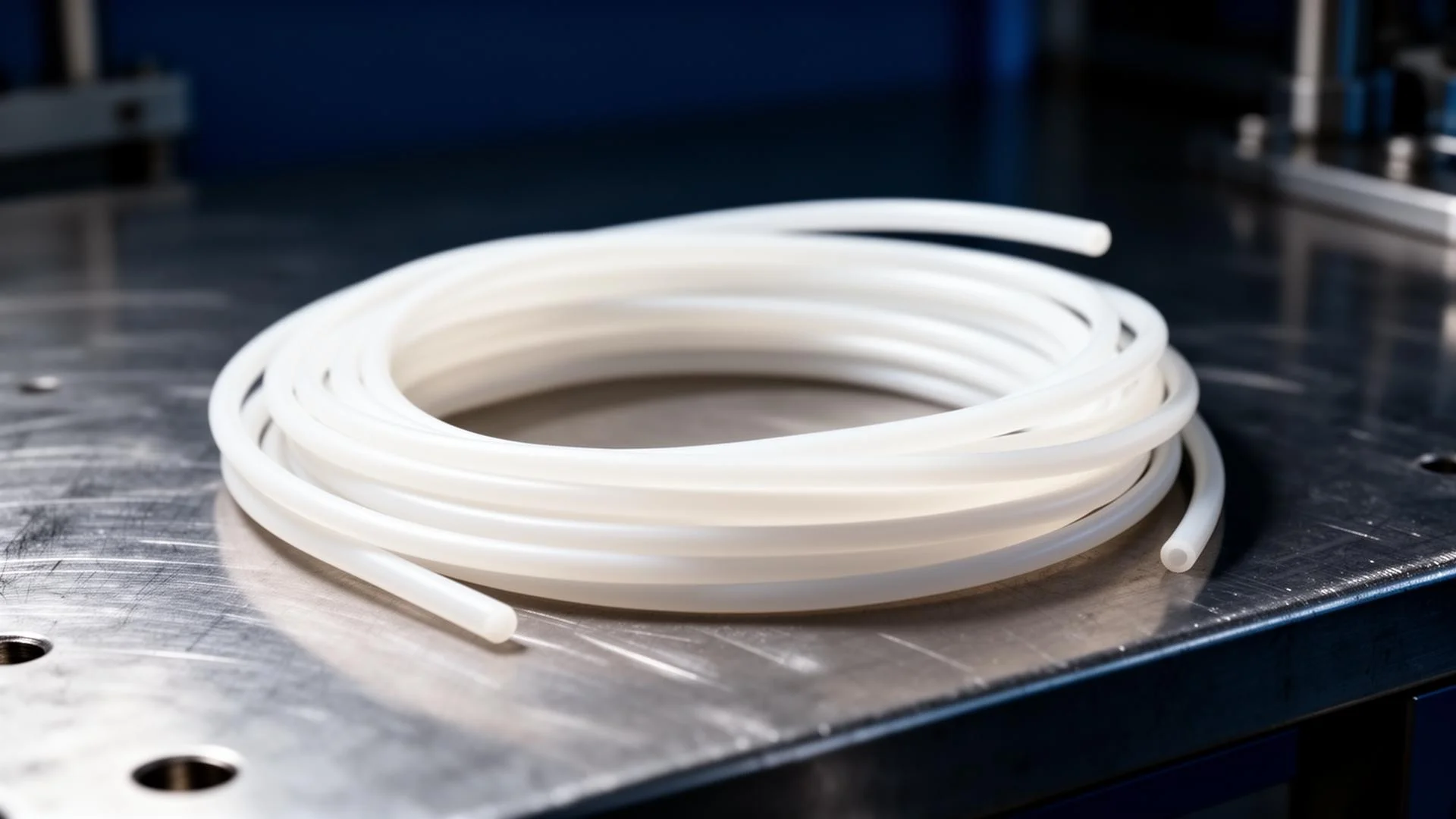
A conductive PTFE hose assembly looks and handles almost identically to a standard SS304-braided hose -- the difference is entirely in the inner liner compound. Carbon black is loaded into the PTFE resin at a level sufficient to bring surface resistivity down to below 10⁶ Ω, turning what is normally one of the best electrical insulators available into a material that actively bleeds off accumulated static charge rather than storing it. The SS304 (or SS316) braid, end fittings, and pressure rating follow the same SAE 100R14 construction standard as non-conductive hose.
Where ATEX/IEC 60079 Guidance Applies
ATEX (the EU directive framework) and IEC 60079 (the international standard series it's largely harmonised with) govern equipment used in potentially explosive atmospheres -- classified zones where flammable gas, vapour, or dust may be present. Fluid-transfer equipment in these zones, including hose assemblies, needs to avoid becoming an ignition source, and uncontrolled electrostatic discharge is one of the recognised ignition mechanisms the guidance addresses. Whether your specific installation falls under a formal ATEX Zone 1/2 classification (or an equivalent national framework) is a determination your site's hazardous-area classification study should already have made -- the hose specification should follow from that, not substitute for it.
| Application | Why Conductive Hose Applies |
|---|---|
| Fuel and hydrocarbon transfer | Low-conductivity fluid, frequently in classified areas, high ignition consequence |
| Solvent dosing and dispensing | Ketones, alcohols, aromatics are all low-conductivity and commonly handled at velocity |
| Paint and coating spray/transfer lines | Solvent-based coatings combine flammability with atomisation, which increases static generation |
| Pharmaceutical solvent recovery | Recovered solvent handling frequently occurs in classified process areas |
| Two-phase (liquid/gas or solid/liquid) transfer | Multi-phase flow generates more static than single-phase liquid transfer at the same velocity |
Bonding and Grounding: Part of the Spec, Not an Afterthought
A conductive hose liner dissipates charge into the hose's own conductive structure, but that structure has to be electrically continuous with ground for the safety benefit to materialise. In practice, that means the end fittings need to maintain electrical continuity from the liner through to the connected equipment, and the equipment on both ends needs to actually be grounded. This is worth confirming as an installation requirement alongside the hose procurement spec -- a technically correct conductive hose installed between two ungrounded connections doesn't deliver the intended protection.
What Doesn't Change vs Standard PTFE Hose
It's worth being clear about what conductive grade doesn't affect: temperature range (still −260°C to +260°C), chemical resistance (still near-universal), dielectric strength as an insulator against external voltage (still high, since the carbon loading affects bulk conductivity for static dissipation, not the material's behaviour as a high-voltage insulator in cable applications), and pressure rating per SAE 100R14 dash size, which follows the same braid-reinforcement construction as non-conductive hose. The carbon loading is a targeted modification for one specific property, not a different product category.
Advanced Fluro: What We Actually Offer
Advanced Fluro Private Limited manufactures conductive PTFE hose from our ISO 9001:2015 certified facility in Vasai East, Mumbai:
- Carbon-loaded PTFE inner liner, surface resistivity <10⁶ Ω, built to ATEX/IEC 60079 relevant guidance.
- SS304 braid standard, SS316 available for chloride-exposure environments, to SAE 100R14 pressure ratings.
- −260°C to +260°C continuous service, unchanged from standard PTFE hose.
- SS304/SS316/carbon steel fittings in BSP, NPT, DIN, and flanged configurations.
We supply conductive hose to automotive fluid-transfer, electrical cable insulation-adjacent, fuel and hydrocarbon transfer, solvent dosing, and pharmaceutical solvent-recovery customers who need documented electrostatic-safety performance.
Frequently Asked Questions
Is conductive PTFE hose required by regulation, or is it a best practice?
In formally classified hazardous areas (ATEX Zone 1/2 or equivalent), using appropriately conductive equipment is generally a compliance requirement, determined by your site's hazardous-area classification study. Outside classified areas, it's a risk-based decision rather than a blanket regulatory mandate.
Does conductive PTFE hose cost significantly more than standard hose?
There's a cost premium for the carbon-loaded liner compound, but it's generally a modest increment relative to the hose assembly's total cost, especially compared to the cost of an uncontrolled ignition event in a classified area.
Can I retrofit conductive hose into an existing system with standard fittings?
Fitting thread standard and size need to match, but conductive hose assemblies are otherwise built to the same SAE 100R14 dash-size and fitting-configuration conventions as standard hose -- retrofit is generally straightforward as long as bonding/grounding continuity is verified at installation.
How is surface resistivity actually verified on a conductive hose assembly?
Surface resistivity is a material property that can be tested with a standard resistivity meter across the hose liner; some suppliers provide test certification with the assembly. Ask your supplier whether resistivity testing is included or available on request for critical installations.

Article by
AFTubes Team
Savio Pereira is a Chemical Engineer who has held leadership roles in companies like IBM. A passionate problem solver who thrives at finding solutions to engineering and business problems alike using simple innovative ideas. He believes in doing things differently rather than doing different things. His vision is to make Advanced Fluro (P) Ltd the most valuable company in the fluouro polymer industry.