
Article by
Savio Pereira
Savio Pereira is a Chemical Engineer who has held leadership roles in companies like IBM. A passionate problem solver who thrives at finding solutions to engineering and business problems alike using simple innovative ideas. He believes in doing things differently rather than doing different things. His vision is to make Advanced Fluro (P) Ltd the most valuable company in the fluouro polymer industry.
A common misconception in fluid handling is that stainless steel braiding serves merely as a protective jacket for the inner tube. In reality, for high-pressure industrial systems, the braiding is the primary structural component that prevents the liner from catastrophic failure under stress. Many procurement specialists in India struggle with frequent hose ruptures in corrosive environments or liner deformation caused by sudden pressure surges. You likely understand that a standard polymer tube cannot withstand the rigors of chemical processing without precision-engineered reinforcement. Selecting a high-quality PTFE hose with SS304 braiding is not just a procurement choice; it's a critical safety decision for your facility's infrastructure.
This guide provides the technical clarity you need to master specifications like SAE 100R14 and the latest USP risk-based frameworks effective in 2026. You'll learn how to ensure zero-leakage performance and extend the service life of your systems while maintaining compliance with ISO 9001:2015 standards. We'll examine specific pressure de-rating factors and explain why virgin-grade PTFE is essential for high-purity applications. From custom-dimension engineering to navigating the rising costs of nickel and fluoropolymer feedstocks, this overview equips you to specify the right hose for your most demanding industrial paths.
Key Takeaways
- Understand the structural synergy between chemically inert PTFE liners and high-tensile SS304 reinforcement for safe fluid transfer in aggressive environments.
- Learn to specify the correct configuration by comparing the high flow rates of smooth bore liners against the superior flexibility of convoluted cores.
- Master technical calculations for temperature de-rating and the Inverse Square Law to ensure your PTFE hose with SS304 braiding operates within safe pressure limits at 200°C.
- Identify how ISO 9001:2015 manufacturing standards and the use of virgin-grade fluoropolymers prevent premature hose failure and ensure zero-leakage performance.
The Critical Role of PTFE Hose with SS304 Braiding in Modern Industry
Standard industrial hoses manufactured from EPDM, PVC, or nitrile rubber often reach their physical limits when exposed to aggressive chemical solvents or extreme thermal gradients. In India's expanding pharmaceutical and petrochemical corridors, these materials frequently suffer from chemical degradation, leading to costly downtime and safety hazards. The engineering solution lies in the high-performance synergy of a PTFE hose with SS304 braiding. This composite structure pairs the near-total chemical inertness of Polytetrafluoroethylene (PTFE) with the mechanical resilience of stainless steel. High-stakes sectors mandate these solutions because they provide a level of reliability that standard elastomers cannot match.
Many facilities are transitioning from traditional rigid stainless steel piping to flexible braided hose assemblies. This shift isn't just about ease of installation. Flexible hoses act as essential vibration dampeners, protecting sensitive instrumentation and pumps from the mechanical stress of system pulsations. This flexibility is vital in Mumbai's industrial zones, where space constraints and complex machinery layouts require versatile fluid transfer paths that maintain structural integrity under pressure.
Overcoming the Challenges of Corrosive Fluid Transfer
Chemical permeation is a silent killer of industrial fluid systems. Non-fluoropolymer liners allow microscopic amounts of aggressive media to migrate through the hose wall, eventually attacking the reinforcement layer. In power generation and automotive testing, thermal cycling further exacerbates this issue. As temperatures fluctuate, materials expand and contract at different rates. Virgin-grade PTFE maintains its integrity across a wide thermal range, ensuring the liner doesn't become brittle or lose its seal. In suction applications, the risk of vacuum collapse is a constant threat. Without the external support of a precision-engineered braid, the inner liner would implode, halting production immediately.
Why SS304 Braiding is the Industry Standard for Reinforcement
Stainless Steel 304 is selected for its exceptional high-tensile strength and resistance to atmospheric corrosion. When woven into a high-density braid, it provides the necessary hoop strength to contain internal pressures that would otherwise deform the PTFE core. It serves as a robust shield against external abrasion in rough industrial environments. By tightly controlling the braiding angle and density, manufacturers limit the volumetric expansion of the hose. This ensures that the system remains responsive and maintains consistent flow characteristics even under significant pressure surges. This technical precision is what defines a reliable PTFE hose with SS304 braiding in modern manufacturing.
Technical Anatomy: How SS304 Braided PTFE Hoses are Engineered
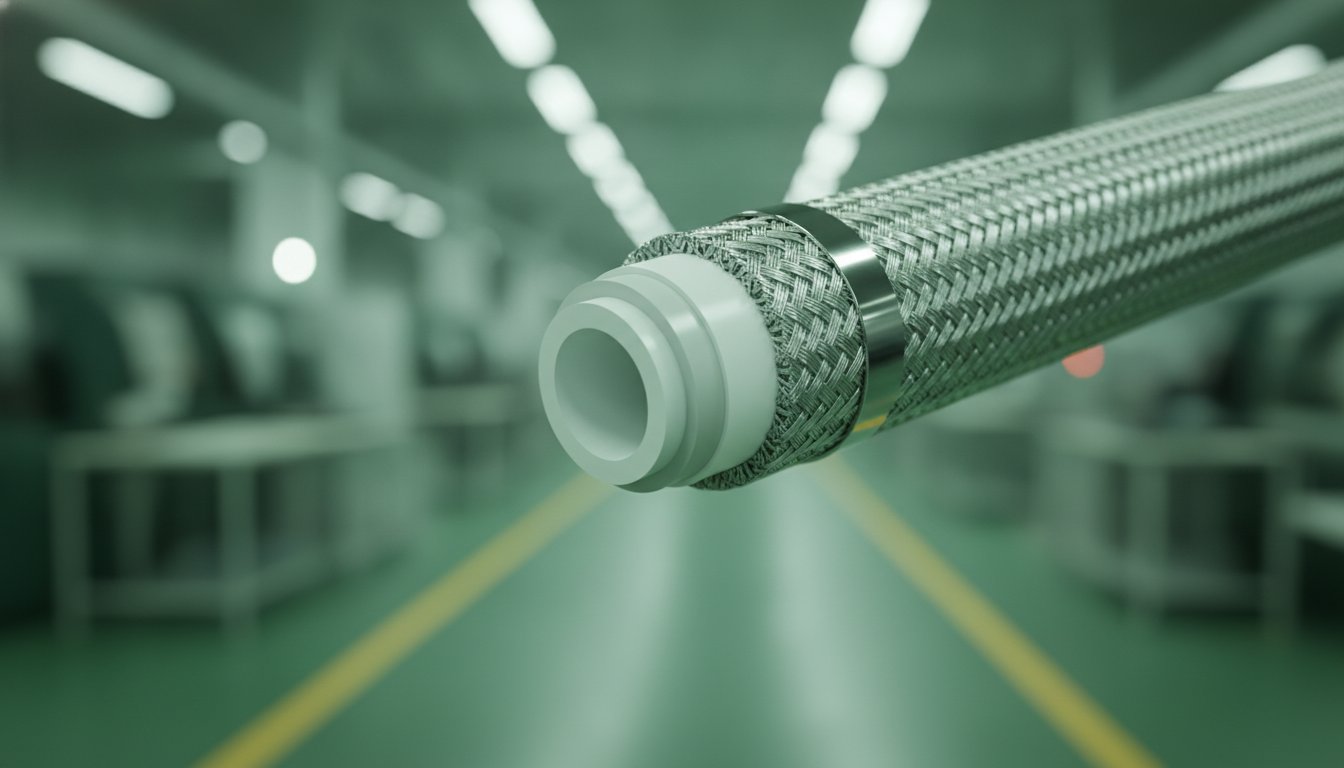
A PTFE hose with SS304 braiding is a high-performance composite assembly designed for extreme environments. Its construction begins with the precision extrusion of the PTFE inner liner. This process involves mixing virgin PTFE fine powder with a lubricant, followed by paste extrusion and sintering to achieve a uniform wall thickness. Once the liner is cured, it's fed through a high-speed braiding machine where high-tensile SS304 wire is woven directly onto the tube. The tightness of this weave determines the hose's ability to handle internal pressure surges without deformation. This engineering sequence ensures that the final product functions as a single, cohesive unit rather than two separate layers.
The Superiority of Virgin-Grade PTFE Liners
Virgin PTFE resin possesses a higher molecular weight than recycled alternatives, which directly translates to a longer flex-life and better resistance to fatigue. Recycled materials often contain microscopic impurities that create stress concentrators. These flaws can lead to "pinhole" leaks, especially in high-pressure gas applications where dielectric strength is critical. For the pharmaceutical sector, the May 2026 transition to risk-based standards like USP <665> requires virgin-grade polymers to ensure zero leachable contaminants in the fluid path. Professionals looking for high-purity solutions should evaluate virgin-grade PTFE tubing options to ensure long-term compliance and system safety.
SS304 Wire Braid Configurations
The reinforcement layer is typically a single braid of SS304 wire, though double braiding is specified for extreme pressure requirements or where additional external protection is needed. High-density braiding is essential for maintaining the volumetric stability of the hose under load. Key technical factors in the braiding process include:
- Braiding Angle: A precision-calculated angle ensures the hose doesn't elongate or contract excessively under pressure.
- Coverage Percentage: High braiding density prevents "bird-caging," a phenomenon where wires separate during tight-radius bending, leaving the liner unsupported.
- Atmospheric Resilience: SS304 provides excellent resistance to the high humidity and corrosive atmospheres found in India's coastal industrial hubs, such as Mumbai or Chennai.
By controlling the wire gauge and the number of carriers in the braiding machine, manufacturers can tailor the burst pressure to meet specific safety factors. This level of customization is what allows a PTFE hose with SS304 braiding to remain the standard for critical fluid transfer. The result is a hose that maintains its structural integrity while providing the flexibility required for complex industrial routing.
Smooth Bore vs. Convoluted Cores: Choosing the Right Configuration
While the external SS304 braiding provides the necessary hoop strength and pressure containment, the internal geometry of the liner dictates the hose's fluid dynamics and mechanical flexibility. Engineering teams must choose between smooth bore and convoluted (corrugated) cores based on the specific requirements of their fluid transfer system. This decision impacts everything from flow efficiency and pressure drop to the ease of sanitation in regulated environments. A PTFE hose with SS304 braiding can be configured in either style, but the trade-offs in bend radius and drainability are significant.
Smooth Bore PTFE Hoses: High Flow and High Purity
Smooth bore liners are the preferred specification for high-velocity fluid transfer where minimizing turbulence is a priority. Because the interior surface is perfectly uniform, it offers the lowest possible frictional resistance, resulting in superior flow rates and minimal pressure drops over long distances. In the pharmaceutical and food processing sectors, this design is essential for maintaining hygiene. The absence of internal ridges prevents material entrapment, ensuring that no residual product or bacteria can accumulate within the hose. This makes smooth bore assemblies ideal for Clean-in-Place (CIP) and Steam-in-Place (SIP) sterilization protocols.
The primary limitation of a smooth bore PTFE hose with SS304 braiding is its stiffness. It requires a larger minimum bend radius compared to convoluted versions. If an installer attempts to force the hose into a tighter curve than specified, the liner may kink. This causes permanent deformation and a dangerous restriction in flow. Engineers should specify smooth bore configurations for straight runs or applications with generous routing space where purity and flow efficiency are the dominant requirements.
Convoluted PTFE Hoses: Maximum Flexibility
When an application involves tight-radius installations or significant equipment vibration, a corrugated (convoluted) PTFE core is the necessary choice. The "bellows" design of the liner allows the hose to flex much more easily than a smooth tube. This flexibility is vital for connecting misaligned ports or for use on mobile machinery where constant motion is expected. While the internal corrugations do create more turbulence and a higher pressure drop, they provide the mechanical compliance needed to prevent fatigue failure in high-vibration environments.
Drainability in convoluted hoses depends on the corrugation pattern. Helical patterns offer a continuous path for fluid to spiral out, whereas annular (parallel) rings can trap small amounts of liquid if the hose isn't pitched correctly. For suction and discharge applications where vacuum collapse is a risk, the corrugated design offers inherently better resistance to implosion when paired with a high-density SS304 braid. This makes it a robust solution for chemical loading and unloading in India's busy industrial ports and refineries.

Technical Specifications: Specifying for Pressure, Temperature, and Size
Precise specification is the difference between a reliable fluid system and a catastrophic mechanical failure. When selecting a PTFE hose with SS304 braiding, you must account for the Inverse Square Law of Hose Pressure. This engineering principle dictates that as the internal diameter (ID) of the hose increases, the maximum working pressure significantly decreases. This occurs because a larger internal surface area is exposed to fluid forces, which places exponentially higher tensile stress on the stainless steel reinforcement. A 6mm hose might safely handle 200 bar, whereas a 25mm version of identical construction may only be rated for 40 bar. Ignoring this relationship often leads to premature hose expansion or braid fatigue.
Pressure Ratings and Safety Factors
Industrial assemblies are defined by their Working Pressure (WP) and Burst Pressure (BP). The standard engineering protocol for a PTFE hose with SS304 braiding follows a 4:1 safety factor, as specified under SAE 100R14 standards. This means the theoretical burst pressure is four times the recommended maximum working pressure. In systems prone to dynamic pressure surges, such as high-speed pumping stations or hydraulic actuators, engineers often specify increased braiding density to prevent liner deformation. This ensures the assembly remains within its elastic limit during peak operational loads, preventing permanent structural damage to the PTFE core.
Temperature Performance Parameters
PTFE maintains its chemical and physical stability across a vast thermal range, from cryogenic levels of -70°C to continuous operating temperatures of 200°C. While the polymer itself can withstand short durations at 260°C, the mechanical integrity of the entire assembly is limited by the reinforcement's thermal limits. The tensile strength of SS304 braiding undergoes significant de-rating as temperatures rise, typically requiring a 20% to 25% reduction in allowable working pressure when operating at 200°C compared to ambient conditions. Failing to apply these de-rating factors can compromise the safety of high-temperature fluid transfer lines.
Compatibility with existing Indian industrial infrastructure requires exact ID and OD measurements to ensure leak-proof fitting engagement. Whether your facility utilizes BSP or NPT threads, or requires sanitary tri-clamp fittings for pharmaceutical batching, the end connections must be precision-swaged. For projects requiring specific tolerances or non-standard lengths, you can request custom-dimension PTFE hose specifications to ensure full compliance with ISO 9001:2015 quality standards. This level of technical oversight guarantees that every component is engineered for maximum durability in demanding environments.
Why Advanced Fluro is the Preferred National Supplier for PTFE Hoses
Advanced Fluro Private Limited has established itself as a disciplined technical partner within the industrial sector since its inception in 2011. Our manufacturing operations are centered on a commitment to technical precision and adherence to international quality benchmarks. By maintaining an ISO 9001:2015 certified production environment, we ensure that every PTFE hose with SS304 braiding provides consistent performance across all batches. This institutional trust is essential for procurement specialists who manage high-stakes fluid transfer systems where component failure is not an option. Our focus on virgin-grade fluoropolymers ensures that the chemical purity and mechanical strength of our liners meet the most demanding industrial requirements.
Quality Assurance and Certification
Quality control at our facility involves a methodical series of testing protocols designed to verify the engineering integrity of every assembly. We perform rigorous hydrostatic pressure testing to confirm that each PTFE hose with SS304 braiding meets its rated working pressure and adheres to the necessary safety factors. Leak detection is conducted with precision to ensure zero-leakage performance, which is critical for the hazardous chemical transfer applications common in India's industrial zones. We maintain full material traceability for all components. This means we can verify the specific material grades of both the PTFE resin and the SS304 reinforcement wire, providing engineers with the documentation required for strict regulatory compliance. Partnering with an established manufacturer like Advanced Fluro ensures that your fluid systems are built on a foundation of verified reliability.
Integrated Solutions for Diverse Industries
Our strategic operations in Mumbai's industrial hub facilitate efficient national distribution to the chemical processing, automotive, and pharmaceutical sectors. We understand that standard off-the-shelf components often fail to meet the complexities of modern engineering. Therefore, we offer a consultative approach to hose selection, helping technical teams optimize their fluid transfer paths for maximum service life. Our custom engineering capabilities allow us to tailor hose lengths, diameters, and end-fittings to your exact B2B specifications. This includes the precision swaging of specialized connectors such as sanitary tri-clamps for pharmaceutical batching or heavy-duty flanged fittings for petrochemical refineries.
We provide engineered solutions that address the specific challenges of vacuum collapse, thermal cycling, and chemical permeation discussed throughout this guide. Our team is dedicated to providing the stability and technical depth required to support India's growing industrial infrastructure. For those seeking a reliable partner for high-pressure fluid handling, we encourage you to Contact Advanced Fluro for a Free Quote on Custom SS304 Braided PTFE Hoses. Our technical consultants are available to assist you in specifying the ideal configuration for your facility's unique operational demands.
Optimizing Industrial Fluid Systems with Technical Precision
Mastering the technical nuances of high-pressure fluid transfer requires a deep understanding of material synergy. We have detailed how the structural reinforcement of a PTFE hose with SS304 braiding provides the essential hoop strength to withstand aggressive chemical environments and thermal cycling. By prioritizing virgin-grade PTFE and accurately calculating temperature de-rating factors, you ensure the long-term integrity of your facility's infrastructure. These engineering choices directly impact the safety and efficiency of your operations.
Advanced Fluro Private Limited stands as an ISO 9001:2015 certified manufacturer dedicated to precision. Our specialization in virgin-grade fluoropolymers and our capability to provide custom dimensions with a fast turnaround make us a reliable partner for India's industrial hub. We understand the critical nature of zero-leakage performance in high-stakes sectors. Request a Technical Consultation and Free Quote for Your PTFE Hose Needs. Let us help you engineer a more durable and compliant fluid transfer path today.
Frequently Asked Questions
What is the maximum temperature for a PTFE hose with SS304 braiding?
The maximum continuous operating temperature for a PTFE hose with SS304 braiding is 200°C. While the PTFE liner itself can withstand short-term exposure up to 260°C, the mechanical strength of the SS304 braiding begins to de-rate significantly at these elevated levels. Engineers must apply a pressure reduction factor of approximately 20% to 25% when operating near the 200°C limit to ensure the assembly maintains its structural integrity and safety margins.
Can SS304 braided PTFE hoses be used for high-vacuum applications?
Yes, these hoses are suitable for high-vacuum applications, particularly when configured with a convoluted core. The corrugated design provides inherent resistance to vacuum collapse, which prevents the liner from imploding under negative pressure. Smooth bore versions can also be used if the wall thickness is sufficient and the braiding density is high enough to support the liner. For critical vacuum paths, we recommend consulting our technical team to verify specific implosion limits.
What is the difference between SS304 and SS316 braiding for PTFE hoses?
SS304 is the standard industrial grade for reinforcement due to its high-tensile strength and general corrosion resistance. In contrast, SS316 contains molybdenum, which provides superior protection against pitting and crevice corrosion in marine environments or highly acidic chemical processing zones. While SS304 is sufficient for most dry industrial applications in India, SS316 is specified for coastal facilities or systems involving high concentrations of chlorides and sulfur.
How do I determine the correct bend radius for my braided hose assembly?
The correct bend radius is determined by the manufacturer's Minimum Bend Radius (MBR) specification, which varies based on the hose's internal diameter and core type. You should measure the radius from the center line of the hose during installation. Convoluted cores allow for much tighter bends than smooth bore liners. Exceeding the MBR leads to braid separation or liner kinking, which permanently compromises the hose's pressure rating and flow characteristics.
Are these hoses suitable for food-grade or pharmaceutical fluid transfer?
These hoses are ideal for food and pharmaceutical sectors when manufactured from virgin-grade PTFE. To ensure compliance, the liner must meet FDA 21 CFR 177.1550 standards for food contact. For pharmaceutical applications in 2026, it's essential to follow the new USP risk-based frameworks that emphasize in-vitro testing. Using a PTFE hose with SS304 braiding made from high-purity resins prevents leachable contaminants from entering the fluid stream during batch processing.
What are the common causes of failure in SS304 braided PTFE hoses?
Failure typically results from chemical permeation, mechanical fatigue, or improper installation. Permeation occurs when aggressive media migrates through the liner and corrodes the SS304 braid from the inside. Mechanical failure is often caused by exceeding the minimum bend radius or subjecting the hose to pressure surges beyond its rated capacity. Finally, improper fitting swaging can create leak paths at the connection points, leading to catastrophic failure under high-pressure conditions.
Does Advanced Fluro provide custom end connections for braided hoses?
Yes, Advanced Fluro specializes in providing precision-engineered end connections tailored to specific B2B requirements. We offer a wide range of fittings, including BSP and NPT threads, flanged ends, and tri-clamp sanitary connectors. Each connection is precision-swaged to ensure a zero-leakage interface with the PTFE hose with SS304 braiding. Our custom engineering capabilities allow us to adapt these fittings to non-standard hose dimensions for seamless integration into your existing fluid systems.
How does the working pressure change as the hose diameter increases?
Working pressure decreases exponentially as the hose diameter increases due to the Inverse Square Law of pressure. A larger internal diameter exposes a greater surface area to the fluid's force, which increases the tensile load on the stainless steel braiding. For example, a 6mm hose can handle significantly higher pressures than a 25mm hose of the same construction. Engineers must consult specific pressure-to-size charts to ensure the selected diameter meets the system's safety factors.

Article by
AFTubes Team
Savio Pereira is a Chemical Engineer who has held leadership roles in companies like IBM. A passionate problem solver who thrives at finding solutions to engineering and business problems alike using simple innovative ideas. He believes in doing things differently rather than doing different things. His vision is to make Advanced Fluro (P) Ltd the most valuable company in the fluouro polymer industry.