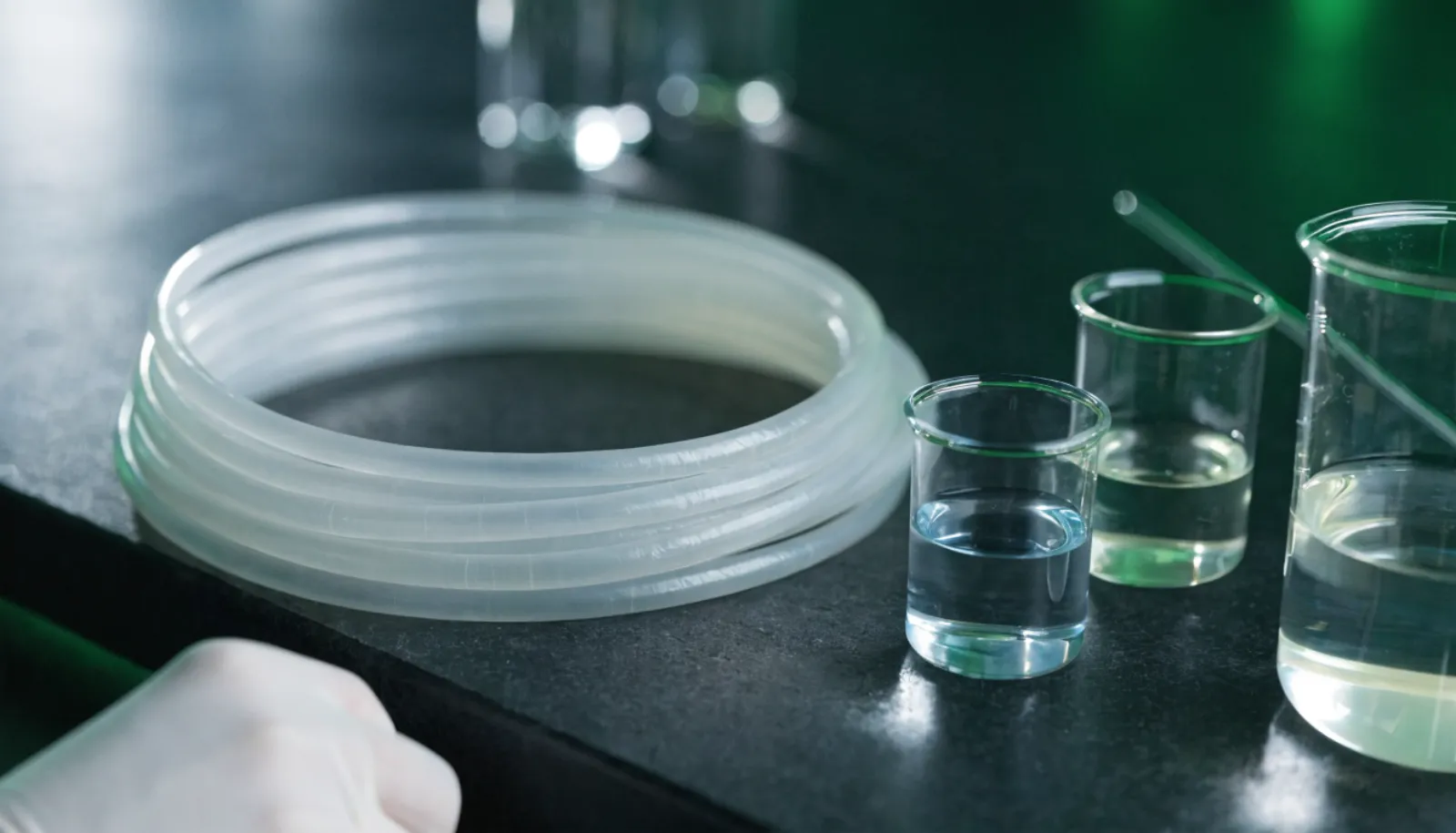
Selecting PTFE tubing for chemical service demands systematic evaluation of compatibility ratings, temperature-pressure interactions, material purity, and manufacturing precision. Engineers in chemical processing, pharmaceutical, and semiconductor facilities face catastrophic consequences when specification errors allow aggressive media to degrade tubing walls, permeate through molecular gaps, or trigger unexpected reactions at elevated temperatures. This guide establishes a methodology for matching chemical exposure conditions to PTFE tube specifications, ensuring long-term reliability in corrosive environments where failure means contamination, downtime, or safety incidents.
Advanced Fluro Private Limited manufactures precision-extruded PTFE tubes from virgin-grade fluoropolymer resins with documented chemical resistance across industrial solvents, acids, and bases. Understanding how to select PTFE tubing chemical compatibility requires examining rating systems, derating factors, material grades, and tolerance requirements that collectively determine whether a tube will perform safely over its intended service life.
Chemical Compatibility Fundamentals and Rating Systems
Chemical compatibility assessment begins with understanding that PTFE exhibits near-universal resistance to industrial chemicals, yet specific conditions create exceptions. The fluoropolymer's carbon-fluorine backbone provides exceptional inertness to concentrated hydrofluoric acid, fuming nitric acid, aggressive organic ketones, and most solvents that destroy conventional elastomers and plastics. However, molten sodium hydroxide above 300°C, elemental fluorine gas, and molten alkali metals can attack PTFE's molecular structure, causing swelling, discoloration, or mechanical degradation.
Industry-standard compatibility rating systems classify chemical-material interactions on an A-through-D scale. An "A" rating indicates complete compatibility with no measurable degradation, swelling, or permeation under continuous exposure at specified temperatures. "B" ratings signal minor effects—slight discoloration or minimal swelling—that may be acceptable for non-critical applications with periodic replacement schedules. "C" ratings warn of moderate attack requiring careful evaluation of exposure duration, temperature, and mechanical stress. "D" ratings mandate material substitution, as the chemical will cause rapid failure.
These ratings incorporate three critical variables: chemical concentration, exposure temperature, and contact duration. A tube rated "A" for 50% sulfuric acid at 20°C may drop to "C" at 150°C, where thermal energy accelerates molecular interactions. Concentration matters equally—PTFE resists dilute sodium hydroxide effectively but faces attack from concentrated solutions above 80°C. Procurement managers must verify that compatibility data matches their exact process conditions, not generic room-temperature ratings.
Permeation represents a distinct compatibility concern beyond chemical attack. Small molecules like hydrogen, helium, and certain organic solvents can migrate through PTFE's molecular structure without causing visible degradation, contaminating downstream processes or creating safety hazards in confined spaces. Semiconductor and pharmaceutical applications demand permeation rate data for critical solvents, measured in grams per square meter per day at operating temperature.
The PTFE hose chemical resistance characteristics extend across acids, bases, oxidizers, and organic solvents, but validation requires consulting manufacturer-specific compatibility charts that account for resin grade, processing method, and quality control standards. Generic PTFE compatibility data from chemical suppliers may not reflect the performance of precision-extruded virgin-grade tubing manufactured under ISO 9001:2015 protocols.
Temperature and Pressure Derating for Chemical Resistance
Temperature fundamentally alters chemical compatibility by accelerating reaction kinetics and reducing PTFE's mechanical strength. A tube rated for 300 PSI working pressure at 22°C may only safely handle 75 PSI at 204°C, a 75% derating that catches engineers unfamiliar with fluoropolymer behavior. This pressure reduction stems from PTFE's thermoplastic nature—as temperature rises toward the 260°C continuous-use limit, the material softens, creeps under stress, and loses tensile strength.
Derating calculations require manufacturer-specific pressure-temperature curves, not generic industry estimates. A standard 6.35mm OD tube with 0.89mm wall thickness might specify 2.07 MPa burst pressure at 20°C, but that figure drops exponentially above 100°C. Engineers must apply safety factors—typically 4:1 for burst-to-working pressure—then further derate based on operating temperature. For a system cycling between 80°C and 180°C, specify pressure ratings at the maximum temperature, not average conditions.
Chemical exposure introduces additional derating requirements beyond thermal effects. Oxidizing acids like concentrated nitric acid or chromic acid cleaning solutions can gradually reduce PTFE's molecular weight through chain scission, weakening the material over months of service. While PTFE maintains its "A" compatibility rating with these chemicals, prudent design reduces working pressure by 20-30% for continuous exposure applications.
Cryogenic applications reverse the temperature concern, as PTFE retains flexibility and toughness down to -200°C without embrittlement. However, thermal cycling between cryogenic and ambient temperatures creates dimensional changes that stress fittings and connections. Tubes handling liquid nitrogen or cryogenic hydrogen require pressure ratings that account for thermal contraction cycles.
The interaction between chemical compatibility and temperature derating appears most critically in steam service. While PTFE resists water and steam chemically, temperatures above 200°C approach the material's continuous-use limit, requiring significant pressure derating. Engineers specifying PTFE steam hose for pharmaceutical sterilization or chemical plant heating must balance pressure requirements against temperature exposure, often selecting reinforced constructions with SS316 braiding to maintain adequate burst margins.
Material Grade Selection: Virgin PTFE vs. Alternatives
Material purity directly determines chemical resistance performance, with virgin-grade PTFE resin offering superior consistency compared to reprocessed or filled compounds. Virgin PTFE manufactured from uncontaminated fluoropolymer powder exhibits uniform crystallinity, minimal residual stress, and predictable chemical behavior across production lots. Reprocessed PTFE—ground from scrap tubing or rejected parts—contains molecular chain breaks, contamination from previous processing, and inconsistent crystallinity that reduces chemical resistance and introduces unpredictable failure modes.
The distinction matters most in aggressive chemical service where molecular uniformity prevents localized weak points. A tube manufactured from virgin resin maintains consistent wall thickness, density, and chemical resistance along its entire length, while reprocessed material may contain voids, inclusions, or density variations that create preferential attack sites. Pharmaceutical and semiconductor applications universally specify virgin-grade PTFE to eliminate contamination risks.
Filled PTFE compounds—incorporating glass fiber, carbon, or graphite—improve mechanical properties but compromise chemical resistance. Glass-filled PTFE offers higher compressive strength and reduced creep, making it suitable for gasket applications, but the glass fibers create pathways for chemical permeation and attack. Carbon-filled conductive PTFE prevents static accumulation in volatile media applications, yet the carbon particles slightly reduce chemical inertness compared to unfilled virgin material.
Alternative fluoropolymers—FEP and PFA—provide different chemical resistance profiles than PTFE. FEP offers similar chemical resistance with improved transparency and lower permeation rates for small molecules, making it preferable for applications requiring visual inspection or minimal gas transmission. PFA combines PTFE's chemical resistance with true melt-processability, enabling complex geometries and welded joints impossible with paste-extruded PTFE.
Specifying virgin-grade PTFE requires verification through supplier documentation. ISO 9001:2015 certified manufacturers like Advanced Fluro maintain material traceability from resin supplier through extrusion, providing certificates of conformance that document virgin resin content, lot numbers, and quality control test results.
Selection Methodology: Matching Chemicals to Specifications
Systematic selection begins with documenting every chemical the tubing will contact, including process fluids, cleaning agents, sterilization media, and incidental exposure during maintenance. Create a matrix listing each chemical with its concentration range, temperature extremes, pressure requirements, and exposure duration—continuous versus intermittent.
Cross-reference each chemical against manufacturer-specific compatibility charts, not generic PTFE data. Advanced Fluro provides detailed compatibility ratings for virgin-grade extruded tubing that reflect actual product performance. Pay particular attention to temperature-dependent ratings, as many chemicals shift from "A" to "C" compatibility as temperature rises above 100°C.
Evaluate worst-case exposure scenarios rather than typical operating conditions. If a chemical reactor normally operates at 80°C but reaches 150°C during exothermic reactions, specify tubing for the maximum temperature. If cleaning cycles expose tubes to concentrated caustic followed by acidic neutralization, verify compatibility with both extremes.
Calculate required pressure ratings by determining maximum system pressure, applying appropriate safety factors, then derating for operating temperature. For a system with 1.5 MPa maximum pressure operating at 120°C, specify tubing rated for at least 6 MPa burst pressure at 120°C (4:1 safety factor).
Consider dimensional requirements beyond pressure rating. Custom dimension PTFE tubes enable precise fitting integration, flow optimization, and space constraints in complex assemblies. Specify inner diameter based on required flow rate and acceptable pressure drop, then select wall thickness that meets pressure requirements with appropriate safety margin.
Document selection rationale in a specification sheet that includes chemical list, compatibility ratings, temperature-pressure requirements, dimensional tolerances, material grade (virgin PTFE), applicable standards (ASTM D3295, SAE 100R14), and any special requirements like conductivity, permeation limits, or purity certifications.
Tolerance and Manufacturing Quality for Aggressive Media
Manufacturing precision directly impacts chemical resistance by controlling wall thickness uniformity, surface finish, and dimensional consistency. Paste extrusion—the primary PTFE tube manufacturing method—forces virgin resin mixed with hydrocarbon lubricant through precision dies under pressures exceeding 6.9 MPa, creating seamless tubes with controlled dimensions. Quality control during extrusion determines whether wall thickness varies by ±0.05mm or ±0.25mm, a difference that matters critically when chemical attack gradually thins tube walls toward failure.
Tight tolerances prevent localized weak points where aggressive chemicals preferentially attack thinner wall sections. A tube specified with 1.0mm nominal wall thickness but manufactured with ±0.25mm tolerance may have sections as thin as 0.75mm that fail prematurely under combined chemical and pressure stress. Precision manufacturing to ±0.05mm tolerance ensures uniform chemical exposure across the entire tube length.
Surface finish quality affects chemical resistance by controlling surface area and molecular accessibility. Smooth bore PTFE tubes manufactured with precision mandrels exhibit lower surface roughness than convoluted or poorly controlled extrusions, reducing surface area available for chemical attack. Medical and semiconductor applications specify surface roughness limits—typically Ra < 0.8 μm—that prevent contamination buildup.
Dimensional consistency across production lots ensures that replacement tubes perform identically to original installations. ISO 9001:2015 certified manufacturers implement statistical process control that monitors critical dimensions—inner diameter, outer diameter, wall thickness, ovality—on every production run, maintaining consistency within specified tolerance bands.
Verification of manufacturing quality requires requesting dimensional inspection reports, material certifications, and process documentation from suppliers. Advanced Fluro provides lot-specific test data showing actual measured dimensions, tolerance compliance, and material traceability for virgin resin content.
Conclusion
Selecting PTFE tubing for how to select ptfe tubing chemical compatibility requires systematic evaluation of compatibility ratings, temperature-pressure derating, material grade purity, and manufacturing precision. Engineers must document complete chemical exposure conditions, verify compatibility at maximum operating temperatures, specify virgin-grade PTFE for consistent performance, and demand tight manufacturing tolerances that eliminate weak points vulnerable to chemical attack.
Advanced Fluro Private Limited manufactures precision-extruded virgin-grade PTFE tubes with documented chemical resistance, controlled tolerances, and ISO 9001:2015 quality systems that support critical applications in pharmaceutical, semiconductor, and chemical processing industries. Explore our PTFE products for detailed specifications, or review our technical blog for additional guidance on fluoropolymer selection. Contact our engineering team to discuss specific chemical compatibility requirements and obtain custom dimension tubes manufactured to your exact specifications.

Article by
AFTubes Team
Savio Pereira is a Chemical Engineer who has held leadership roles in companies like IBM. A passionate problem solver who thrives at finding solutions to engineering and business problems alike using simple innovative ideas. He believes in doing things differently rather than doing different things. His vision is to make Advanced Fluro (P) Ltd the most valuable company in the fluouro polymer industry.