
Article by
Savio Pereira
Savio Pereira is a Chemical Engineer who has held leadership roles in companies like IBM. A passionate problem solver who thrives at finding solutions to engineering and business problems alike using simple innovative ideas. He believes in doing things differently rather than doing different things. His vision is to make Advanced Fluro (P) Ltd the most valuable company in the fluouro polymer industry.
Steam service is one of the more unforgiving applications a flexible hose can be asked to handle. Unlike a cold chemical transfer line, a steam hose is under continuous thermal cycling, elevated pressure, and -- if something goes wrong -- the failure mode is a live steam release rather than a slow leak. PTFE hose with a stainless steel braid is the standard choice for this duty, but "PTFE hose" alone isn't a complete specification for steam. The details that actually matter are the ones most quote sheets skip.
Key Takeaways
- PTFE's usable temperature range for continuous steam service is −65°C to +260°C, but the pressure rating at the hose's upper temperature is meaningfully lower than its room-temperature rating.
- SS304 braid is standard for saturated steam; SS316 is worth the premium in condensate lines carrying any chloride contamination.
- Corrugated (Type B) inner bore trades some pressure capacity for flex life under the constant expansion/contraction of steam cycling.
- Fitting torque and end-fitting material matter as much as the hose itself -- most steam hose failures happen at the crimp or fitting, not mid-hose.
- Re-rating a hose for steam based only on its cold working pressure is a common and avoidable mistake.
Why PTFE Is the Default Choice for Steam
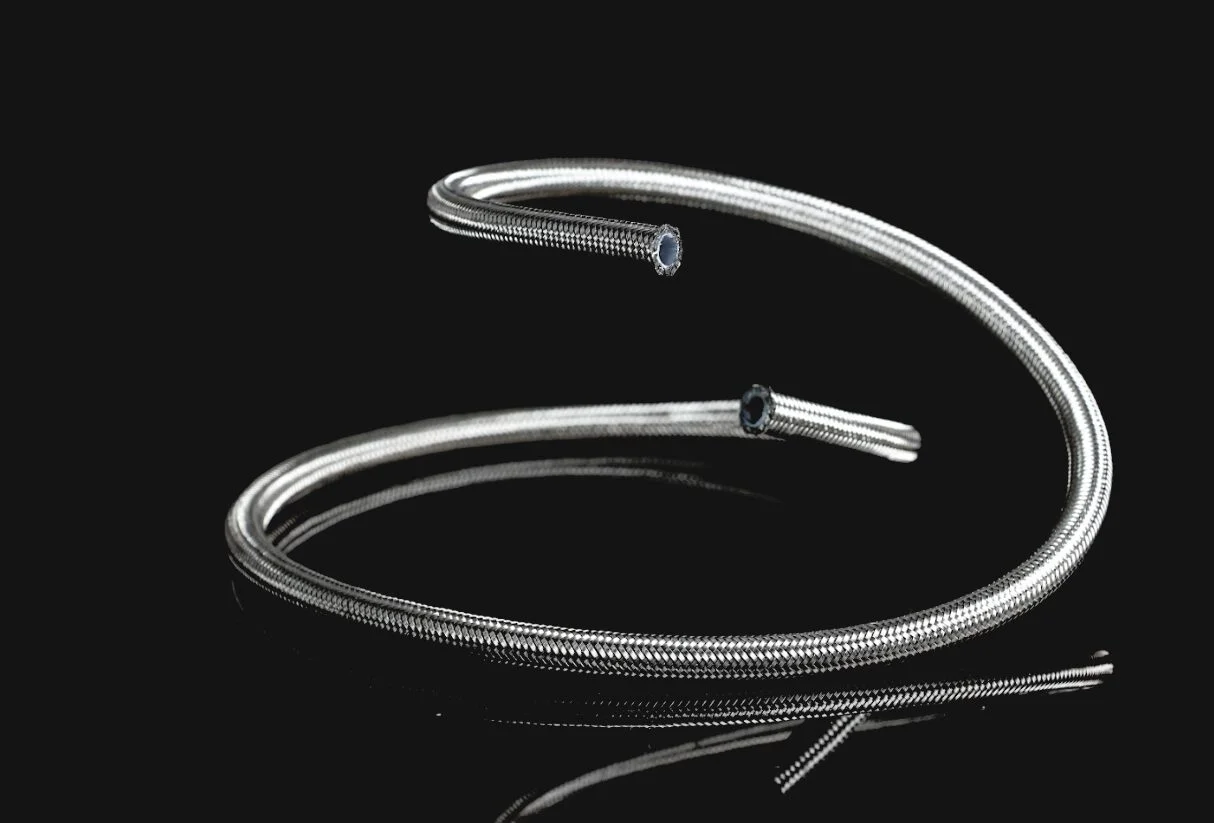
Live steam rules out most elastomer-lined hoses outright: rubber and most thermoplastic liners either soften, permeate, or degrade well below typical steam temperatures. PTFE's melting point sits above 327°C, and it holds its mechanical and sealing properties across the full −200°C to +260°C range with no plasticizers to leach out under heat. Combined with SS304 or SS316 braid reinforcement to carry the pressure load the liner alone can't, PTFE hose becomes one of the few flexible options rated for continuous saturated steam duty.
Pressure Derating: The Number Most Quotes Don't Show
A hose rated to 207 bar at room temperature is not rated to 207 bar at 260°C. SAE 100R14, the governing standard for PTFE braided hose, publishes working pressure by dash size at ambient conditions -- the actual usable pressure at elevated steam temperature is derated, typically to a fraction of the cold rating depending on size and braid configuration. Any supplier quoting a single pressure number without asking your operating temperature is giving you an incomplete spec.
| Consideration | Why It Matters for Steam |
|---|---|
| Operating temperature at pressure | Working pressure derates as temperature rises toward PTFE's upper service limit |
| Braid material (SS304 vs SS316) | SS316 resists chloride-driven pitting in condensate; SS304 is standard for clean steam |
| Bore type (smooth vs corrugated) | Corrugated offers better flex-fatigue life under thermal cycling, at a lower baseline pressure rating |
| Fitting material and torque spec | Most in-service failures occur at the fitting, not the hose body -- correct crimp/torque is safety-critical |
| Bend radius under thermal expansion | Hose that's routed at minimum bend radius cold can be over-stressed once it expands hot |
Smooth Bore vs Corrugated for Steam Duty
Smooth-bore (Type A) hose carries the highest pressure rating per size and is the right choice for straight or gently routed steam runs. Corrugated (Type B) hose sacrifices some pressure capacity for a tighter minimum bend radius and better tolerance of the repeated flex that comes with thermal cycling on equipment that moves or vibrates -- rotary joints, reciprocating equipment, or connections that see frequent maintenance disconnection. For steam lines that are routed once and stay static, smooth bore is usually the more economical and higher-rated option.
Fitting Selection and the Real Failure Point
In our experience supplying steam hose assemblies to process plants, the hose body itself is rarely where a failure originates -- it's the crimp or the fitting thread. Carbon steel fittings are common on cost-driven quotes but corrode under condensate exposure over time; stainless fittings cost more but eliminate that failure mode entirely on wet steam or condensate return lines. Crimp specification matters just as much: an under-crimped assembly can weep under thermal cycling even when the hose and fitting are both individually correct.
Common Mistakes in Steam Hose Specification
- Specifying by cold pressure rating only. Always confirm the derated working pressure at your actual steam temperature, not the ambient-condition number on the catalogue page.
- Using SS304 braid on condensate return with chloride exposure. Pitting corrosion on SS304 braid under chloride attack is a known, avoidable failure mode -- SS316 is the correct call here.
- Routing at minimum bend radius while cold. Thermal expansion during startup can push a hose routed at its cold-state minimum radius past its rated limit once it reaches operating temperature.
- Reusing carbon steel fittings from a prior rubber-hose installation. Fitting compatibility isn't universal -- confirm thread standard (BSP, NPT, DIN) and material against the new hose spec, not the one it's replacing.
- Skipping periodic visual inspection. PTFE hose doesn't degrade the way rubber does, but braid wire fatigue and fitting corrosion are progressive and worth a scheduled visual check on critical steam lines.
Advanced Fluro: What We Actually Offer
Advanced Fluro Private Limited manufactures PTFE hose assemblies for steam and high-temperature service from our ISO 9001:2015 certified facility in Vasai East, Mumbai. Specifics relevant to steam applications:
- SS304 and SS316 braided hose to SAE 100R14 Type A (smooth bore), rated for continuous service across PTFE's full −65°C to +260°C temperature range.
- Corrugated (Type B) option for installations needing tighter bend radius or better thermal-cycling flex life.
- Stainless steel end fittings in BSP, NPT, metric, and DIN flanged configurations, sized to match existing plant standards.
- In-house extrusion and assembly, so custom lengths, non-standard dash sizes, and fitting configurations don't route through a third-party factory.
We supply steam and high-temperature process hose to power generation, steel manufacturing, pharmaceutical CIP/SIP, and industrial boiler applications across India, with pan-India delivery.
Frequently Asked Questions
What is the maximum continuous temperature for PTFE steam hose?
PTFE itself is rated to +260°C continuous service. The hose assembly's effective pressure-temperature limit depends on braid material and dash size -- always confirm the derated working pressure at your specific steam temperature, not just the polymer's theoretical maximum.
Should I choose SS304 or SS316 braid for steam service?
SS304 is standard for clean, dry saturated steam. SS316 is the safer choice for condensate return lines or any steam system with chloride contamination risk, since it resists pitting corrosion significantly better than SS304 under those conditions.
Is corrugated PTFE hose weaker than smooth bore for steam?
At the same dash size, corrugated hose typically carries a lower pressure rating than smooth bore, but offers meaningfully better fatigue life under repeated flex from thermal cycling or vibration. The right choice depends on whether your installation is static or subject to movement.
How often should steam hose assemblies be inspected?
There's no universal interval, but a scheduled visual inspection for external braid wire damage, fitting corrosion, and any signs of weeping at the crimp is good practice for critical steam lines, particularly after any thermal cycling event outside normal operating parameters.

Article by
AFTubes Team
Savio Pereira is a Chemical Engineer who has held leadership roles in companies like IBM. A passionate problem solver who thrives at finding solutions to engineering and business problems alike using simple innovative ideas. He believes in doing things differently rather than doing different things. His vision is to make Advanced Fluro (P) Ltd the most valuable company in the fluouro polymer industry.