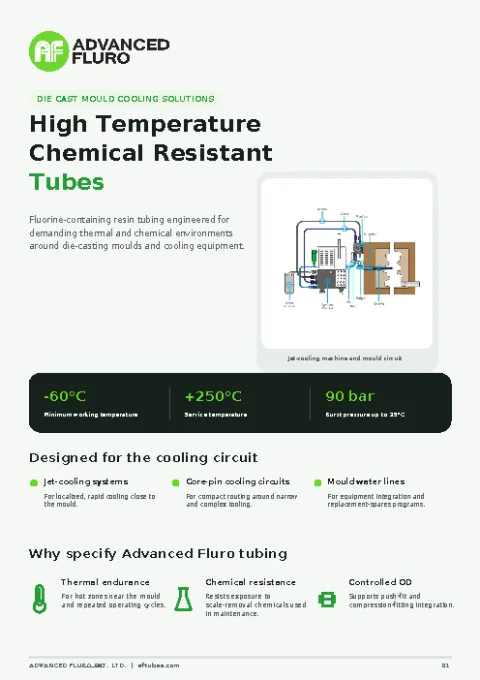
How to choose high temperature, chemical resistant tubing for jet-cooling, core-pin and mould water circuits in die-casting.
In high pressure die-casting, the cooling circuit decides cycle time, part quality and die life. Jet-cooling (spot cooling) units push water through small-bore lines right into core pins and hot spots in the die. The tubing in those lines sits next to some of the hottest metal in the plant, flexes every time the die is serviced, and gets flushed with descaling chemicals during maintenance.
When that tubing fails, the result is a leak at the die, a blocked circuit, a hot spot and scrap castings. This guide covers what die-cast cooling tubing has to survive, which sizes are used, and how to specify it so it lasts.
1. Where tubing sits in a die-cast cooling circuit
A typical jet-cooling setup has a water softener, a spot-cooling machine, a manifold and a set of small lines running to individual cooling points in the die. Tubing is used in three places:
- Jet-cooling lines: short, small-bore lines that deliver water at pressure to a point very close to the cavity for fast, local cooling.
- Core-pin cooling circuits: compact routing into and around narrow core pins and complex tooling, where there is little room and tight bends.
- Mould water lines: connections between the cooling equipment, manifold and die, including the spare lines kept for planned replacement.
2. Why standard tubing fails near the die
Nylon, polyurethane and rubber lines are cheap and easy to fit, but near a die-casting mould they tend to fail in three ways:
- Heat ageing: lines close to the die see repeated heat cycles. Many plastics harden, crack or lose pressure rating over time.
- Chemical attack: descaling and scale-removal chemicals used to keep small cooling channels open can swell or embrittle ordinary tubing.
- Loose fittings: if the outside diameter varies, push-fit and compression fittings don't seal consistently, which leads to leaks or tubes pulling out.
3. Why fluoropolymer tubing suits die-casting
Fluoropolymer (fluorine-containing resin) tubing is used in this job because it handles both the heat and the chemicals:
- Wide temperature range: our die-cast cooling tubes are rated from -60°C, with a working temperature up to +260°C in the size table.
- Chemical resistance: they stand up to the scale-removal chemicals used in routine cooling-circuit maintenance.
- Controlled OD: tight diameter tolerances give repeatable sealing in push-fit and compression fittings.
For a wider comparison of the materials, see our guide to PTFE vs FEP vs PFA tubing.
4. Standard sizes and ratings
Advanced Fluro makes die-cast cooling tube in three controlled-OD sizes, for new equipment and for service replacements:
| Size (ID × OD) | ID / OD tolerance | Wall tolerance | Burst pressure at 25°C | Working temperature |
|---|---|---|---|---|
| 2 × 4 mm | ±0.10 mm | ±0.10 mm | 90 bar | -60 to +260°C |
| 4 × 6 mm | ±0.15 mm | ±0.10 mm | 54 bar | -60 to +260°C |
| 6 × 8 mm | ±0.15 mm | ±0.10 mm | 42 bar | -60 to +260°C |
Every size comes in natural plus six colours: black, red, blue, green, yellow and orange.
Note: burst pressures are stated at 25°C. Pressure capability falls as temperature rises, so always rate the line for the actual water temperature at the die, not room temperature.
5. Use colour to make servicing faster
Die-cast tools can have a dozen or more cooling points. Colour-coding the lines (for example, blue for supply and red for return, or one colour per zone) lets maintenance teams trace circuits quickly, reconnect them correctly after a die change and spot a wrongly routed line before it causes a hot spot.
6. For machine builders
- Build the tubing into jet-cooling and mould-temperature-control equipment from the start.
- Standardise on one or two tube sizes across machine builds and spare-parts kits.
- Use colour coding so your customers can identify circuits without drawings.
- Specify controlled OD so fittings perform the same on every machine.
7. For foundries and maintenance teams
- Replace tubing near the die that is heat-aged, discoloured or chemically attacked before it leaks.
- Keep identified spare tube sizes in stock as part of preventative maintenance.
- Route compact lines carefully around complex dies and core pins, and respect the bend radius.
- Check that tube, fitting and pressure requirements match before installation.
8. Specification checklist
Before ordering, confirm:
- The fluid (softened water, water with additives) and the cleaning chemicals used.
- The continuous temperature at the hottest point of the line.
- The working pressure, and the burst rating at that temperature.
- The minimum bend radius around core pins and tooling.
- The fitting type (push-fit or compression) and its OD requirement.
- The colours needed for circuit identification.
Get the brochure or a sample
Our Die Cast Cooling Tubes brochure has the full size table, colour options and selection notes. For samples, size confirmation or OEM supply, contact Advanced Fluro. We are an ISO 9001:2015 certified manufacturer based in Vasai East, Maharashtra, supplying since 2011.

Article by
AFTubes Team
Savio Pereira is a Chemical Engineer who has held leadership roles in companies like IBM. A passionate problem solver who thrives at finding solutions to engineering and business problems alike using simple innovative ideas. He believes in doing things differently rather than doing different things. His vision is to make Advanced Fluro (P) Ltd the most valuable company in the fluouro polymer industry.