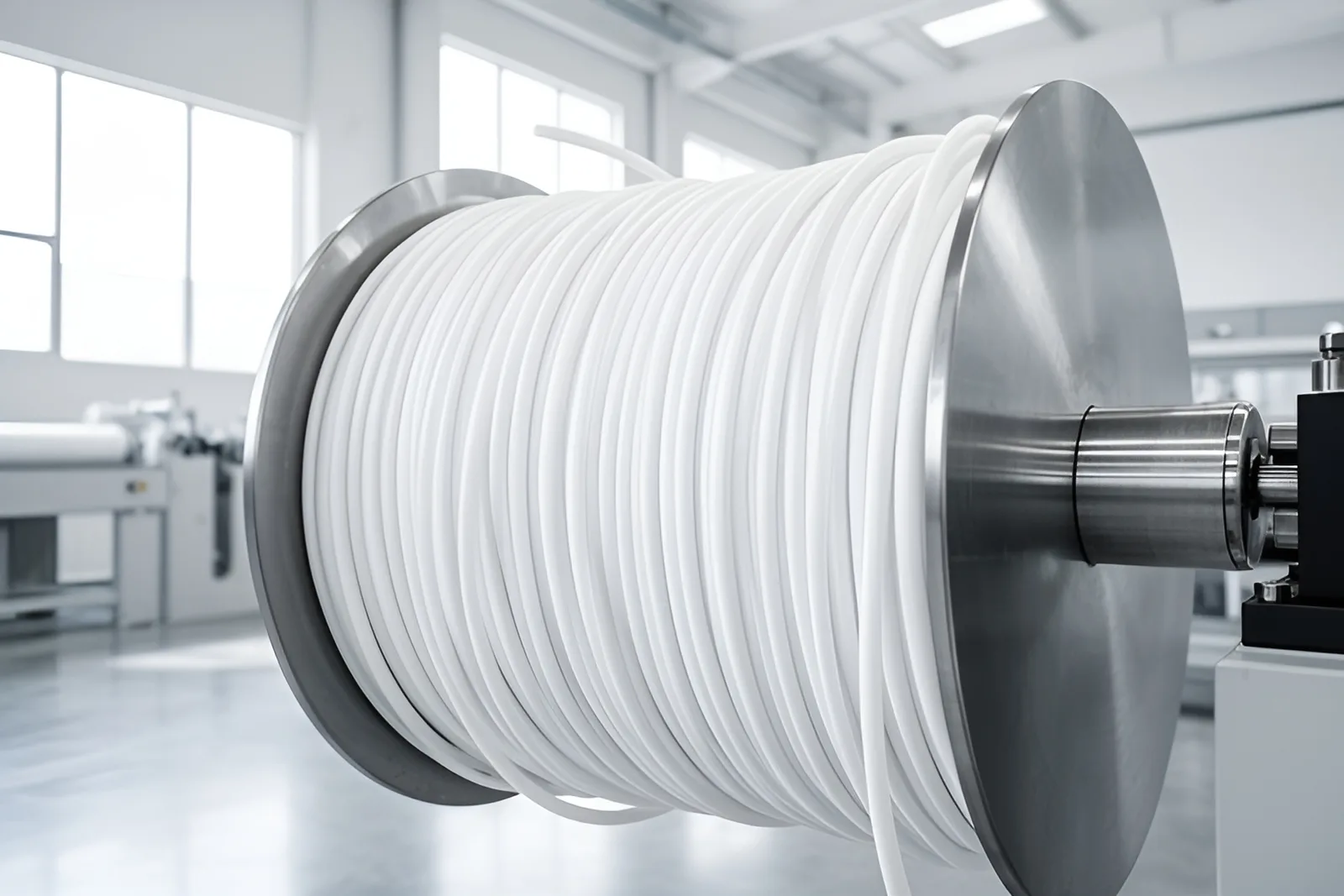
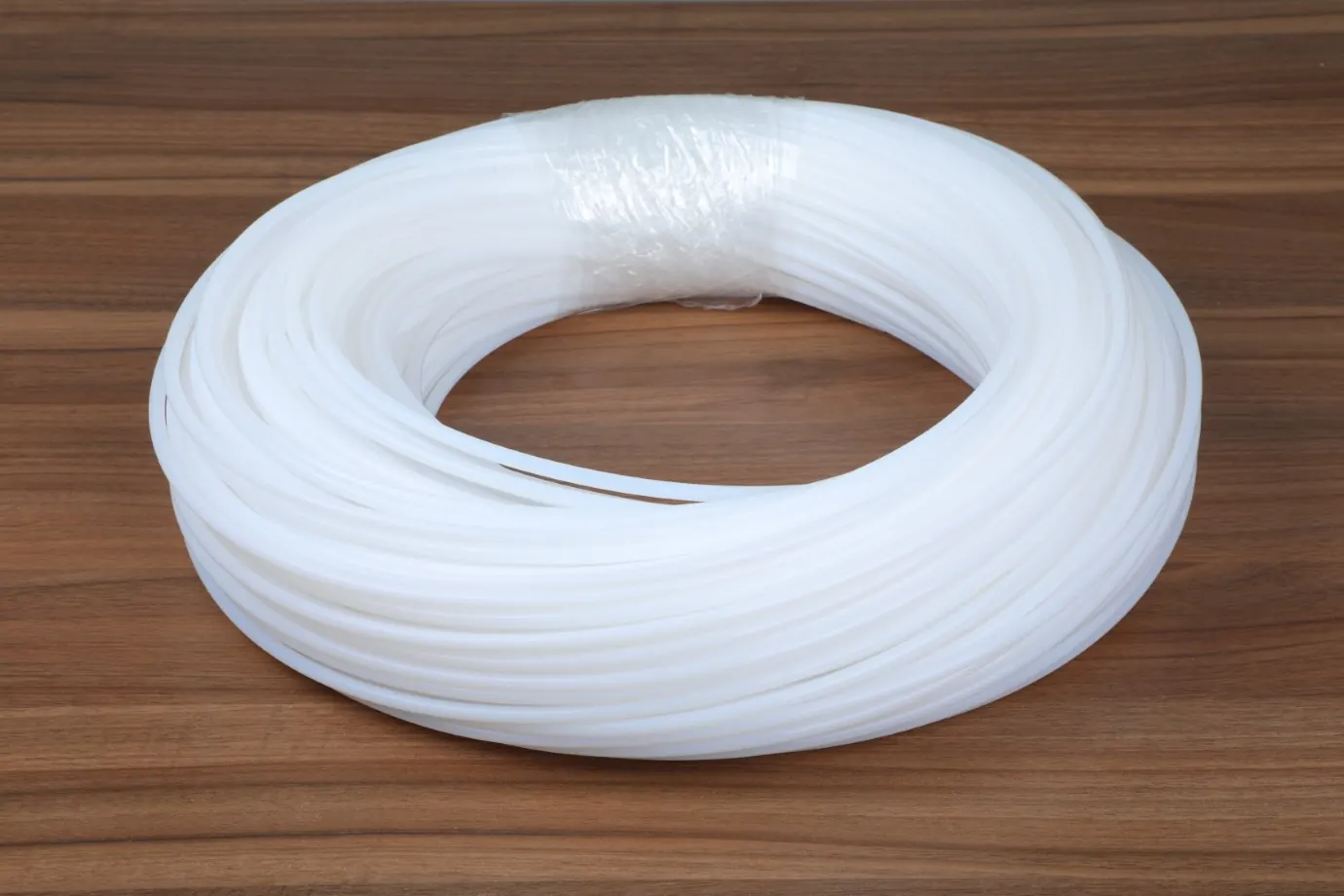
PTFE paste extrusion is how most thin-wall, long-length PTFE tube is made, and it is the reason PTFE tube can be supplied in coils rather than short rigid sticks. PTFE does not flow when heated, so it cannot be extruded like nylon or FEP. Fine powder is mixed with a hydrocarbon lubricant, pushed through a die as a paste, dried and then sintered. The sections below cover each stage, show how it affects the finished tube, and list what to ask a supplier if you are buying tube for a process line.
Why PTFE needs a different extrusion route
PTFE has a crystalline melting point of about 327°C (621°F), but above that temperature it becomes a clear, highly viscous gel rather than a runny melt. Its molecular weight is very high; fine powder grades are typically quoted in the range of 1 million to 30 million. Standard screw extrusion, as used for FEP and PFA, does not work. (Those melt-processable fluoropolymers include FEP Tube and PFA.)
The industry therefore uses a few specialized routes. Granular resin can be compressed and sintered into billets and then machined or skived into sheet and thick-wall parts. Fine powder resin, made by dispersion polymerization, is processed by paste extrusion. Chemours describes its PTFE fine powder resins as suitable for paste extrusion into continuous articles such as tubes, tapes and membranes. Advanced Fluro makes its PTFE tube by paste extrusion only.
The PTFE paste extrusion process, step by step
1. Resin selection and lubricant blending
The process starts with a fine powder resin. The grade is chosen to suit the tube size, because the amount of work put into the resin depends on the die geometry. The powder is blended with a petroleum-based hydrocarbon lubricant, which turns it into a damp, handleable paste. Lubricant type and level are set by the resin maker's guidance and the tube being made, so the exact figures differ between grades and producers.
Blending temperature is tightly controlled because PTFE has a crystal transition near 19°C (66°F), from a triclinic to a hexagonal lattice. Above it the powder becomes softer and more deformable, and mixing above this point risks premature fibrillation, which gives a poorer final product. Blending is therefore normally done at or below that temperature, and the blend is then conditioned before use.
2. Maturing and preforming
The lubricated blend is left to rest so the lubricant spreads evenly through the powder. It is then compressed in a cylinder at low pressure into a cylindrical preform, or billet. The 3M Dyneon processing sequence lists these stages as mixing with lubricant, maturing, preform compression and then extrusion. The preform loads the extruder with a void-free charge. It has little strength at this point.
3. Extrusion through the die
The preform is loaded into a barrel and a piston forces it through a die and over a mandrel, which forms the bore. The paste leaves as a continuous tube. It is soft, lubricant-wet and fragile, and it must be supported as it is drawn off.
The key variable here is the reduction ratio, the cross-sectional area of the barrel divided by the area of the die opening. A higher ratio puts more work into the resin and raises extrusion pressure. Published work on paste extrudates reports that more fibrils form with a larger reduction ratio or lower lubricant content. Those fibrils give the unsintered tube its green strength: the shear in the die draws the PTFE particles into a network of fine fibers that holds the tube together before it is heated. 3M's datasheets describe the same mechanism, with sintering later fusing the particles and closing the voids.
4. Drying off the lubricant
The extruded tube passes through an oven that evaporates the lubricant. Published tube and extrusion patents describe drying ranges of roughly 100 to 250°C (212 to 482°F). If the lubricant is not fully removed, it can cause bubbles, voids or discoloration in the sintering stage, so drying has to be complete and even along the whole length.
5. Sintering
Sintering heats the tube above the PTFE melting point so the particles coalesce into a continuous solid. Unsintered PTFE shows a first melting point near 340°C (644°F), and after sintering the melting point settles slightly below 327°C (621°F). Patent literature gives sintering ranges from about 340 to 400°C (644 to 752°F), and tube patents commonly describe heating at around 400°C (752°F). The right figure depends on resin grade, wall thickness and line speed, so treat these as typical values and check them against your resin maker's guidance before copying them.
The rate of cooling after sintering affects crystallinity, which in turn affects flexibility, density and permeability. Faster quenching gives lower crystallinity and a more flexible tube; slow cooling gives a stiffer, more crystalline one.
How process choices show up in the finished tube
Every stage affects the fibril structure and the final crystalline structure, so small process differences can be visible in tube you hold in your hands. The table below links the main variables to what a buyer or maintenance engineer can notice.
| Process stage | What goes wrong if poorly controlled | What you may see in service |
|---|---|---|
| Lubricant blending | Uneven lubricant, mixing too warm | Streaks, density variation, weak spots |
| Preform | Trapped air or poor compaction | Voids or lamination in the wall |
| Extrusion | Unstable pressure or die and mandrel misalignment | Wall thickness variation, ovality |
| Drying | Residual lubricant | Bubbles, discoloration, odor on first heating |
| Sintering and cooling | Under- or over-sintering, uneven cooling | Brittleness, stiffness, poor flex life, higher permeation |
Wall thickness uniformity is a practical check on receipt. If the mandrel sits off center in the die, one side of the wall is thinner. That thin side is where a tube will kink first, wear first and permeate most, so measure the wall at several points instead of relying on the nominal figure on the drawing.
Color and filled grades
Pigments and fillers are blended into the powder before the lubricant is added, which is why filled tubes behave differently in the die. Colored tube needs good dispersion so the color is even along the length. For a plain, unfilled option see PTFE Natural Tube.
What paste extrusion means for tube sizes and lengths
Paste extrusion suits small and medium bores with thin to medium walls, and it produces continuous lengths. Length is limited by the handling of the extrudate and the oven line, and the process itself sets no fixed limit. Very thick walls are harder to dry and sinter evenly and are often made by other PTFE routes. That is a general industry point about those routes and says nothing about how Advanced Fluro works.
Tube made this way is also the starting point for further forming. Corrugating the tube gives better flexibility and bend radius, and braiding it with stainless steel or fiber gives a pressure-rated hose. Hose forming and braid assembly are done in-house at Advanced Fluro. See PTFE Corrugated Tube for the formed product.
What to ask a supplier about their extrusion process
You cannot see most of the process from a data sheet, so ask direct questions:
- Which process do they use for the tube? Paste extrusion for continuous thin-wall tube is the normal answer; treat a vague answer with caution.
- Is the resin virgin? Resin source affects purity, color and mechanical properties. Ask for the grade and the declaration that goes with it.
- What material paperwork is available? At Advanced Fluro, EN 10204 3.1 material test certificates are available with shipments on request, and REACH, RoHS and FDA 21 CFR 177.1550 compliance declarations are available for the PTFE.
- What quality system is in place? Advanced Fluro's quality management system is certified to ISO 9001:2015.
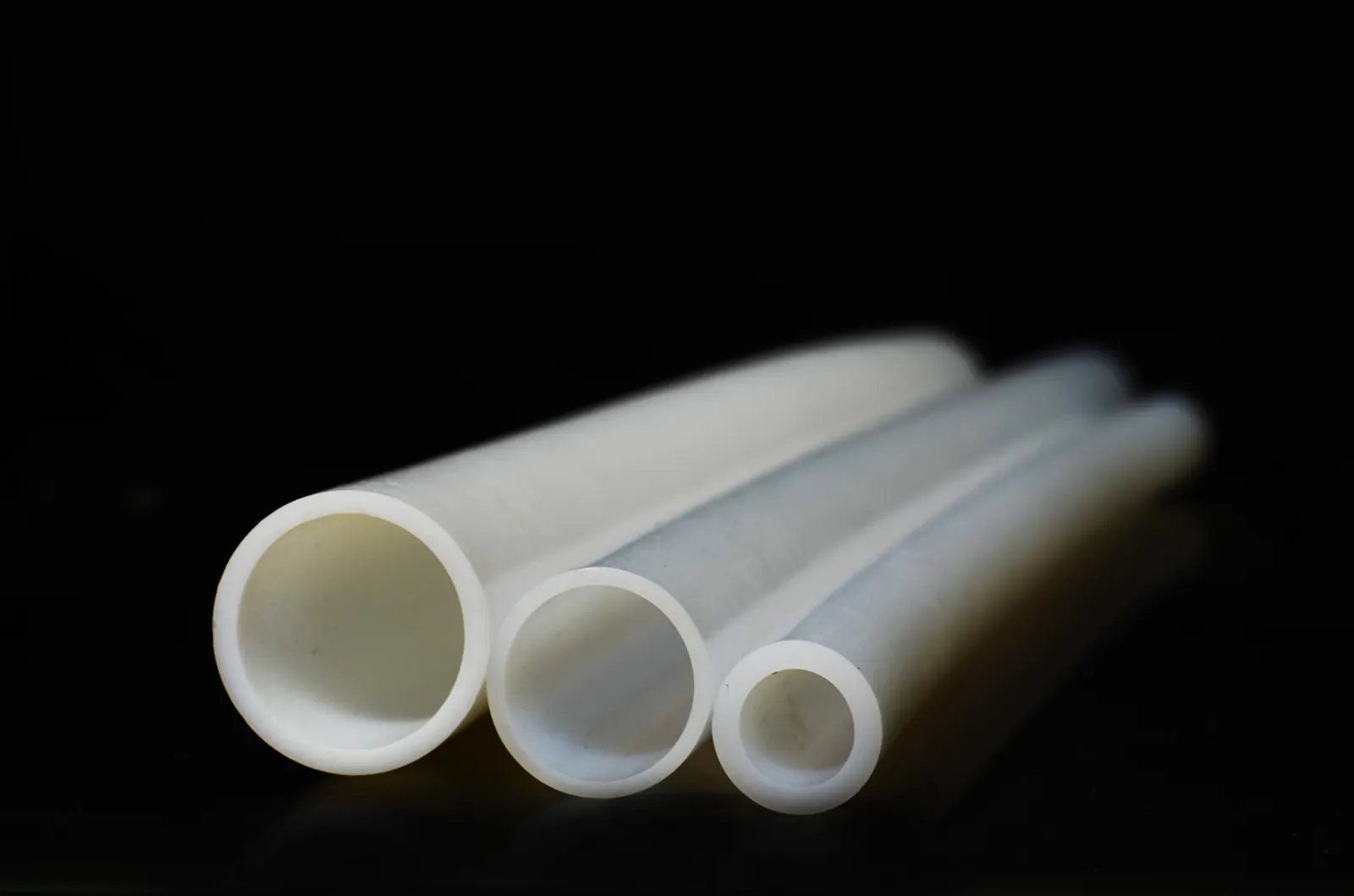
- What are the dimensional tolerances on bore and wall? Agree these in the order, and measure on receipt.
Frequently Asked Questions
What is PTFE paste extrusion?
PTFE paste extrusion is a process in which PTFE fine powder is mixed with a hydrocarbon lubricant, formed into a preform, forced through a die as a paste, dried to remove the lubricant and then sintered above the PTFE melting point. The result is a solid, continuous tube.
Why can't PTFE be melt extruded like FEP or PFA?
PTFE has a very high molecular weight and does not flow as a normal melt above its melting point of about 327°C (621°F). FEP and PFA are melt-processable copolymers, so they can be screw extruded, while PTFE needs paste extrusion or other specialized routes.
Why does the 19°C transition affect blending?
PTFE changes crystal structure near 19°C (66°F), and above that point the powder becomes softer and can fibrillate prematurely under mixing. Processors therefore hold the temperature at or below that point during blending and conditioning, which avoids density variation and weak spots in the final tube.
Does the sintering stage affect tube performance?
Yes. Under-sintering leaves weak particle bonding, and the cooling rate sets crystallinity, which changes flexibility, density and permeation. Tube that has been sintered and cooled consistently along its full length behaves more predictably in service, with fewer surprises in flex life and in permeation through the wall.
Next step: specify PTFE tube
To choose a size, grade or color, start with the PTFE tube range, then use the contact page to send your bore, wall, length and media for a quote or sample.

Article by
AFTubes Team
Savio Pereira is a Chemical Engineer who has held leadership roles in companies like IBM. A passionate problem solver who thrives at finding solutions to engineering and business problems alike using simple innovative ideas. He believes in doing things differently rather than doing different things. His vision is to make Advanced Fluro (P) Ltd the most valuable company in the fluouro polymer industry.