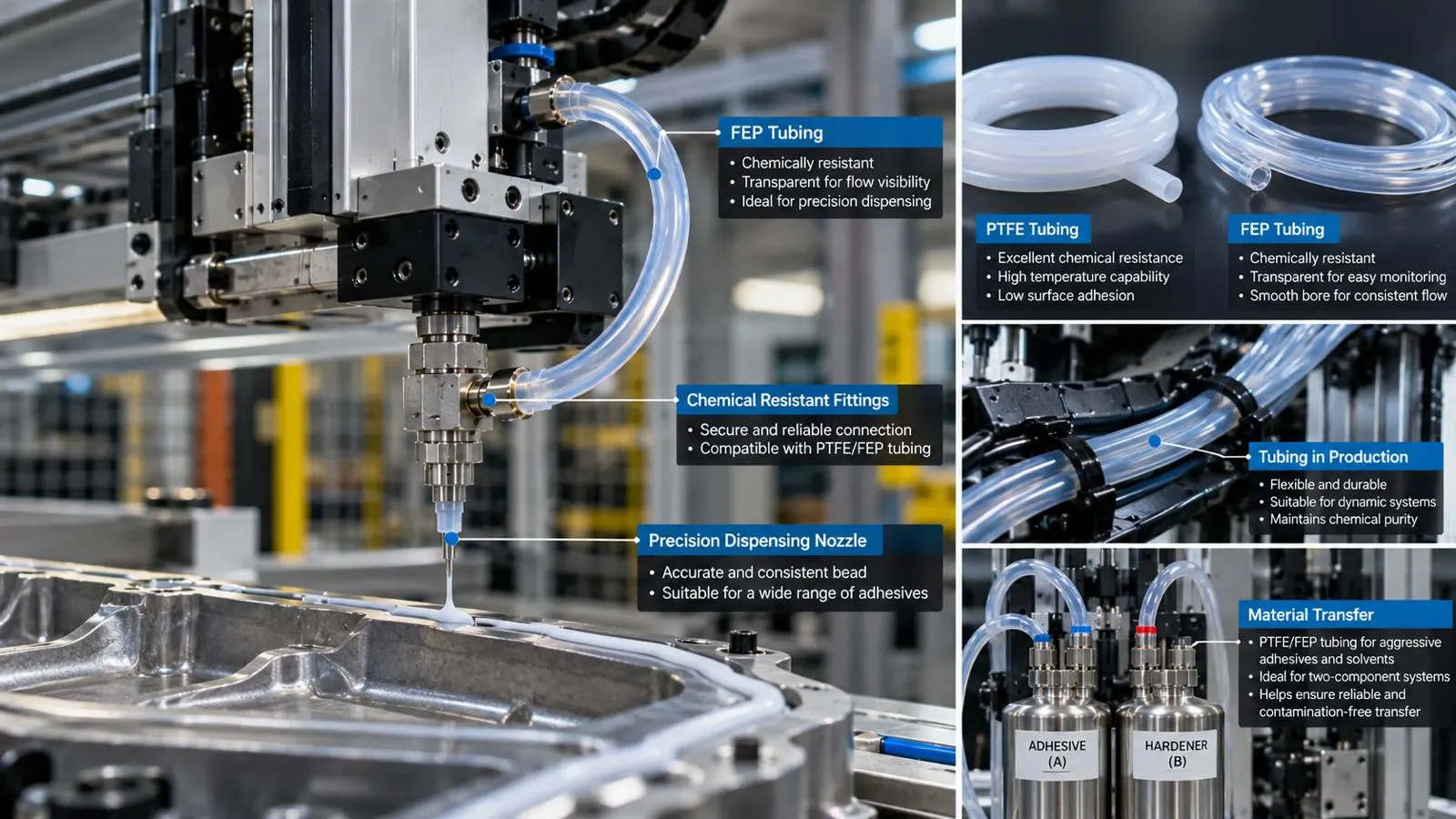
How to select chemically resistant tubing for precision adhesive dispensing, automated dosing systems and industrial sealant applications.
In industrial adhesive dispensing systems, selecting the correct tubing material is just as important as selecting the dispensing pump, valve or nozzle.
Adhesives and sealants used in automotive manufacturing, electronics assembly, aerospace, chemical processing and industrial automation can contain aggressive solvents, reactive chemicals, curing agents and other ingredients that are incompatible with conventional tubing materials.
Exposure to these chemicals can cause tubing to swell, soften, crack, become brittle or release contaminants into the adhesive. These failures may result in inaccurate dispensing, inconsistent bead formation, equipment downtime and premature tubing replacement.
PTFE (Polytetrafluoroethylene) and FEP (Fluorinated Ethylene Propylene) tubing provide an effective solution for many chemically aggressive adhesive and sealant dispensing applications. Their broad chemical resistance, low surface energy and suitability for demanding industrial environments make them valuable components in automated dosing and dispensing equipment.
However, not every adhesive requires fluoropolymer tubing. The decision depends on the chemical formulation, operating temperature, pressure, viscosity and cleaning procedure. This article explains when PTFE or FEP tubing should be specified and how to select the appropriate material.
1. Why Tubing Material Matters in Adhesive Dosing and Dispensing
Industrial adhesive dispensing equipment must deliver a controlled quantity of material to a specific location. These systems are commonly used for automated adhesive bead dispensing, precision micro-dosing, two-component adhesive mixing, industrial sealant application, potting and encapsulation, gasket sealing, electronics bonding and resin dispensing.
A typical dispensing system consists of a material reservoir, feed pump or pressure vessel, fluid transfer tubing, dispensing valve and application nozzle. The tubing connects these components and remains in direct contact with the adhesive or sealant.
Common tubing-related problems include:
- Chemical swelling: solvents penetrate incompatible tubing, causing dimensional changes and affecting flow consistency.
- Chemical degradation: reactive ingredients weaken tubing and can cause cracking or leakage.
- Material contamination: incompatible tubing may release additives, plasticisers or degradation products.
- Inconsistent dosing: changes in tubing dimensions or compliance can affect delivered volume.
- Cleaning-related failure: tubing may tolerate the adhesive but not the flushing solvent.
In applications where these risks cannot be controlled with conventional materials, PTFE or FEP tubing may be required.
2. Which Adhesives and Sealants May Require PTFE or FEP Tubing?
The chemical composition of an adhesive matters more than its general product classification. Two epoxy adhesives, for example, may have very different compatibility requirements depending on their hardeners, diluents and solvents.
A. Solvent-based industrial adhesives
Solvent-based adhesives may contain acetone, methyl ethyl ketone (MEK), toluene, xylene, ethyl acetate or other organic solvents. These substances can attack or swell certain conventional tubing materials. Applications include automotive component bonding, industrial laminating, footwear bonding, packaging machinery and contact adhesive dispensing.
PTFE or FEP tubing is worth specifying when the solvent blend is incompatible with conventional tubing, or when long-term dimensional stability and chemical resistance are essential.
B. Two-component epoxy adhesive dispensing
Two-component epoxy systems typically contain a resin and hardener delivered through separate fluid paths before mixing. Some hardeners contain amines; some systems use aggressive reactive diluents or solvents. Evaluate tubing compatibility separately for both components.
PTFE or FEP may be appropriate for epoxy resin feed lines, amine hardener dispensing lines, electronics potting equipment and automated industrial bonding machines. For highly viscous formulations, also consider bore size, pressure drop and mechanical strength.
C. Polyurethane adhesive and sealant dispensing
Polyurethane systems may contain isocyanate-functional components, polyols, catalysts and other additives. Some formulations react with moisture. PTFE and FEP can provide useful chemical resistance, but chemical compatibility alone does not guarantee suitability for moisture-sensitive polyurethane dispensing.
Moisture permeation, connection sealing, residence time and cleaning must be evaluated. Critical applications may require additional barrier protection or a different fluid-transfer construction.
D. Silicone sealants and specialty adhesives
Many standard silicone formulations can use several types of tubing without requiring PTFE or FEP. Specialty formulations with aggressive solvents or reactive ingredients may justify fluoropolymer tubing, particularly where cleaning requirements or visual flow inspection are important. Base the choice on the complete formulation.
E. Anaerobic adhesives and thread-locking compounds
Anaerobic adhesives are used for thread locking, retaining and flange sealing. Curing depends on factors such as oxygen availability, metal contact and formulation chemistry. PTFE or FEP can be considered for compatible dispensing circuits, but the tubing material alone cannot prevent premature curing. Evaluate fittings, valves, oxygen exposure and wetted metal components.
F. Chemically aggressive specialty sealants
Some protective sealants and specialty aerospace or electronics bonding compounds contain aggressive solvents or reactive curing agents. Evaluate PTFE or FEP where the entire formulation is incompatible with conventional tubing. Consult the safety data sheet (SDS), technical data sheet and application testing.
3. PTFE vs FEP Tubing: Which Is Better for Adhesive Dispensing?
Both are fluoropolymers with broad chemical resistance and low surface energy. They differ in thermal performance and visibility.
| Property | PTFE tubing | FEP tubing |
|---|---|---|
| Chemical resistance | Broad | Broad |
| General continuous service temperature | Up to approximately 260°C | Up to approximately 200°C |
| Appearance | Typically opaque or translucent | Transparent for fluid monitoring |
| Surface energy | Low | Low |
| Best suited to | Applications where elevated temperature capability matters | Applications where spotting trapped air or incomplete priming matters |
These temperature values are general material capabilities, not guaranteed limits for a particular tube assembly. Pressure and chemical compatibility must be validated for the application.
Choose PTFE where chemical resistance and higher temperature capability are priorities. Choose FEP where broad chemical resistance and visual monitoring are both important, subject to validated operating limits.
4. Seven Situations Where PTFE or FEP Tubing May Be Essential
- Aggressive solvents attack conventional tubing. When solvent blends swell or degrade the existing material, PTFE or FEP may provide a more resistant fluid path.
- Cleaning solvents are more aggressive than the adhesive. A line handling a mild adhesive may still need to tolerate acetone, MEK or other strong flushing solvents. Consider the full cleaning cycle.
- Adhesive purity is critical. Sensitive electronics, optical or precision manufacturing can demand low contamination. Appropriately manufactured and validated PTFE or FEP tubing may reduce material-derived contamination risk.
- High-temperature dispensing is required. Some adhesives are warmed to control viscosity. PTFE generally offers higher thermal capability than FEP, but the assembly must also meet pressure and chemical requirements.
- The process requires visual monitoring. Transparent FEP makes it easier to observe bubbles, priming and fluid movement in suitable precision dispensing systems.
- Frequent cleaning and product changeovers occur. Low surface energy can reduce adhesion of some materials, but cured adhesives can still block PTFE and FEP tubing. Cleaning procedures remain necessary.
- Conventional tubing has an unacceptable service life. Repeated swelling, leaks or solvent damage may indicate a compatibility mismatch. Investigate pressure, bending and connections as well as chemistry.
5. Industrial Applications of PTFE and FEP Adhesive Dispensing Tubing
- Automotive manufacturing: automated bonding, sealing, gasket application and electronics assembly may use fluoropolymer tubing where aggressive fluids or cleaning chemicals are present.
- Electronics equipment assembly: precision dispensing for bonding, potting and encapsulation may benefit from chemical resistance, low contamination and FEP's transparency.
- Aerospace and industrial equipment: specialty bonding and sealing systems may require chemically resistant transfer lines, subject to application qualifications.
- Automated dispensing machine OEMs: robotic adhesive applicators, two-component metering and mixing systems, micro-dosing machines, potting systems and solvent flushing circuits may require PTFE or FEP tubing.
6. Important Engineering Considerations
- Chemical compatibility: check the complete adhesive, hardener, resin, solvent and cleaning blend at actual operating concentrations and temperatures.
- Operating pressure: account for normal pressure, pulsation, surge and blocked-nozzle scenarios. Ratings depend on tubing dimensions, temperature, construction and fittings. Where unsupported tubing is not enough, consider a PTFE braided hose.
- Viscosity and pressure drop: long tubing runs and small bores increase pressure losses. For a Newtonian fluid in laminar flow through a circular tube, pressure drop equals 8 × viscosity × length × volumetric flow rate divided by (π × internal radius to the fourth power). Many adhesives are non-Newtonian, so actual calculations may require rheological data.
- Flexibility and routing: respect bend radius, dynamic movement and mechanical loading limits.
- Permeation: PTFE and FEP are not absolute barriers to gases, moisture or every solvent. Check moisture-sensitive and volatile formulations carefully.
- Connections and fittings: use compatible fittings that account for dimensional tolerances and fluoropolymer creep under sustained compression.
- Dosing accuracy: tube dimensions and compliance can influence repeatability, especially in pressure-controlled systems.
7. Common Tubing Selection Mistakes
- Selecting tubing based only on labels such as "epoxy" or "polyurethane".
- Assuming chemical resistance means unlimited pressure resistance.
- Ignoring cleaning solvents.
- Assuming low surface energy will stop a reactive adhesive from curing inside a tube.
8. How to Specify PTFE or FEP Tubing for a Dispensing Machine
Share the following with your tubing supplier:
- Adhesive or sealant name, SDS and relevant formulation details
- Viscosity and its temperature or shear dependence
- Normal and maximum operating temperature
- Normal, peak and surge pressure
- Required internal diameter, outer diameter and tube length
- Static or dynamic installation and bend requirements
- Cleaning chemicals and flushing frequency
- Transparency, contamination, moisture barrier or permeation requirements
9. PTFE and FEP Tubing Solutions from Advanced Fluro
Advanced Fluro manufactures fluoropolymer tubing and hose products for industrial applications, including PTFE tubing, FEP tubing and PFA tubing. For adhesive dosing and dispensing equipment, PTFE and FEP can be evaluated where aggressive chemicals, solvent exposure, elevated temperatures and precision fluid transfer require careful material selection.
Potential users include dispensing equipment OEMs, automation integrators, automotive component manufacturers, electronics manufacturers and industrial maintenance teams. Selecting the correct tube means considering internal diameter, wall thickness, operating pressure, chemical compatibility and installation conditions together.
Frequently Asked Questions
Is PTFE tubing suitable for adhesive dispensing?
Yes, for many formulations, particularly where broad chemical resistance or higher temperature capability is required. Verify the complete formulation and operating conditions.
Is FEP tubing resistant to acetone and MEK?
FEP generally offers excellent resistance to many common organic solvents, including acetone and MEK. Verify the actual blend, temperature, pressure and exposure duration.
Which tubing is best for solvent-based adhesives?
PTFE and FEP are strong candidates where the solvent attacks conventional tubing. Selection also depends on temperature, pressure and visibility requirements.
Can PTFE tubing be used for two-component epoxy dispensing?
Yes, when compatibility and mechanical requirements are satisfied. Evaluate resin and hardener independently.
What is the advantage of FEP tubing in precision dosing?
Its transparency helps operators observe fluid movement, bubbles and priming while providing broad chemical resistance.
Can PTFE stop adhesive curing inside a tube?
No. Low surface energy does not prevent curing when the adhesive's reaction conditions are met.
Is PTFE suitable for high-pressure dispensing?
Only in a suitably engineered and pressure-rated system. Some applications require reinforced hose rather than unsupported tubing.
Conclusion
PTFE and FEP tubing can play an important role in adhesive dosing and dispensing when chemical compatibility, temperature capability and reliable transfer are critical. PTFE is often chosen for broad chemical resistance and higher temperature capability. FEP offers the additional benefit of transparency for visual flow monitoring.
Neither material is required for every adhesive or sealant. The strongest reason to specify fluoropolymer tubing is an actual compatibility or operating requirement that conventional tubing cannot satisfy.
Looking for PTFE or FEP tubing for your adhesive or sealant dispensing process? Contact Advanced Fluro with the adhesive chemistry, operating temperature, pressure and required tube dimensions to discuss suitable options, subject to application-specific validation.

Article by
AFTubes Team
Savio Pereira is a Chemical Engineer who has held leadership roles in companies like IBM. A passionate problem solver who thrives at finding solutions to engineering and business problems alike using simple innovative ideas. He believes in doing things differently rather than doing different things. His vision is to make Advanced Fluro (P) Ltd the most valuable company in the fluouro polymer industry.