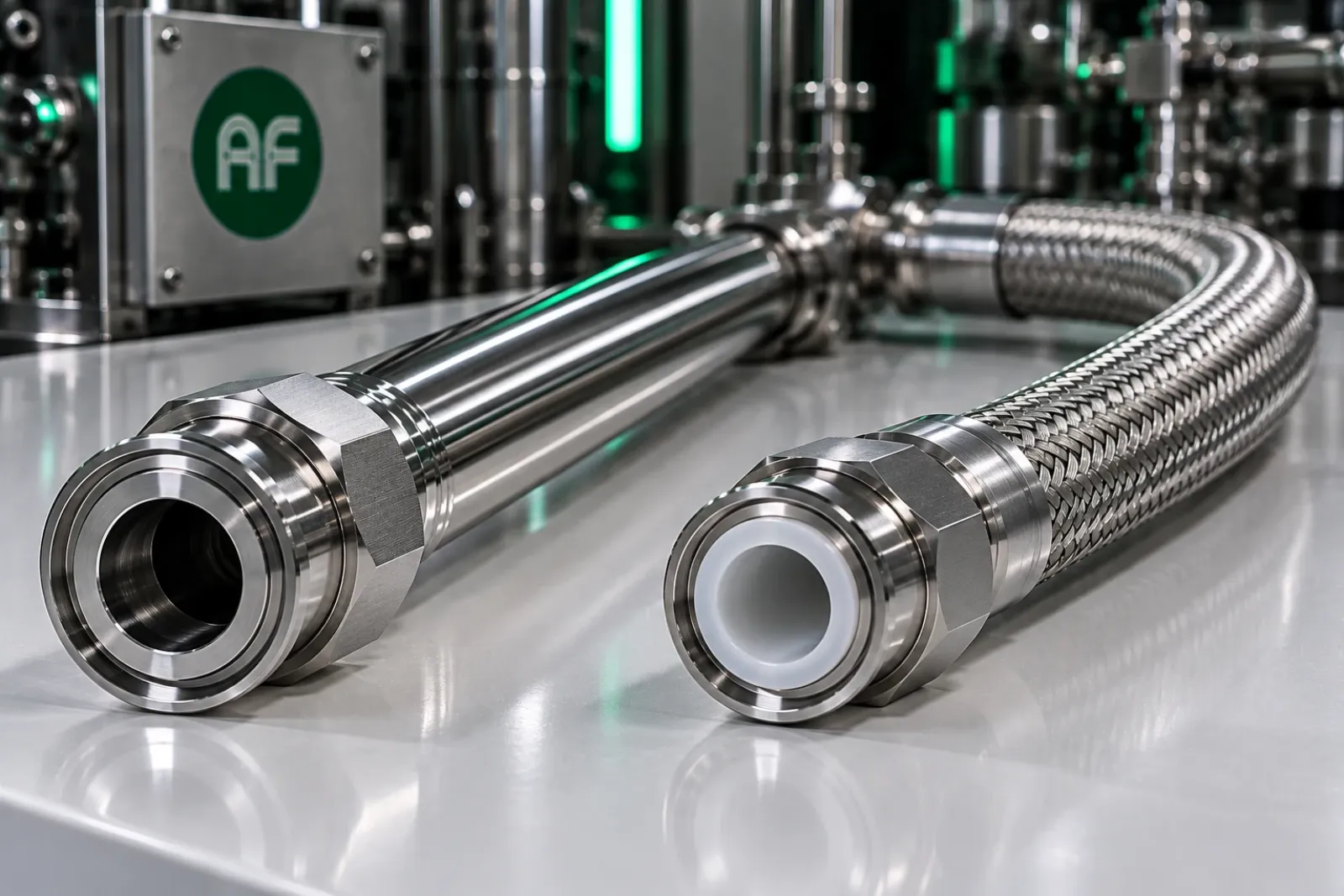
Selecting materials for semiconductor process gas delivery means balancing chemical compatibility, pressure containment, cleanliness and movement. 316L VIM/VAR (vacuum induction melted / vacuum arc remelted) stainless steel remains the standard for rigid structural runs. For flexible, highly corrosive gas and fluid transport, high purity PTFE hose and high purity SS braided PTFE hose assemblies are the premier choice.
Why PTFE Outperforms Metals in Halogenated Gases
Some process gases, including wet chlorine, fluorine, volatile halides and strong inorganic acids, can attack even double-melt stainless steels.
- Halogen attack on metals: chlorides and fluorides can strip the passive chromium oxide layer from 316L stainless steel, causing micro-pitting and iron contamination in the gas stream.
- Inertness of PTFE: PTFE has a carbon-fluorine backbone, one of the strongest single bonds in organic chemistry, which makes a high purity PTFE hose unreactive to aggressive etch and deposition gases.
Material comparison at a glance
| Property | 316L VIM/VAR stainless | PTFE (braided hose) |
|---|---|---|
| Best use | Rigid structural runs | Flexible, highly corrosive transport |
| Halogenated gases | Risk of micro-pitting over time | Chemically inert |
| Flexibility | Rigid | Flexible with stainless over-braid |
Eliminating Electrostatic Charge in Gas Lines
When gases or non-conductive ultra-pure fluids flow through non-metallic tubing at high velocity, static charge can build up on the inner wall. Unmanaged electrostatic discharge (ESD) can puncture a non-metallic hose wall or ignite flammable gases such as hydrogen or silane.
Advanced Fluro offers anti-static lined assemblies, such as our conductive PTFE hose. A carbon-loaded inner liner lets static discharge safely through the stainless steel braid to ground. Read more in our guide to conductive PTFE hose and electrostatic safety.
Choosing Advanced Fluro for Chemical and Gas Distribution
From flexible pigtails for gas cylinder cabinets to durable transfer lines inside wet benches, Advanced Fluro makes high purity PTFE hose assemblies matched to your pressure, temperature and chemical compatibility requirements.
Frequently Asked Questions
Can 316L stainless steel handle fluorine and chlorine gases?
It performs well in many cleanroom duties, but chlorides and fluorides can strip its passive chromium oxide layer over time, causing micro-pitting and iron contamination.
Why is PTFE so chemically resistant?
PTFE has a carbon-fluorine backbone, one of the strongest single bonds in organic chemistry, so it does not react with aggressive etch and deposition gases.
How do you prevent static build-up in a PTFE gas line?
Use an anti-static (conductive) PTFE liner so charge travels through the stainless steel braid to ground.
Talk to Advanced Fluro
Need help choosing between metal and PTFE for a corrosive gas line? Request a quote or technical consultation, call +91 96990 55600 or email contact@aftubes.com.

Article by
AFTubes Team
Savio Pereira is a Chemical Engineer who has held leadership roles in companies like IBM. A passionate problem solver who thrives at finding solutions to engineering and business problems alike using simple innovative ideas. He believes in doing things differently rather than doing different things. His vision is to make Advanced Fluro (P) Ltd the most valuable company in the fluouro polymer industry.