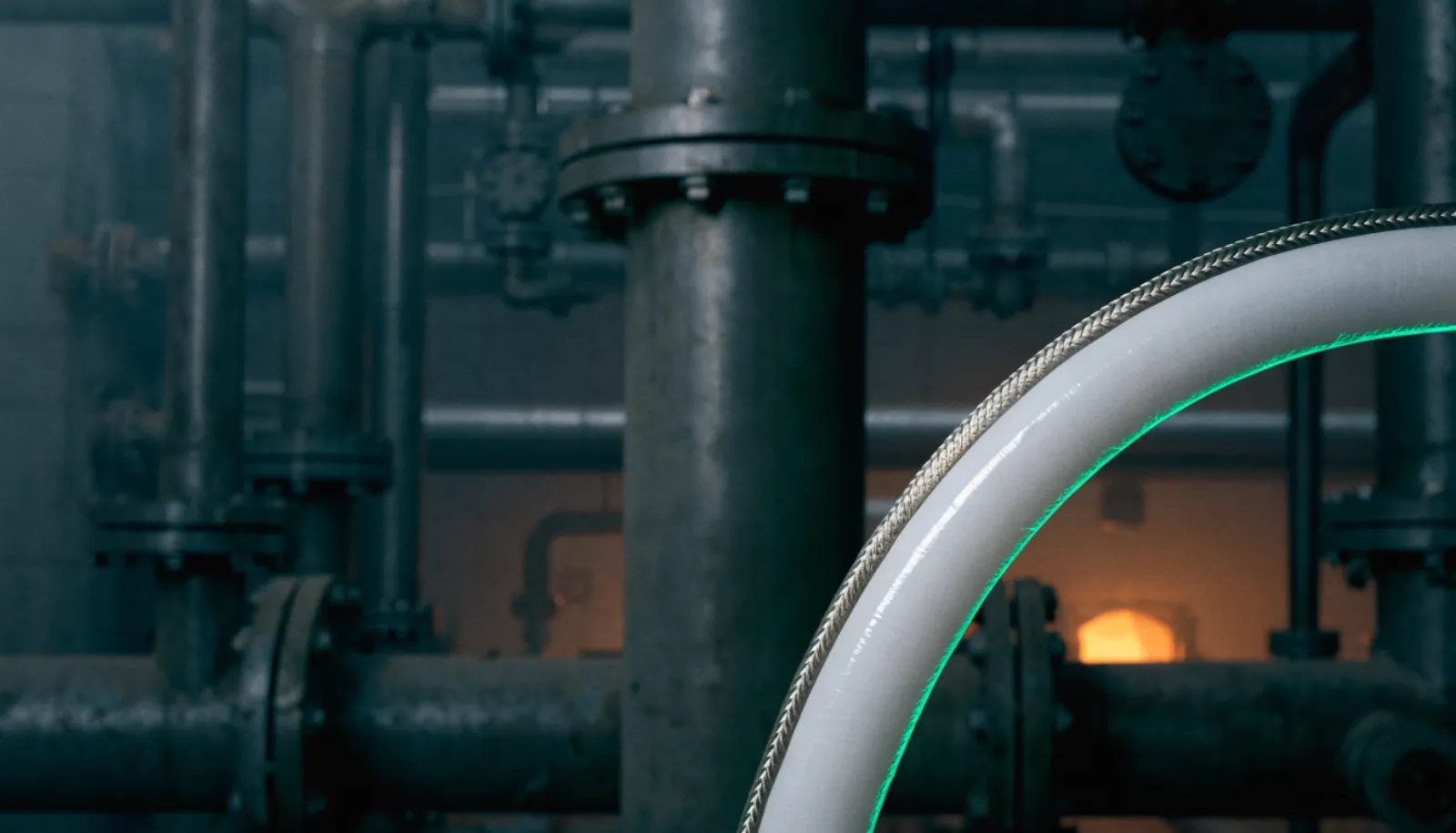
High temperature PTFE hose rated to 260°C represents the upper continuous-use limit for standard polytetrafluoroethylene in industrial fluid transfer systems. At this temperature threshold, PTFE maintains chemical inertness and structural integrity across chemical processing, pharmaceutical manufacturing, semiconductor fabrication, and high-temperature steam applications. Engineers specifying high temperature ptfe hose 260 degrees celsius must account for pressure derating, material purity requirements, dimensional tolerances, and mechanical property changes as operating temperature approaches the polymer's continuous service ceiling.
This technical guide addresses critical specification parameters for PTFE hose operating at or near 260°C: how pressure ratings decline with temperature, which chemical exposures remain safe at elevated temperatures, what manufacturing tolerances are achievable, how to calculate proper wall thickness and burst pressure margins, and why virgin-grade resin selection impacts long-term performance.
Temperature Performance and Pressure Derating at 260°C
PTFE tubing operates across -200°C to +260°C, but mechanical strength decreases significantly as temperature rises. A tube rated for 300 PSI working pressure at 22°C may only safely handle 75 PSI at 204°C due to reduced tensile strength and increased creep tendency. At 260°C—the continuous-use ceiling for standard PTFE—pressure capacity typically drops to 20-25% of room-temperature rating, requiring careful derating calculations during specification.
The pressure derating phenomenon occurs because PTFE's crystalline structure becomes more mobile above 200°C, allowing molecular chains to slide past one another under stress. This cold flow or creep behavior accelerates dramatically between 200°C and 260°C. A hose dimensionally stable at 150°C may deform noticeably under the same pressure at 250°C. Engineers must apply manufacturer-specific derating curves rather than linear interpolation, as strength loss accelerates non-linearly in the upper temperature range.
For applications requiring both high temperature and elevated pressure, SS316 stainless steel braided reinforcement becomes essential. A braided high temperature ptfe hose 260 degrees celsius construction maintains working pressures of 100-150 bar at maximum temperature, compared to 20-30 bar for unreinforced tube of equivalent bore. The metal braid constrains radial expansion and resists creep forces that would otherwise cause dimensional instability and eventual rupture. PTFE Stainless Steel Braided Hose: In-Stock vs. Custom Options provides detailed specifications for reinforced constructions across pressure and temperature ranges.
Thermal cycling between ambient and 260°C introduces additional stress factors. Repeated expansion and contraction can cause microcracking in the PTFE liner, particularly at connection points where mechanical fittings constrain thermal movement. Systems experiencing frequent thermal cycles should specify heavier wall constructions with 20-30% greater thickness than steady-state calculations suggest, and fittings designed to accommodate axial thermal expansion without imposing bending stress.
Chemical Compatibility and Material Selection
PTFE exhibits near-universal chemical resistance across acids, bases, solvents, and oxidizers, with only three notable exceptions: elemental fluorine gas, molten alkali metals (sodium, potassium), and molten sodium hydroxide above 300°C. This exceptional inertness persists at 260°C, where most alternative polymers degrade rapidly. Concentrated sulfuric acid, fuming nitric acid, aqueous hydrofluoric acid, chlorinated solvents, and aggressive ketones flow safely through high temperature ptfe hose 260 degrees celsius without material degradation or contamination.
Chemical compatibility at elevated temperature requires verification beyond room-temperature resistance data. Some chemicals showing "A-rated" compatibility at 20°C may exhibit accelerated permeation or stress-cracking behavior at 200-260°C. Aromatic hydrocarbons permeate through PTFE walls more rapidly at elevated temperatures, potentially creating flammability hazards or contaminating ultra-pure processes. Permeation rates typically double for every 20-30°C temperature increase, making wall thickness selection critical for volatile organic compounds at high temperature.
Pharmaceutical and food-grade applications demand virgin PTFE resin meeting FDA 21 CFR 177.1550 compliance for direct food contact. At 260°C, any residual processing lubricants or contaminants from reprocessed resin can volatilize and migrate into the process stream. High-purity applications in semiconductor manufacturing require PTFE meeting SEMI F57 standards for extractable metals and particles, with ion chromatography verification that no ionic contaminants leach from the tube wall even under high-temperature, high-purity water exposure.
The chemical resistance advantage of PTFE over alternative fluoropolymers becomes pronounced at maximum temperature. FEP (fluorinated ethylene propylene) offers similar chemical resistance but only to 200°C continuous use. PFA extends to 260°C like PTFE but at significantly higher material cost. For applications where 260°C exposure is continuous rather than occasional, standard PTFE provides optimal balance of chemical resistance, temperature capability, and economic value. PTFE Hose Chemical Resistance offers detailed compatibility data across chemical families and temperature ranges.
Precision Tolerances and Manufacturing Standards
Manufacturing tolerances for high temperature ptfe hose 260 degrees celsius directly impact system performance, particularly in applications requiring precise flow control, minimal dead volume, or contamination-free fluid paths. Paste extrusion—the primary manufacturing method for PTFE tubing—achieves inner diameter tolerances of ±0.05 mm for small-bore tubes (under 6 mm ID) and ±0.10 mm for larger diameters when produced under ISO 9001:2015 quality systems. Medical-grade and semiconductor-grade tubing can achieve ±0.01 mm (10 micron) tolerances through secondary sizing operations and 100% dimensional inspection.
Wall thickness uniformity matters as much as absolute dimensional accuracy. Eccentricity—the variation in wall thickness around the tube circumference—should not exceed 10% of nominal wall for pressure applications. A tube with 1.0 mm nominal wall and 0.15 mm eccentricity has a thin section of only 0.85 mm, reducing burst pressure by 15% at that location. High-quality paste extrusion with precision-machined dies and controlled ram pressure produces concentricity within 5% for critical applications.
ASTM D3295 provides the primary specification standard for PTFE tubing dimensions and tolerances in North America, while ISO 12086 governs European markets. For automotive hydraulic applications, SAE 100R14 specifies construction requirements for PTFE hose assemblies including pressure ratings, burst factors, and impulse testing protocols. Semiconductor applications reference SEMI F57 for purity requirements and extractables testing. Engineers should specify the applicable standard in procurement documents to ensure suppliers understand the required quality level. The Ultimate Guide to Thin Wall PTFE Tubing Dimensions and Tolerances provides detailed guidance on tolerance specification and measurement protocols.
Sizing: Wall Thickness, ID/OD, and Burst Pressure Calculation
Wall thickness selection for high temperature ptfe hose 260 degrees celsius begins with burst pressure calculation and applies a safety factor appropriate to application criticality. The Barlow formula provides a conservative estimate: Burst Pressure (PSI) = (2 × Tensile Strength × Wall Thickness) / Outside Diameter. For PTFE at 260°C, use a tensile strength value of 1,500-2,000 PSI rather than the 3,000-4,000 PSI room-temperature value to account for thermal degradation of mechanical properties.
A practical example: A 10 mm OD tube with 1.5 mm wall thickness yields a calculated burst pressure of approximately 600 PSI at 260°C using 2,000 PSI tensile strength. Applying a 4:1 safety factor—standard for critical chemical service—gives a maximum working pressure of 150 PSI. For non-critical applications, a 3:1 factor may suffice, raising working pressure to 200 PSI.
Braided reinforcement transforms pressure capability. An unreinforced 8 mm ID × 12 mm OD tube might rate to 30 bar at 260°C, while the same tube with SS316 braid can reach 150 bar working pressure. The braid carries hoop stress, allowing the PTFE liner to function primarily as a chemical barrier rather than a pressure vessel. Specify braid coverage density (typically 85-95% for high-pressure applications) and wire diameter (0.20-0.30 mm for flexible hose, 0.40-0.50 mm for rigid high-pressure assemblies) based on pressure requirements and flexibility needs.
Minimum bend radius increases with wall thickness and decreases with temperature. A thin-wall tube (wall thickness 10-15% of OD) may bend to 3× OD radius at room temperature but requires 5× OD at 260°C to prevent kinking and stress concentration. Heavy-wall constructions (wall thickness 25-30% of OD) may need 8-10× OD bend radius even at room temperature.
Virgin vs. Reprocessed PTFE and Quality Assurance
Virgin-grade PTFE resin—polymerized directly from tetrafluoroethylene monomer without any recycled content—provides superior performance in high temperature ptfe hose 260 degrees celsius applications compared to reprocessed material. Virgin resin exhibits higher tensile strength (3,500-4,000 PSI at 23°C vs. 2,500-3,000 PSI for reprocessed), lower extractables, and more consistent molecular weight distribution. These differences become critical at 260°C, where already-reduced mechanical properties of reprocessed PTFE may fall below safe operating margins.
Reprocessed PTFE originates from manufacturing scrap, rejected parts, or post-consumer waste that is ground, re-lubricated, and re-extruded. While this recycling reduces material cost by 30-50%, it introduces performance compromises. Thermal degradation during the original processing cycle breaks some polymer chains, reducing molecular weight and tensile strength. Contamination from grinding equipment or mixed material streams can introduce particles or ionic impurities unacceptable in pharmaceutical or semiconductor applications.
Quality assurance for virgin PTFE begins with resin certification. Reputable manufacturers provide certificates of analysis documenting the resin lot number, specific gravity (virgin PTFE: 2.14-2.20 g/cm³), melt flow rate, and absence of recycled content. ISO 9001:2015 certification ensures documented quality management systems, but does not itself guarantee virgin resin use—explicitly specify "100% virgin PTFE resin" in procurement documents and request material traceability documentation.
The performance difference between virgin and reprocessed PTFE becomes most apparent in long-term service at 260°C. Virgin material maintains dimensional stability and pressure rating over thousands of hours at maximum temperature, while reprocessed material may exhibit accelerated creep, dimensional growth, and eventual failure at 60-70% of virgin material's service life. For critical applications—pharmaceutical manufacturing, semiconductor chemical delivery, aerospace hydraulics—the 30-50% material cost premium for virgin PTFE represents minimal expense compared to the cost of system failure, contamination events, or safety incidents.
Advanced Fluro Private Limited manufactures high temperature ptfe hose 260 degrees celsius using exclusively virgin-grade fluoropolymer resin from certified suppliers, with full material traceability and ISO 9001:2015 quality assurance. Our products include precision-extruded PTFE tubing in stock dimensions and custom sizes, SS316 braided assemblies rated to 300 bar, and application-specific solutions for chemical processing, pharmaceutical, and industrial manufacturing sectors. For technical specifications, dimensional data, and material certifications, visit our online shop or consult our technical blog for detailed application guides.
How to Choose the Right High Temperature PTFE Hose
Selecting appropriate high temperature ptfe hose 260 degrees celsius requires systematic evaluation of six critical parameters. First, confirm the actual maximum operating temperature and duration of exposure—continuous 260°C service demands different specifications than occasional temperature spikes. Second, calculate required working pressure at maximum temperature using manufacturer derating curves, not room-temperature ratings. Third, verify chemical compatibility at operating temperature, not just at ambient conditions, as permeation rates and stress-cracking behavior change significantly with temperature.
Fourth, specify dimensional tolerances appropriate to the application: ±0.10 mm suffices for general chemical transfer, but precision metering, analytical sampling, or medical applications may require ±0.02 mm or tighter. Fifth, determine whether virgin PTFE is mandatory (pharmaceutical, food, semiconductor) or whether reprocessed material meets performance requirements. Sixth, evaluate whether unreinforced tube provides adequate pressure rating or whether braided reinforcement is necessary for the pressure-temperature combination.
For applications involving both high temperature and aggressive chemicals—such as concentrated acid transfer at 240°C or high-temperature steam condensate return—consult manufacturers with documented experience in similar service conditions. Request pressure-temperature curves specific to the proposed construction, chemical compatibility data at operating temperature, and case studies or reference installations in comparable applications.
External resource: The Plastics International PTFE Technical Guide provides comprehensive chemical resistance tables, pressure-temperature derating curves, and material property data for PTFE and other fluoropolymers across industrial applications.

Article by
AFTubes Team
Savio Pereira is a Chemical Engineer who has held leadership roles in companies like IBM. A passionate problem solver who thrives at finding solutions to engineering and business problems alike using simple innovative ideas. He believes in doing things differently rather than doing different things. His vision is to make Advanced Fluro (P) Ltd the most valuable company in the fluouro polymer industry.