
Article by
Savio Pereira
Savio Pereira is a Chemical Engineer who has held leadership roles in companies like IBM. A passionate problem solver who thrives at finding solutions to engineering and business problems alike using simple innovative ideas. He believes in doing things differently rather than doing different things. His vision is to make Advanced Fluro (P) Ltd the most valuable company in the fluouro polymer industry.
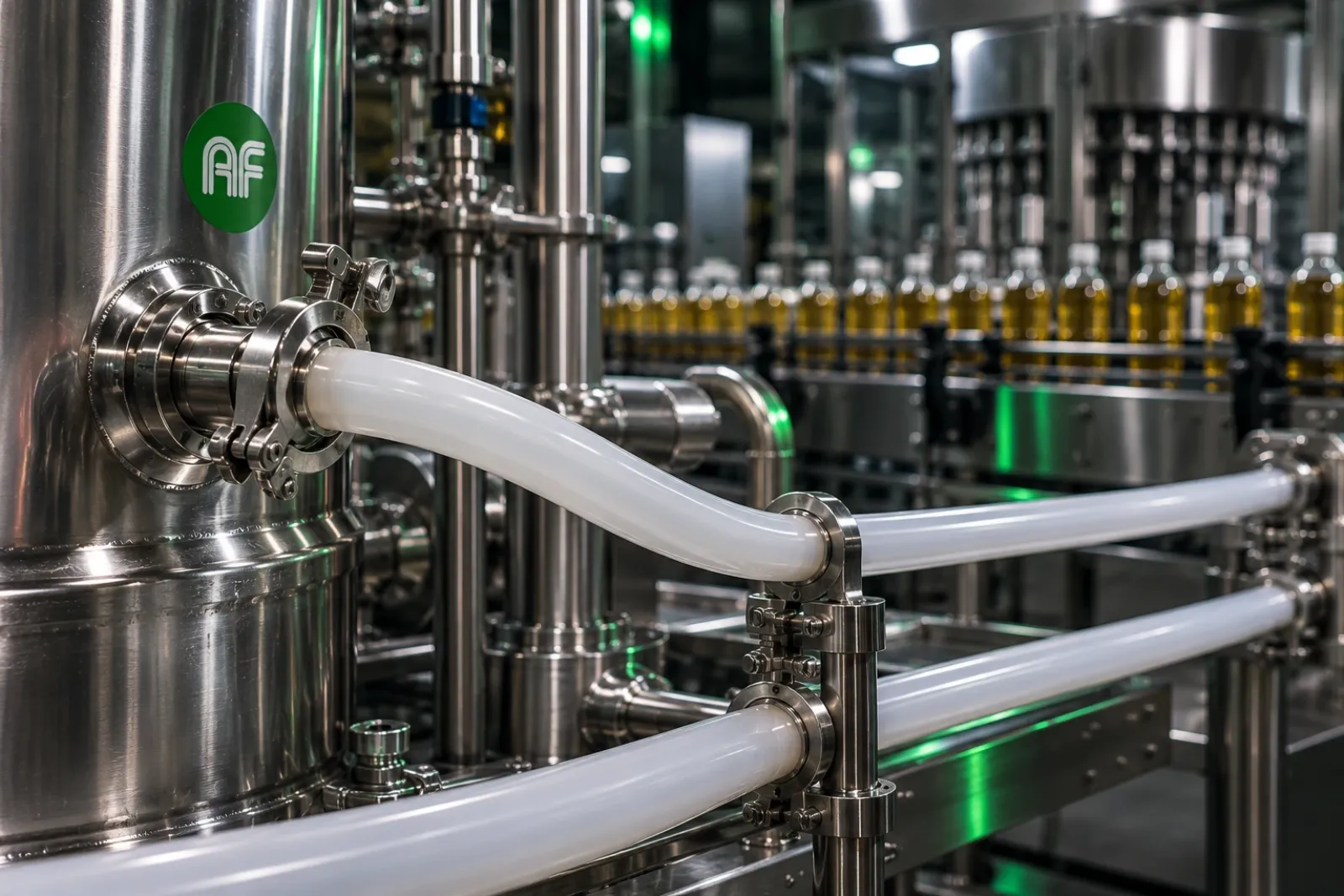
Food and beverage processors specifying flexible tubing face two separate compliance questions that are often conflated into one: is the material approved for food contact, and is it safe for the human body if trace amounts migrate into the product. PTFE tubing answers both, but the two certifications that prove it -- FDA 21 CFR 177.1550 and USP Class VI -- test different things, and a supplier who only mentions one hasn't given you the full picture.
Key Takeaways
- FDA 21 CFR 177.1550 and USP Class VI are separate certifications: one governs food-contact material composition, the other governs biocompatibility and extractables. PTFE tubing should carry both for pharmaceutical-adjacent food applications.
- Natural (uncolored) PTFE is the standard choice for direct product-contact tubing; pigmented PTFE should not be assumed food-safe unless the specific colorant is separately verified.
- PTFE's continuous service range of −260°C to +260°C comfortably covers both CIP (Clean-in-Place, typically 80–95°C) and SIP (Steam-in-Place, up to 121–134°C) cycles without degrading or leaching.
- PTFE's smooth, non-porous bore reduces microbial harborage compared to some elastomer tubing -- a real factor in dairy and brewing hygiene audits.
- 3-A Sanitary Standards (common in US dairy/food equipment specs) are a separate reference from FDA -- confirm which certification your auditor is actually asking for before you quote.
Why Food & Beverage Processors Specify PTFE Over Silicone or PVC
Silicone and PVC tubing dominate lower-cost, lower-temperature food-transfer lines, but both have limits that push processors toward PTFE once the application gets demanding. Silicone tolerates repeated steam sterilization reasonably well but is permeable to gases and can absorb flavor compounds over repeated cycles -- a problem in brewing and dairy where product taste carries commercial risk. PVC's temperature ceiling sits well below CIP/SIP cycle temperatures, ruling it out for any line that gets steam-sterilized in place. PTFE's chemical inertness means it doesn't interact with the product at all -- no flavor absorption, no plasticizer migration, no swelling under fat or alcohol content -- while its −260°C to +260°C range covers cryogenic storage lines and high-temperature sterilization with the same tube.
FDA 21 CFR 177.1550 vs. USP Class VI: What Each Actually Certifies
These two standards get referenced interchangeably in casual conversation, but they test different properties and neither one substitutes for the other.
| Standard | What It Actually Tests |
|---|---|
| FDA 21 CFR 177.1550 | Confirms the polymer composition is approved for direct food contact under the FDA's food-additive regulations -- a materials-composition standard, not a biological safety test |
| USP Class VI | A biocompatibility test (systemic toxicity, intracutaneous reactivity, implantation) originally developed for pharmaceutical/medical plastics -- confirms extractables don't harm biological systems |
| 3-A Sanitary Standards | US dairy-equipment-specific design and material standards, referenced independently by many dairy processors and auditors |
| Relevant for food & beverage | FDA 177.1550 is the baseline requirement; USP Class VI is commonly requested for pharmaceutical-adjacent food production (nutraceuticals, infant formula) where extractable safety margins are tighter |
CIP and SIP Compatibility
Clean-in-Place cycles typically run caustic or acid cleaning solutions at 80–95°C, and Steam-in-Place sterilization can reach 121–134°C. Both are well within PTFE's continuous service range, and -- unlike some elastomers -- PTFE doesn't take on a compression set or degrade mechanically from repeated thermal cycling through a CIP/SIP schedule. That matters for total cost of ownership: a tube that needs replacing every few hundred cycles because it's hardened or cracked is a recurring cost that natural PTFE tubing largely avoids.
Common Mistakes When Specifying Food-Grade PTFE Tubing
- Assuming any PTFE tube is automatically food-safe. FDA 177.1550 compliance needs to be confirmed with the specific supplier and grade, not assumed from the base polymer.
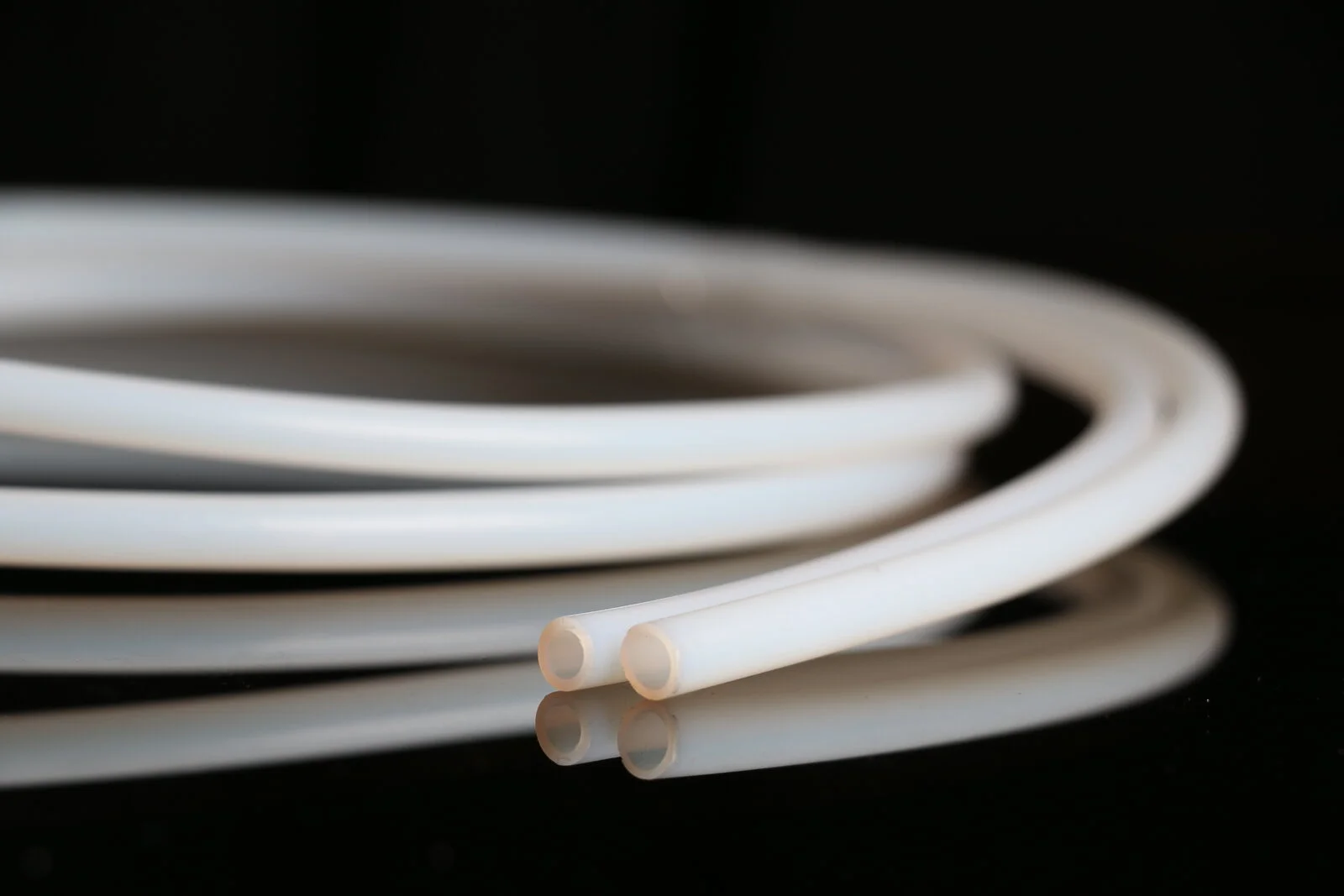
- Using colored PTFE tube in direct product contact. Colorants used for line identification in industrial PTFE tube are not automatically food-safe -- specify natural (uncolored) tube for anything touching product, and reserve colored tube for external/utility lines only.
- Confusing FDA approval with USP Class VI. If your auditor or customer specifically asks for USP Class VI, FDA 177.1550 alone won't satisfy that requirement -- confirm which certificate is actually needed before ordering.
- Under-specifying wall thickness for vacuum or CIP suction lines. PTFE tube under vacuum needs adequate wall thickness to resist collapse -- thin-wall tube sized for gravity-fed lines can fail under CIP suction cycles.
- Not confirming 3-A compliance separately when required. Dairy processors and auditors following 3-A Sanitary Standards need that reference checked independently -- it isn't implied by FDA or USP certification.
Advanced Fluro: What We Actually Offer
Advanced Fluro Private Limited manufactures PTFE tubing for food and beverage processing from our ISO 9001:2015 certified facility in Vasai East, Mumbai. Specifics relevant to food-contact applications:
- Natural (uncolored) PTFE tube manufactured to FDA 21 CFR 177.1550, the standard grade for direct product-contact lines.
- Custom dimensions from 0.5 mm ID, so CIP suction lines and dosing/metering tube can be sized to the exact wall thickness the application needs rather than the nearest stock size.
- FEP tube for applications needing full visual clarity for flow confirmation, at a slightly lower continuous temperature ceiling than PTFE.
- In-house extrusion, so we can confirm material traceability and certification documentation directly rather than through a third-party distributor.
We supply food-contact and pharmaceutical-adjacent tubing to dairy, brewing, bottling, and nutraceutical processors across India, with pan-India delivery and export capability.
Frequently Asked Questions
Is all PTFE tubing automatically food-safe?
No. Food-contact compliance under FDA 21 CFR 177.1550 needs to be confirmed with the specific manufacturer and grade you're buying -- it isn't an inherent property of the base polymer that applies to every PTFE tube on the market regardless of supplier.
What's the difference between FDA compliance and USP Class VI for tubing?
FDA 21 CFR 177.1550 certifies the material composition is approved for food contact. USP Class VI is a separate biocompatibility test for extractables and systemic toxicity, originally developed for pharmaceutical and medical plastics. Both are commonly requested together for pharmaceutical-adjacent food production such as nutraceuticals or infant formula.
Can colored PTFE tube be used for food contact?
Not by default. Pigments used in colored PTFE tube for line identification are not automatically food-safe. Natural (uncolored) PTFE is the standard specification for any tube in direct product contact; colored tube should be reserved for non-contact identification or utility lines.
Does PTFE tubing survive repeated CIP and SIP cycles?
Yes. PTFE's continuous service range of −260°C to +260°C comfortably covers CIP cleaning cycles (typically 80–95°C) and SIP steam sterilization (up to 121–134°C) without mechanical degradation, cracking, or compression set -- a common failure mode in elastomer tubing subjected to the same repeated thermal cycling.
What temperature range does food-grade PTFE tube handle?
PTFE tubing operates continuously from −260°C to +260°C, covering cryogenic storage and transfer lines at one extreme and steam sterilization at the other, without a material change between applications.

Article by
AFTubes Team
Savio Pereira is a Chemical Engineer who has held leadership roles in companies like IBM. A passionate problem solver who thrives at finding solutions to engineering and business problems alike using simple innovative ideas. He believes in doing things differently rather than doing different things. His vision is to make Advanced Fluro (P) Ltd the most valuable company in the fluouro polymer industry.