
Article by
Savio Pereira
Savio Pereira is a Chemical Engineer who has held leadership roles in companies like IBM. A passionate problem solver who thrives at finding solutions to engineering and business problems alike using simple innovative ideas. He believes in doing things differently rather than doing different things. His vision is to make Advanced Fluro (P) Ltd the most valuable company in the fluouro polymer industry.
In critical chemical processing, a single millimetre of dimensional variance in a fluid transfer line can result in systemic failure and costly industrial downtime. You likely recognize that in high-stakes sectors like pharma or automotive, standard components often fail to meet the rigorous demands of corrosive environments. Finding a reliable PTFE tube manufacturer India that prioritizes virgin-grade material and ISO 9001:2015 standards is essential for maintaining your operational integrity.
This guide provides a technical deep dive into selecting high-performance PTFE tubing and hoses, detailing how precision engineering and material purity ensure long-term durability. We'll examine the shift toward IS 14635:2020 compliance, custom dimensioning for seamless integration, and why India's manufacturing sector is becoming a global hub for specialized polymer solutions. You'll gain the insights needed to source components that handle extreme temperatures and aggressive chemicals without compromising on safety or performance. Whether you're managing bulk orders or require custom engineering support, understanding these technical benchmarks is the first step toward a more resilient fluid transfer assembly.
Key Takeaways
- Understand the critical role of high-performance fluoropolymers in India's expanding pharmaceutical and chemical sectors to ensure long-term system reliability and safety.
- Compare the technical advantages of RAM extrusion for long-length tubing against moulded processes designed for larger diameter industrial applications.
- Identify the essential criteria for selecting a PTFE tube manufacturer India, focusing on ISO 9001:2015 certification and the consistent use of 100% virgin-grade resin.
- Evaluate the structural risks associated with recycled PTFE, such as micro-porosity, and why material purity is non-negotiable for corrosive fluid transfer.
- Determine the optimal hose configuration for your specific assembly by balancing the flexibility of corrugated designs with the high-pressure resistance of SS304 braided variants.
The Role of a PTFE Tube Manufacturer in India's Industrial Growth
India's manufacturing sector recorded a 5.5% year-on-year expansion in May 2026, signaling a robust phase of industrial maturation. This growth is particularly evident in the chemical, pharmaceutical, and power sectors, where fluid transfer systems must operate under increasingly aggressive conditions. A specialized PTFE tube manufacturer India serves as a critical link in this supply chain, providing the material science required to handle volatile substances safely. Polytetrafluoroethylene (PTFE) is the foundational material for these systems, offering a unique combination of chemical and thermal properties that traditional polymers cannot match.
The transition toward specialized fluoropolymer solutions reflects a broader shift in Indian industry toward higher-value production. Engineering teams now prioritize long-term durability over low-cost, generic alternatives. While a standard supplier might offer basic tubing, an ISO 9001:2015 certified manufacturer ensures that every batch meets rigorous international quality benchmarks. This commitment to precision directly impacts operational costs. Precision-manufactured tubing reduces unexpected system downtime, preventing leaks and material failures that could jeopardize large-scale industrial assemblies. Reliability isn't just a goal; it's a technical requirement.
Key Properties of Industrial PTFE
Industrial-grade PTFE is defined by its extreme chemical inertness, making it resistant to almost all industrial chemicals and solvents used in Indian processing plants. Its thermal stability is equally impressive, maintaining structural integrity across an operational range of -200°C to +260°C. Additionally, the material's low friction and non-stick characteristics facilitate efficient fluid flow, which minimizes pressure drops and prevents the accumulation of residues within the transfer lines. These properties ensure that the material doesn't react with the media it conveys, preserving the purity of the final product.
Critical Industrial Applications
In chemical processing, PTFE tubing is essential for handling corrosive acids and alkalis that would otherwise degrade metal or lower-grade plastic piping. The pharmaceutical sector relies on these tubes for fluid transfer because they maintain high purity standards and offer non-contamination properties. Automotive and electrical industries also leverage the material's high dielectric strength and thermal resistance to protect critical wiring and sensors in high-heat environments. As a dedicated PTFE tube manufacturer India, we ensure these products integrate seamlessly into existing assemblies, supporting the specific regulatory and technical demands of each sector.
Manufacturing Standards: Extrusion and Moulding Processes
Selecting the appropriate manufacturing method is critical for ensuring that PTFE components perform reliably under industrial stress. As a specialized PTFE tube manufacturer India, we utilize distinct processes tailored to the specific geometric and structural requirements of your fluid transfer system. The choice between RAM extrusion and compression moulding isn't merely operational; it dictates the material density, tensile strength, and maximum continuous length available for your project.
RAM extrusion is the primary method for producing long-length, high-density tubing. In this process, granular PTFE resin is fed into a cylinder and compressed by a reciprocating ram through a heated die. This continuous cycle creates a solid, uniform structure ideal for industrial lines that require high pressure resistance. For applications involving larger diameters or shorter, heavy-walled sections, moulding is the preferred alternative. Moulded tubes are produced through compression moulding, where resin is compacted in a static die and then sintered. This method allows for the creation of components with outer diameters that exceed the limits of standard extrusion machinery.
RAM Extrusion vs. Paste Extrusion
While RAM extrusion produces high-density tubes for rigid industrial use, paste extrusion is employed for thin-walled sleeves and flexible liners. Paste extrusion uses a fine powder resin mixed with a volatile lubricant, which is then forced through a die at lower temperatures. This technique is essential for creating the flexible liners found in SS304 braided PTFE hoses. The final tensile strength of the tubing is heavily influenced by the extrusion speed and the precise temperature gradients maintained during the sintering phase. Controlling these variables prevents structural defects and ensures the material maintains its characteristic chemical resistance.
Quality Assurance and Tolerances
Precision in wall thickness and internal diameter (ID) is non-negotiable for seamless integration into existing hydraulic or chemical assemblies. We adhere to international dimension standards to ensure that every batch remains consistent, even in bulk industrial orders. High-pressure applications require rigorous testing, including hydrostatic pressure tests, to verify that the tubing won't fail under operational loads. Understanding the nuances of Virgin Grade vs. Recycled PTFE is also vital here, as material purity directly affects the consistency of these dimensions. In the context of PTFE manufacturing precision, tolerance is the permissible limit of variation in a physical dimension that ensures components fit and function correctly within a mechanical system. Our quality control protocols include automated monitoring to maintain these strict tolerances across all production runs.
Virgin Grade vs. Recycled PTFE: Why Material Purity Matters
Material purity is the cornerstone of reliability in high-performance fluoropolymers. While price-sensitive procurement may consider recycled grades, a leading PTFE tube manufacturer India will emphasize that virgin-grade resin consists of 100% pure polymer without reprocessed additives. Recycled PTFE is manufactured from sintered scrap, which inevitably compromises the molecular chain. This results in micro-porosity, a structural defect where tiny voids allow chemicals to permeate the tube wall. In corrosive environments, this permeability leads to premature failure and hazardous contamination of the transferred media.
Pharmaceutical and semiconductor industries don't just prefer virgin material; they mandate it. These sectors require ultra-pure PFA and virgin PTFE to meet stringent non-contamination standards. Identifying a manufacturer that provides material certification is essential for verifying that your components meet these high-stakes requirements. Without guaranteed material origin, the risk of systemic failure increases significantly.
The Advantage of Virgin PTFE Tubing
Virgin PTFE tubing provides a level of mechanical integrity that reprocessed materials cannot replicate. Its technical advantages include:
- Superior Mechanical Properties: It offers higher elongation and tensile strength, which are vital for systems experiencing thermal cycling.
- Enhanced Surface Finish: The lack of additives results in a smoother bore, reducing the risk of bacterial growth in pharma applications.
- Extended Service Life: It maintains structural stability in aggressive chemical environments longer than recycled grades.
Ultra-Pure PFA and FEP Alternatives
Certain industrial applications require properties that exceed the capabilities of standard PTFE. FEP transparent tubing is the preferred choice when visual monitoring of fluid flow is required, as it offers excellent chemical resistance combined with optical clarity. For semiconductor manufacturing and specialized laboratory use, ultra-pure PFA tubing remains the gold standard. PFA provides superior thermal stability and an exceptionally smooth internal surface, which is critical for transporting volatile chemicals without metallic ion contamination. Comparing thermal and chemical performance across the fluoropolymer spectrum helps engineers select the precise material for their specific industrial assembly. Choosing the right PTFE tube manufacturer India ensures access to these high-purity variants, backed by the technical support needed for custom engineering projects.

Selecting the Right PTFE Hose Assembly for Industrial Systems
Engineering a fluid transfer system requires a precise match between the assembly's mechanical structure and the operational environment. While previous sections detailed material purity, the physical configuration of the hose determines its success in high-pressure or high-temperature applications. A reputable PTFE tube manufacturer India provides the technical support needed to navigate these variables, ensuring that your assembly doesn't just fit but excels under stress. Choosing the wrong assembly configuration often leads to premature fatigue, especially in systems experiencing constant vibration or extreme thermal cycling.
Industrial systems often face a technical trade-off between smooth-bore and corrugated designs. Smooth-bore tubing offers maximum flow efficiency and is easier to clean, which is critical in pharmaceutical lines to prevent batch cross-contamination. However, in cramped machinery where tight bend radii are unavoidable, corrugated PTFE hoses provide the necessary flexibility without kinking or collapsing. Balancing these factors is essential for maintaining consistent flow rates while protecting the structural integrity of the line.
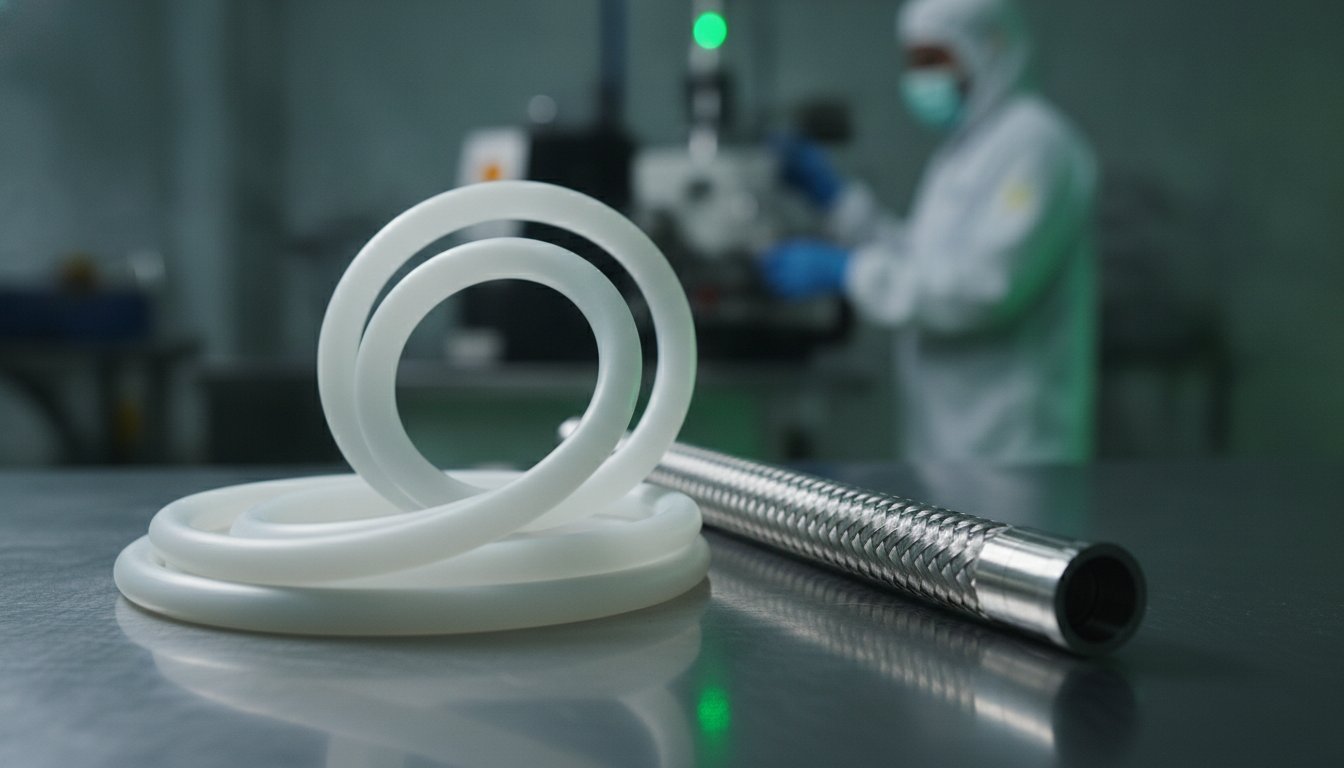
SS304 Braided PTFE Hoses
High-pressure hydraulic and steam systems demand structural reinforcement that a standard PTFE liner cannot provide alone. SS304 braiding serves as a protective external layer, shielding the inner liner from external abrasion and preventing volumetric expansion under internal pressure. This configuration is paramount in India's oil and gas and power generation sectors, where durability is a non-negotiable safety requirement. We provide various end-fitting options, including flanged and threaded connections, to ensure leak-proof integration into your specific industrial footprint.
Corrugated and Conductive Variants
In environments where volatile media are transferred at high velocities, electrostatic discharge poses a significant ignition risk. Conductive PTFE hoses feature a carbon-filled inner liner that prevents static buildup by providing a path to the ground. A conductive PTFE liner functions as a continuous grounding path, safely dissipating static electricity accumulated during the high-velocity transfer of non-polar fluids in accordance with 2026 safety protocols. This safety mechanism is vital for chemical plants handling flammable solvents.
When specifying custom dimensions for unique industrial footprints, use the following checklist to ensure a seamless fit:
- Maximum Operating Pressure: Factor in potential pressure surges beyond the standard working load.
- Minimum Bend Radius: Identify the tightest curve the hose must navigate within the machinery housing.
- Chemical Compatibility: Confirm the liner and fittings are resistant to the specific media and cleaning agents used.
- End-Fitting Specifications: Define the exact thread standards or flange ratings required for secure attachment.
If your project requires a bespoke solution tailored to a complex assembly, you can request a technical consultation for custom PTFE hoses to ensure your system meets international performance benchmarks.
Partnering with Advanced Fluro: Precision Engineered Solutions
Selecting a specialized PTFE tube manufacturer India is a strategic decision that directly impacts the long-term safety and efficiency of your industrial infrastructure. Advanced Fluro Private Limited operates an ISO 9001:2015 certified manufacturing facility, where we prioritize technical precision and material purity above all else. Our manufacturing philosophy is anchored in the exclusive use of virgin-grade fluoropolymers, ensuring that every component we deliver meets the rigorous demands of the pharmaceutical, chemical, and automotive sectors. We don't just supply commodity tubing; we provide engineered solutions designed to integrate seamlessly into complex national industrial assemblies.
Our role as a trusted technical partner involves supporting procurement specialists and engineers through the entire lifecycle of a project. Whether you're managing a new plant setup or upgrading existing fluid transfer lines, our team provides the technical depth required to ensure regulatory compliance and operational durability. We understand the critical nature of these components in high-stakes environments, which is why our facility is optimized for both high-volume production and specialized, low-volume custom engineering.
Custom Manufacturing Capabilities
Industrial instrumentation often requires non-standard geometries that off-the-shelf products simply can't accommodate. We specialize in engineering Custom Dimension PTFE Tubes to exact internal and outer diameter specifications, maintaining strict tolerances for specialized laboratory and medical applications. Our capabilities extend to developing multi-layer or braided assemblies designed to solve complex fluid transfer challenges, such as those found in high-pressure hydraulic systems or volatile chemical lines. This bespoke approach allows you to source components that are perfectly calibrated for your unique equipment footprints, reducing the risk of installation errors or system mismatches.
The Advanced Fluro Quality Commitment
Reliability at Advanced Fluro is verified through a rigorous internal testing regimen that leaves no room for material failure. Every production batch undergoes comprehensive evaluation for chemical resistance, pressure ratings, and thermal stability to ensure absolute compliance with global quality standards. We maintain documented traceability for all virgin-grade resins, providing our partners with the technical assurance required for high-stakes operations in the semiconductor and power sectors. If you're managing a large-scale project and require specific performance data, our team is available for technical consultations to help define the optimal material specifications for your bulk orders. You can Contact Advanced Fluro for a technical quote on your PTFE requirements to begin the engineering process for your next fluid transfer assembly and receive a transparent, comprehensive quotation tailored to your project's needs.
Securing Your Industrial Fluid Transfer Infrastructure
Maintaining the integrity of fluid transfer systems requires more than just standard components; it demands engineered precision. As a dedicated PTFE tube manufacturer India, Advanced Fluro Private Limited bridges the gap between material science and industrial application. By prioritizing virgin-grade fluoropolymers and adhering to ISO 9001:2015 certified processes, we ensure your assemblies resist chemical degradation and mechanical fatigue. You've seen how specific configurations like SS304 braiding or conductive liners address high-pressure and volatile media challenges. These technical benchmarks are essential for the pharma, chemical, and oil and gas sectors operating across the national landscape. Ensuring your infrastructure meets these rigorous global standards protects both your operational uptime and your personnel. It's clear that material purity and dimensional accuracy are the primary drivers of reliability in modern manufacturing. We invite you to Request a Free Technical Quotation for Your PTFE Tubing Needs to begin optimizing your system's performance. Our team is ready to support your custom engineering requirements with the technical depth your projects deserve. We look forward to helping you achieve a more resilient and efficient industrial assembly.
Frequently Asked Questions
What is the difference between PTFE and Teflon tubing?
PTFE is the technical chemical name for Polytetrafluoroethylene, whereas Teflon is a registered brand name for the same polymer. While the material properties remain identical, a professional PTFE tube manufacturer India focuses on the material's engineering specifications to ensure it meets industrial standards like IS 14635:2020, regardless of the brand name used.
Why is virgin-grade PTFE preferred over recycled PTFE for industrial use?
Virgin-grade PTFE is produced from 100% pure resin, which ensures maximum molecular weight and structural consistency. Recycled PTFE often contains reprocessed scrap that leads to micro-porosity, a defect that allows chemicals to permeate the tube wall. This purity is essential for preventing systemic failure and contamination in corrosive environments.
Can PTFE tubes handle high-pressure steam applications?
PTFE tubing can handle high-temperature steam up to 260°C, but it requires SS304 braiding for pressure containment. Without this external reinforcement, the liner may experience volumetric expansion or burst under the internal force of pressurized steam. Braided assemblies are the standard for steam lines in the power and chemical sectors.
What are the standard dimensions for PTFE tubes in the Indian market?
The Indian industrial sector primarily follows metric dimensions, with common internal diameters ranging from 2mm to 100mm. However, many projects require custom ID and OD specifications to ensure a precision fit within specialized instrumentation. A reliable PTFE tube manufacturer India will provide these bespoke dimensions to match your specific assembly requirements.
How do I choose between a smooth-bore and a corrugated PTFE hose?
Choose a smooth-bore hose when your priority is maximum flow efficiency and easy sterilization, which is typical in pharmaceutical fluid transfer. Opt for a corrugated hose when your system has a tight footprint. The corrugated design allows for a significantly smaller bend radius without the risk of kinking or structural collapse.
What certifications should I look for in an Indian PTFE tube manufacturer?
ISO 9001:2015 certification is the foundational standard for quality management systems in the manufacturing sector. You should also verify that the manufacturer complies with the revised IS 14635:2020 standards. Documented material traceability is equally important to confirm that the resin used is indeed virgin-grade and free from contaminants.
Is PFA tubing better than PTFE for pharmaceutical applications?
PFA tubing is often preferred for ultra-pure pharmaceutical applications because its melt-processability results in a smoother internal surface. This reduces the risk of particulate entrapment and facilitates more effective cleaning. While PTFE offers excellent resistance, PFA provides the optical clarity and purity levels required for the most sensitive laboratory environments.
How does SS304 braiding improve the performance of a PTFE hose?
SS304 braiding provides a mechanical reinforcement that significantly increases the hose's working pressure rating. It also serves as a protective barrier against external abrasion and physical damage in harsh environments like oil and gas plants. This braiding ensures the internal PTFE liner maintains its shape even under extreme vacuum or pressure conditions.

Article by
AFTubes Team
Savio Pereira is a Chemical Engineer who has held leadership roles in companies like IBM. A passionate problem solver who thrives at finding solutions to engineering and business problems alike using simple innovative ideas. He believes in doing things differently rather than doing different things. His vision is to make Advanced Fluro (P) Ltd the most valuable company in the fluouro polymer industry.