
Article by
Savio Pereira
Savio Pereira is a Chemical Engineer who has held leadership roles in companies like IBM. A passionate problem solver who thrives at finding solutions to engineering and business problems alike using simple innovative ideas. He believes in doing things differently rather than doing different things. His vision is to make Advanced Fluro (P) Ltd the most valuable company in the fluouro polymer industry.
The material itself is rarely the reason high vacuum PTFE tubing fails. In most documented system failures, the root cause traces back to inadequate wall thickness calculations and substandard extrusion tolerances, not the polymer grade selected. For engineers and procurement specialists working in pharmaceutical processing, semiconductor fabrication, or analytical instrumentation, that distinction carries serious consequences.
You already know that PTFE is the logical choice for vacuum-critical fluid transfer. Its chemical inertness, broad thermal range, and exceptionally low outgassing characteristics make it difficult to replace. The challenge isn't choosing the material; it's specifying it correctly. Wall thickness, dimensional tolerances, and virgin-grade purity all determine whether a tubing assembly holds integrity under sustained negative pressure or becomes a contamination liability.
This technical reference guide addresses exactly that. It covers the structural and material specifications required to prevent collapse under vacuum, outlines how virgin-grade PTFE eliminates contamination risks in high-purity systems, and details how to evaluate manufacturers capable of supplying custom dimensions for precision vacuum fittings. By the end, you'll have a clear framework for making defensible, specification-driven procurement decisions.
Key Takeaways
- Understand why virgin-grade material is mandatory for preventing outgassing and maintaining system purity in high-vacuum environments.
- Learn to calculate the critical relationship between wall thickness and collapse pressure to ensure structural stability under sustained negative pressure.
- Discover the technical requirements for specifying custom dimensions for high vacuum PTFE tubing to achieve precise tolerances and secure compression fitting seals.
- Identify key procurement parameters, including permeation rates and thermal resistance limits, for high-purity pharmaceutical and semiconductor applications.
- Evaluate the role of ISO 9001:2015 certified manufacturing in ensuring consistent material performance and traceability for bulk industrial orders.
Understanding High Vacuum PTFE Tubing in Industrial Systems
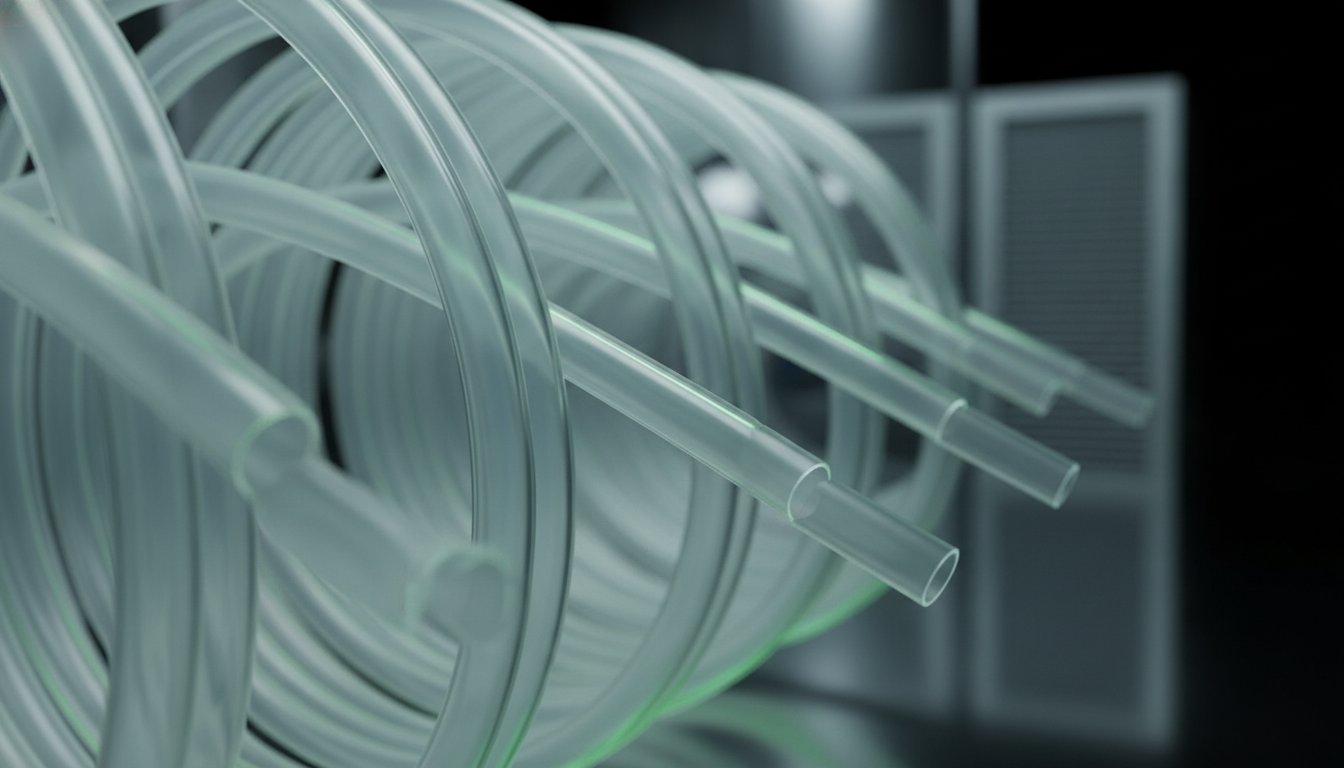
High vacuum PTFE tubing is a specialized fluoropolymer solution engineered specifically for environments where internal pressure is significantly lower than the surrounding atmosphere. While standard fluid handling components focus on burst pressure and flow rates, vacuum-rated variants prioritize structural rigidity and material purity. In these systems, the tubing must act as a rigid conduit that resists the crushing force of external atmospheric pressure while maintaining a chemically inert path for the process media.
The reliability of a vacuum system depends heavily on the polytetrafluoroethylene (PTFE) material properties, specifically its resistance to outgassing and its ability to maintain seal integrity at connection points. Standard tubing often fails in high-vacuum scenarios because its wall thickness isn't optimized for negative pressure. High vacuum PTFE tubing is manufactured with precise extrusion techniques to ensure the wall is uniform and dense enough to resist deformation. This level of engineering is essential in sectors like semiconductor fabrication, pharmaceutical processing, and aerospace research, where even a minor structural failure leads to system-wide contamination.
The Mechanics of Vacuum in Polymer Tubing
Atmospheric pressure exerts roughly 14.7 psi on the tubing exterior during vacuum operations, creating compressive hoop stress. If the wall-thickness-to-diameter ratio is insufficient, the tube will flatten or kink. This structural failure immediately compromises the vacuum seal. The transition to high vacuum requirements in tubing occurs when internal pressures drop below 10⁻³ Torr, necessitating specialized material density and wall configurations to ensure long-term stability.
PTFE vs. Alternative Materials for Vacuum
While FEP and PFA offer transparency, PTFE remains the standard for demanding vacuum applications due to its superior thermal stability. PTFE maintains mechanical integrity at temperatures where other fluoropolymers soften, preventing a decrease in collapse pressure. Conversely, rubber or PVC hoses are unsuitable; they release plasticizers and volatile compounds under vacuum. This outgassing contaminates high-purity systems and makes achieving deep vacuum levels impossible.
Material Science: Why Virgin-Grade PTFE is Essential for Vacuum Integrity
PTFE's molecular architecture is the foundation of its vacuum suitability. The polymer consists of a carbon backbone fully shielded by fluorine atoms, creating one of the strongest bonds in organic chemistry. This carbon-fluorine bond structure is responsible for PTFE's universal chemical inertness, its non-polar surface, and its resistance to thermal degradation across a working range that extends from cryogenic temperatures up to approximately 260°C. No solvent, acid, or oxidizing agent can penetrate that fluorine shell under normal operating conditions, which is precisely why it dominates in chemically aggressive vacuum environments.
The grade of PTFE used in manufacturing, however, determines whether those theoretical properties translate into real-world vacuum performance. Virgin-grade PTFE is produced from unprocessed, never-recycled resin. Recycled or reprocessed PTFE, by contrast, contains residual processing aids, filler contamination from prior applications, and inconsistent molecular weight distributions. These impurities directly reduce dielectric strength, lower the threshold for thermal degradation, and create microscopic voids within the extruded wall. Under sustained vacuum, those voids act as nucleation points for structural failure and as reservoirs for trapped gases that slowly migrate into the vacuum chamber.
Virgin-grade material also produces a denser, more uniform extrusion. This density is critical because it eliminates the microscopic porosity that allows atmospheric gases to permeate through the tube wall at ultra-low pressures. In high vacuum PTFE tubing applications operating below 10⁻³ Torr, even marginal porosity becomes a measurable leak path that prevents achieving target vacuum levels.
The Problem with Outgassing
Outgassing is the release of dissolved or trapped gases from a material's surface under reduced pressure. In recycled or lower-purity PTFE, residual volatile organic compounds and absorbed moisture desorb into the vacuum chamber, contaminating the process environment and elevating the base pressure. Virgin-grade PTFE minimizes this risk because its uncontaminated molecular structure has a substantially lower surface area for gas adsorption and contains no processing residues capable of volatilizing. Moisture absorption is also relevant; PTFE's hydrophobic surface naturally limits water uptake, but impurities in non-virgin grades can increase that absorption rate, adding to the outgassing burden during pump-down cycles.
Purity Standards for Semiconductor and Pharma
In semiconductor fabrication and pharmaceutical processing, material purity isn't a preference; it's a qualification requirement. ISO 9001:2015 certified manufacturing provides the quality management framework that ensures consistent resin sourcing, controlled extrusion parameters, and traceable batch documentation. Where PTFE's opacity is acceptable, virgin-grade tubing meets most purity thresholds. For ultra-trace contamination sensitivity, ultra-pure PFA tubing offers comparable chemical resistance with added transparency and a smoother internal bore that resists particle entrapment. Smooth internal diameters are a non-negotiable specification in both sectors because surface irregularities trap particulates and biological residues that standard flushing protocols cannot fully remove.
Procurement teams specifying tubing for either sector should confirm resin certification documentation as a baseline requirement. To discuss material certification and custom extrusion options for your specific vacuum system, contact a qualified PTFE tubing manufacturer before finalizing your specification.
Critical Specifications: Wall Thickness, Outgassing, and Permeation
Specifying tubing for vacuum service requires a fundamentally different analytical framework than specifying for pressure service. The failure mode is reversed: instead of containing internal pressure, the tube wall must resist external compressive load. That single distinction changes every calculation. Before procurement, engineers should confirm the following parameters against system requirements:
- Wall thickness (WT) and wall-thickness-to-diameter ratio
- Collapse pressure rating at operating temperature
- Safety factor applied to collapse calculations
- Inside diameter (ID) and outside diameter (OD) tolerances
- Gas permeation rate for process-critical species
- Resin grade certification and batch traceability documentation
Dimensional tolerances deserve particular attention at connection points. Compression fittings used in vacuum assemblies rely on precise OD consistency to achieve a gas-tight seal. An OD variation of even ±0.005 inches across a batch can produce inconsistent bite depth in ferrule-type fittings, creating micro-leak paths that are indistinguishable from outgassing during initial pump-down diagnostics. Specifying tight OD tolerances isn't a preference; it's a leak prevention requirement.
Calculating Collapse Resistance
Collapse pressure is governed by three primary variables: outside diameter, wall thickness, and the elastic modulus of PTFE at operating temperature. As temperature rises, PTFE's modulus decreases, which directly reduces the tube's resistance to compressive deformation. A wall thickness that provides adequate collapse resistance at 23°C may be insufficient at 150°C under the same vacuum level. For high vacuum PTFE tubing operating at or below 10⁻³ Torr, a general engineering guideline is to maintain a wall-thickness-to-OD ratio of no less than 0.15 for tubing with an OD below 12mm, and to apply a safety factor of at least 3:1 against the theoretical collapse pressure. Pressure applications typically accept a 2:1 safety factor; vacuum applications demand higher margins because collapse is sudden and catastrophic rather than gradual. Heavy-wall configurations, where WT exceeds 20% of OD, are the appropriate selection for sustained deep vacuum service or elevated-temperature vacuum processes.
Permeation and Gas Transmission
Gas permeation through a PTFE wall is a diffusion-driven process distinct from leakage at fittings. Different gases permeate at measurably different rates: helium, with its small atomic radius, transmits through PTFE significantly faster than nitrogen or oxygen. This is a critical consideration in systems where helium leak detection is used, because background permeation can mask real leak signals. Higher crystallinity in the PTFE matrix reduces free volume within the polymer structure, which in turn lowers gas transmission rates. Virgin-grade PTFE, processed under controlled extrusion parameters, achieves higher and more consistent crystallinity than reprocessed material. Where even lower gas transmission is required, FEP tubing offers a measurable advantage: its semi-crystalline structure and different chain packing geometry produce lower permeation coefficients for most common gases compared to standard PTFE, making it a technically defensible alternative when gas purity or ultra-low base pressure is the primary design constraint.
Specifying Custom Dimensions for High Vacuum Applications
Standard catalogue dimensions are engineered for the broadest possible compatibility, not for the precision demands of vacuum-critical assemblies. When a system integrates custom manifolds, multi-port distribution blocks, or proprietary vacuum fittings, off-the-shelf tubing frequently introduces dimensional mismatches that standard procurement processes don't catch until commissioning. At that stage, the cost of remediation, including system disassembly, re-specification, and requalification, far exceeds the cost of correct specification at the outset.
Custom extrusion resolves this by producing high vacuum PTFE tubing to exact inside diameter, outside diameter, and wall thickness values rather than forcing the system design to accommodate fixed catalogue sizes. For large-scale industrial vacuum installations, bulk supply of custom-dimensioned tubing also delivers a secondary advantage: dimensional consistency across the entire installation lot. Batch-to-batch variation in standard supply can introduce subtle OD drift that accumulates across dozens of connection points, creating a distributed leak risk that's difficult to isolate during system commissioning.
Custom Tolerances and Fitting Compatibility
Compression fittings in vacuum assemblies function on precise interference geometry. The ferrule must bite into the tubing OD at a controlled depth to form a gas-tight seal; too shallow and the seal leaks, too deep and the tubing wall deforms inward, partially restricting bore flow. Concentricity is equally critical: an eccentric wall, where the bore is not centered within the OD, produces uneven ferrule engagement around the circumference, leaving a micro-gap on the thinner wall side. Advanced Fluro's custom extrusion process controls both OD tolerance and wall concentricity to tight limits, ensuring that ferrule engagement is uniform and repeatable across every fitting in a bulk installation. Specifying tubing to match the exact OD requirement of the fitting manufacturer's design envelope eliminates the dimensional ambiguity that standard sizing introduces.
Hose Assemblies for Vacuum Systems
Not every vacuum line runs a fixed, rigid path. Where equipment vibration, thermal cycling, or installation geometry requires flexibility, the choice between smooth-bore and corrugated PTFE construction carries structural implications. Smooth-bore PTFE hose maintains a consistent internal cross-section and lower surface roughness, which is preferable for high-purity fluid transfer and systems sensitive to particle entrapment. Corrugated PTFE hose provides superior flexibility and bend radius accommodation but introduces a larger internal surface area and potential for fluid retention in the convolutions, making it more appropriate for dry vacuum lines or low-sensitivity transfer applications.
Where external mechanical protection is required, SS304 braided PTFE hose provides abrasion resistance and crush protection without compromising the vacuum integrity of the inner PTFE liner. The stainless steel braid carries external mechanical loads, preventing kinking or collapse from incidental contact, while the PTFE bore remains the sole fluid and vacuum boundary. End-fitting selection is the final and often overlooked variable: the fitting material, thread form, and sealing mechanism must be specified to match both the vacuum level and the process media to prevent a precision hose assembly from being undermined by an incompatible termination.
Advanced Fluro: Precision Manufacturing for Vacuum Environments
Most suppliers in the fluoropolymer tubing market are distributors working from fixed catalogue inventory. Advanced Fluro operates differently: as an ISO 9001:2015 certified primary manufacturer, the company controls the extrusion process from resin selection through to dimensional inspection and batch documentation. That distinction matters to engineers specifying high vacuum PTFE tubing because it determines whether the supplier can respond to a precise dimensional requirement or simply offer the nearest standard size.
Every vacuum-grade product manufactured by Advanced Fluro uses 100% virgin-grade PTFE resin. There is no reprocessed or blended material in the production stream. This isn't a marketing position; it's a manufacturing discipline that directly determines the outgassing profile, wall density, and crystallinity of the finished tube. For procurement teams qualifying a supplier for semiconductor or pharmaceutical applications, that resin commitment is the baseline requirement against which all other specifications are measured.
Custom dimension capability extends across the full product range, including PTFE tubing, FEP transparent tubing, ultra-pure PFA tubing, SS304 braided PTFE hose, corrugated PTFE hose, and conductive PTFE hose. Bulk national supply is available for large-scale industrial installations where dimensional consistency across the entire order lot is a system-level requirement, not a preference.
Quality Assurance and Certification
ISO 9001:2015 certification governs the quality management framework across all production stages, from incoming resin verification to final dimensional inspection. For vacuum-grade tubing, this means controlled extrusion parameters are documented per batch, OD and wall thickness measurements are recorded against specified tolerances, and resin certification is traceable through the supply chain. Bulk industrial orders are supplied with batch documentation that supports qualification audits and incoming inspection protocols. In regulated industries, that traceability record is as critical as the tubing itself; a component without a verifiable material history cannot be qualified into a validated process.
Getting a Custom Quote
Requesting a custom dimension quotation requires nothing more than a defined set of parameters: inside diameter, outside diameter, wall thickness, tolerance class, and required quantity. Advanced Fluro's technical team works directly with engineers during the specification phase, providing input on wall-thickness-to-OD ratios, fitting compatibility, and material grade selection before the order is placed. That pre-order technical engagement prevents the specification errors that surface at commissioning.
For vacuum system designers who need to confirm dimensional feasibility before committing to a procurement decision, that access to manufacturing-level technical knowledge is a practical resource. Consult with our technical team for custom high vacuum PTFE tubing solutions and establish the correct specification from the outset.
Build Your Vacuum System on a Specification You Can Defend
Correct specification of high vacuum PTFE tubing isn't a single decision; it's a sequence of engineering choices that compound. Virgin-grade resin determines your outgassing baseline. Wall thickness and OD tolerances determine whether compression fittings seal reliably and whether the tube survives sustained negative pressure. Custom dimensions determine whether your assembly performs as designed rather than as approximated.
Each of those choices carries downstream consequences in regulated environments. A traceable, ISO 9001:2015 certified supply chain isn't a procurement preference; it's the foundation that makes qualification audits possible and keeps validated processes defensible.
Advanced Fluro's technical team works directly with engineers during the specification phase, before an order is placed, to confirm dimensional feasibility, wall thickness ratios, and fitting compatibility. That pre-order engagement is where specification errors are prevented, not discovered at commissioning.
Don't carry forward an assumption that the nearest standard size will perform to your system's requirements. Get the specification confirmed by a manufacturer with the capability to meet it exactly.
Frequently Asked Questions About High Vacuum PTFE Tubing
What is the maximum vacuum level PTFE tubing can handle?
PTFE tubing can operate reliably at pressures below 10⁻⁶ Torr when correctly specified with adequate wall thickness and virgin-grade resin. The limiting factor isn't the polymer's chemical resistance; it's the structural geometry. A wall-thickness-to-OD ratio below the recommended threshold will cause collapse well before the material itself reaches its performance limits. Correct dimensional specification, not material substitution, determines the achievable vacuum depth.
Does PTFE tubing outgas in a high vacuum environment?
Virgin-grade PTFE exhibits very low outgassing rates, making it one of the more suitable polymers for vacuum service. The primary outgassing risk comes from non-virgin or reprocessed material, which retains residual processing aids and absorbed moisture that desorb under reduced pressure. For systems requiring rapid pump-down cycles or ultra-low base pressures, confirming the resin grade and requesting batch certification documentation from your supplier is a non-negotiable qualification step.
Why does PTFE tubing collapse under vacuum, and how can I prevent it?
Collapse occurs when the compressive hoop stress exerted by atmospheric pressure exceeds the tube wall's resistance to deformation. This happens when the wall-thickness-to-OD ratio is insufficient for the operating vacuum level. Prevention requires specifying a minimum wall-thickness-to-OD ratio of 0.15 for tubing below 12mm OD, applying a safety factor of at least 3:1 against the theoretical collapse pressure, and selecting heavy-wall configurations for sustained deep vacuum or elevated-temperature service.
Can I use standard PTFE tubing for high-purity semiconductor vacuum lines?
Standard catalogue PTFE tubing is generally not appropriate for semiconductor vacuum lines. The qualification requirements in semiconductor fabrication demand traceable resin certification, controlled extrusion parameters, and tight dimensional tolerances that standard supply chains don't consistently provide. Smooth internal bore geometry is also a hard requirement; surface irregularities entrap particulates that standard flushing protocols can't fully clear. High vacuum PTFE tubing produced under ISO 9001:2015 certified manufacturing conditions with documented batch traceability is the correct specification baseline.
How does temperature affect the vacuum rating of PTFE tubes?
Elevated temperature reduces PTFE's elastic modulus, which directly lowers its resistance to compressive deformation under vacuum. A wall thickness that provides adequate collapse resistance at 23°C may be structurally insufficient at 150°C under identical vacuum conditions. Engineers specifying tubing for high-temperature vacuum processes must recalculate collapse pressure using the modulus value at the actual operating temperature, then reapply the 3:1 safety factor against that reduced figure rather than the room-temperature baseline.
What is the difference between PTFE, FEP, and PFA for vacuum applications?
PTFE offers the broadest thermal range and superior mechanical rigidity, making it the standard choice for structurally demanding vacuum service. FEP's semi-crystalline structure produces lower gas permeation coefficients for most common gases, which is a technical advantage in systems where helium leak detection is used or ultra-low base pressure is the primary constraint. PFA combines chemical resistance comparable to PTFE with a smoother internal bore and added transparency, making it preferable in ultra-trace contamination-sensitive pharmaceutical and semiconductor applications where particle entrapment is a disqualifying risk.
Are custom dimensions available for high vacuum PTFE tubing?
Yes. Custom extrusion allows tubing to be produced to exact inside diameter, outside diameter, and wall thickness values rather than the nearest standard catalogue size. For vacuum assemblies integrating proprietary fittings or custom manifolds, this eliminates the dimensional mismatches that produce micro-leak paths at connection points. Advanced Fluro's custom dimension capability covers PTFE tubing, FEP transparent tubing, and ultra-pure PFA tubing, with batch-level dimensional documentation available for incoming inspection and qualification audits.
How do I ensure a leak-proof connection with PTFE vacuum tubing?
Leak-proof compression fitting connections depend on three controlled variables: OD consistency, wall concentricity, and correct ferrule engagement depth. An OD variation across a batch, or an eccentric wall where the bore isn't centered within the OD, produces uneven ferrule bite that leaves micro-gaps on the thinner wall side. Specifying tubing with tight OD tolerances matched to the fitting manufacturer's design envelope, and confirming wall concentricity as part of the dimensional specification, eliminates the geometric ambiguity that standard sizing introduces at vacuum-critical connection points.

Article by
AFTubes Team
Savio Pereira is a Chemical Engineer who has held leadership roles in companies like IBM. A passionate problem solver who thrives at finding solutions to engineering and business problems alike using simple innovative ideas. He believes in doing things differently rather than doing different things. His vision is to make Advanced Fluro (P) Ltd the most valuable company in the fluouro polymer industry.