
Article by
Savio Pereira
Savio Pereira is a Chemical Engineer who has held leadership roles in companies like IBM. A passionate problem solver who thrives at finding solutions to engineering and business problems alike using simple innovative ideas. He believes in doing things differently rather than doing different things. His vision is to make Advanced Fluro (P) Ltd the most valuable company in the fluouro polymer industry.
In high-stakes industrial fluid transfer, relying on standard specifications is often the first step toward a catastrophic system failure. You're likely aware that even a microscopic deviation in ID/OD tolerances or a trace amount of material impurity can compromise the integrity of a pharmaceutical or semiconductor production line. When corrosive environments and high-purity requirements intersect, the margin for error disappears. This guide helps you master the technical nuances of precision fluoropolymer tubing to ensure absolute reliability and performance in your most demanding systems.
We'll examine how to select the correct polymer, whether it's PTFE, FEP, or PFA, based on specific thermal and chemical thresholds. You'll also learn to evaluate the impact of virgin-grade extrusion quality on tubing longevity and identify how to source custom dimensions from reliable national manufacturers. With the EU formally adopting REACH amendments to restrict fluoropolymers as of July 2026, understanding these engineering standards and material grades is now a critical requirement for maintaining both regulatory compliance and operational excellence in the Indian market.
Key Takeaways
- Define precision fluoropolymer tubing based on high-tolerance engineering and wall thickness consistency required for maintaining specified pressure ratings in critical systems.
- Differentiate between the thermal operating limits of PTFE, FEP, and PFA to ensure material compatibility with your specific chemical processing environment.
- Learn how specialized extrusion processes and rigorous temperature controls prevent material degradation and ensure the long-term reliability of industrial hoses.
- Evaluate fluid purity requirements and electrostatic buildup risks to select a material grade that eliminates contamination in high-stakes applications.
- Discover how to source custom-dimensioned, virgin-grade tubing from an ISO-certified manufacturer to meet rigorous Indian engineering standards.
Defining Precision in Fluoropolymer Tubing: Beyond Basic Dimensions
Precision in fluid transfer systems isn't a luxury; it's a fundamental engineering requirement. Unlike general-purpose industrial tubing, precision fluoropolymer tubing is manufactured to exacting internal diameter (ID) and outer diameter (OD) specifications that ensure predictable flow and mechanical fit. In analytical chemistry and precision instrumentation, even a minor variance in the internal bore can cause inconsistent flow rates or sample dispersion. Standard industrial tubing often lacks the concentricity needed for these high-stakes applications, where a "close enough" fit results in turbulent flow or premature component failure.
The primary materials utilized in this high-performance category include Polytetrafluoroethylene (PTFE), Fluorinated Ethylene Propylene (FEP), and Perfluoroalkoxy (PFA). Each fluoropolymer offers a unique set of physical properties, but they all share a common requirement: they must be extruded with absolute wall thickness consistency. This uniformity is critical for maintaining pressure ratings. A thin spot in the wall becomes a localized point of weakness, significantly reducing the tube's burst pressure and overall safety factor in pressurized systems.
The Role of Virgin-Grade Materials in Precision
For high-tolerance systems, the use of virgin-grade resins is mandatory. Virgin polymers are materials that haven't been previously processed or recycled, which ensures a consistent molecular weight distribution and stable physical properties. Reprocessed materials often contain contaminants or degraded chains that compromise the tube's molecular stability. In precision applications, this purity directly impacts the dielectric strength and chemical inertness of the conduit. Using virgin-grade PTFE tubing ensures that the material won't leach impurities into sensitive fluid streams. It's vital for maintaining the integrity of pharmaceutical or semiconductor manufacturing processes.
Dimensional Tolerances and System Performance
Dimensional precision is measured by more than just nominal size. Concentricity, which is the centering of the ID within the OD, is a decisive factor in fluid dynamics. High concentricity promotes laminar flow and prevents the localized turbulence that can occur in unevenly extruded tubes. Tight tolerances are also essential for the integrity of compression fitting assemblies. Precision fluoropolymer tubing often requires tolerances as tight as +/- 0.05mm to ensure a leak-proof seal. When tubing dimensions are inconsistent, fittings can't bite into the material uniformly. This leads to leaks or complete blowouts under high-pressure cycles, especially in demanding Indian industrial environments where temperature fluctuations are common.
Material Performance: Comparing PTFE, FEP, and PFA for High-Tolerance Systems
Selecting the right material for precision fluoropolymer tubing requires a rigorous analysis of thermal limits, chemical compatibility, and optical requirements. Engineers typically evaluate the "Big Three" fluoropolymers: Polytetrafluoroethylene (PTFE), Fluorinated Ethylene Propylene (FEP), and Perfluoroalkoxy (PFA). While they all share the carbon-fluorine bond that provides exceptional inertness, their physical structures dictate their performance in high-tolerance systems. PTFE and PFA both maintain structural integrity up to 260°C, whereas FEP is limited to 200°C. This distinction is vital for steam sterilization or high-temperature chemical processing in industrial environments.
Clarity is another deciding factor in material selection. FEP and PFA are melt-processable, which results in higher transparency compared to the opaque, milky-white appearance of PTFE. This transparency is essential for visual flow monitoring or UV-curing applications. Although all three polymers offer near-universal chemical resistance, they differ in permeability. PFA generally provides the lowest permeability among the melt-processable options, making it a superior choice for preventing gas migration in sensitive analytical instruments. Understanding these nuances helps prevent material failure before it impacts your production line.

PTFE: The Industrial Standard for Chemical Resistance
PTFE is renowned for its unmatched lubricity and the lowest coefficient of friction among solid materials. This property prevents "stiction" in moving parts and ensures that viscous fluids move through the system without residue buildup. For general high-temperature fluid transfer, the PTFE natural tube serves as a reliable baseline. In environments where flammable media or high-velocity powders are present, the PTFE anti-static tube is necessary to dissipate electrostatic charges that could lead to ignition or material clogging.
PFA and FEP: Melt-Processable Precision
While PTFE is shaped via paste extrusion, PFA and FEP are melt-processable, allowing for tighter dimensional control and smoother internal surfaces. PFA tubing is the gold standard for ultra-pure semiconductor and pharmaceutical applications because it combines the thermal resistance of PTFE with the purity of a melt-processed resin. It adheres to strict engineering standards like ASTM D6867-03, which defines the requirements for PFA materials used in critical fluid handling.
For applications requiring UV stability and constant visual inspection, FEP transparent tubing is the most cost-effective choice. It offers excellent flex-life, though PFA generally exhibits better stress-crack resistance under repeated mechanical strain. If you're unsure which material grade fits your specific pressure and temperature profile, you should consult with a technical specialist to review your system requirements and dimensional needs.
The Engineering of Precision: Extrusion Processes and Quality Control
Manufacturing precision fluoropolymer tubing requires a sophisticated understanding of polymer rheology and thermal dynamics. The extrusion method varies significantly depending on the resin's molecular structure. PTFE, which doesn't melt even at high temperatures, is shaped through paste extrusion. This process involves mixing fine-powder resin with a lubricant, preforming a billet, and forcing it through a die under high pressure. In contrast, FEP and PFA are melt-processable and utilize screw-driven melt extrusion. This dichotomy in manufacturing means that achieving consistent tolerances requires specialized machinery tailored to the specific flow characteristics of each polymer.
Maintaining exact temperature control during the extrusion cycle is the most critical variable in preventing material degradation. If temperatures fluctuate, the polymer's molecular chains can break or cross-link prematurely, leading to brittle spots or "voids" in the tubing wall. Modern extrusion lines integrate real-time laser monitoring systems that measure the outer diameter and wall thickness at several points per second. These systems provide immediate feedback to the control unit, allowing for micro-adjustments in line speed or melt temperature. This level of process control is what distinguishes precision fluoropolymer tubing from standard industrial grades, ensuring that the final product meets the rigorous demands of high-stakes fluid systems.
Surface Finish and Internal Smoothness
Internal bore smoothness is a decisive factor in pharmaceutical and food-grade applications. A low-porosity surface prevents the "trap-and-release" of contaminants and reduces the risk of bacterial accumulation. During extrusion, excessive line speeds can cause the "sharkskin" effect, which creates microscopic surface irregularities that increase friction. By optimizing the shear rate at the die head, manufacturers produce smooth bores that minimize pressure drop and ensure laminar flow. This is particularly important in analytical chemistry, where surface-level interactions can skew sensitive test results.
Quality Assurance and Certification
Engineering excellence is validated through exhaustive testing protocols that go beyond simple dimensional checks. Every production batch undergoes tensile strength and elongation testing to ensure the material hasn't been compromised during processing. Burst pressure tests are conducted to verify that the tubing can handle the mechanical stresses defined in its technical specification. For materials like FEP, adherence to standards such as ASTM D3296-03 provides a verified framework for physical property requirements.
Batch traceability is a mandatory requirement for industries like aerospace and medical device manufacturing, where component failure is not an option. Detailed documentation tracks the resin from its virgin source through every stage of the extrusion process. Adherence to ISO 9001:2015 standards ensures that these rigorous quality management systems are consistently applied across every production run, guaranteeing that bulk orders maintain the same precision as the initial prototype.
Critical Selection Criteria for Demanding Industrial Applications
Selecting precision fluoropolymer tubing involves more than matching a chemical to a material. You must evaluate the total operational environment, including chemical concentration levels, peak operating temperatures, and static versus dynamic pressure requirements. In many Indian chemical processing plants, systems face aggressive solvents alongside high ambient temperatures. These conditions accelerate material fatigue if the tubing isn't specified for the exact mechanical load. You should also consider the fluid's viscosity and purity levels, as these factors dictate whether a standard bore or a high-purity melt-processed surface is necessary to prevent contamination.
Mechanical stressors like constant vibration or a tight bending radius often lead to premature failure in rigid piping. Compliance with international regulatory standards, such as FDA or USP Class VI, is mandatory for pharmaceutical and food-grade applications to ensure the material doesn't leach harmful substances. Every selection criterion must be weighed against the system's expected lifecycle and the cost of downtime caused by component failure. Using a technical partner to verify these parameters ensures that the chosen assembly meets the rigorous safety benchmarks of your industry.
Addressing Electrostatic Risks and Abrasion
Static electricity is a silent threat in fluid transfer systems. When non-conductive fluids move at high velocities, they generate friction that leads to electrostatic buildup. To mitigate the risk of spark discharge in volatile environments, you should utilize a PTFE conductive hose. This specialized tubing incorporates a conductive carbon lining that safely dissipates charges to the end fittings. It's an essential safety measure in solvent transfer and fuel lines where ignition risks are high.
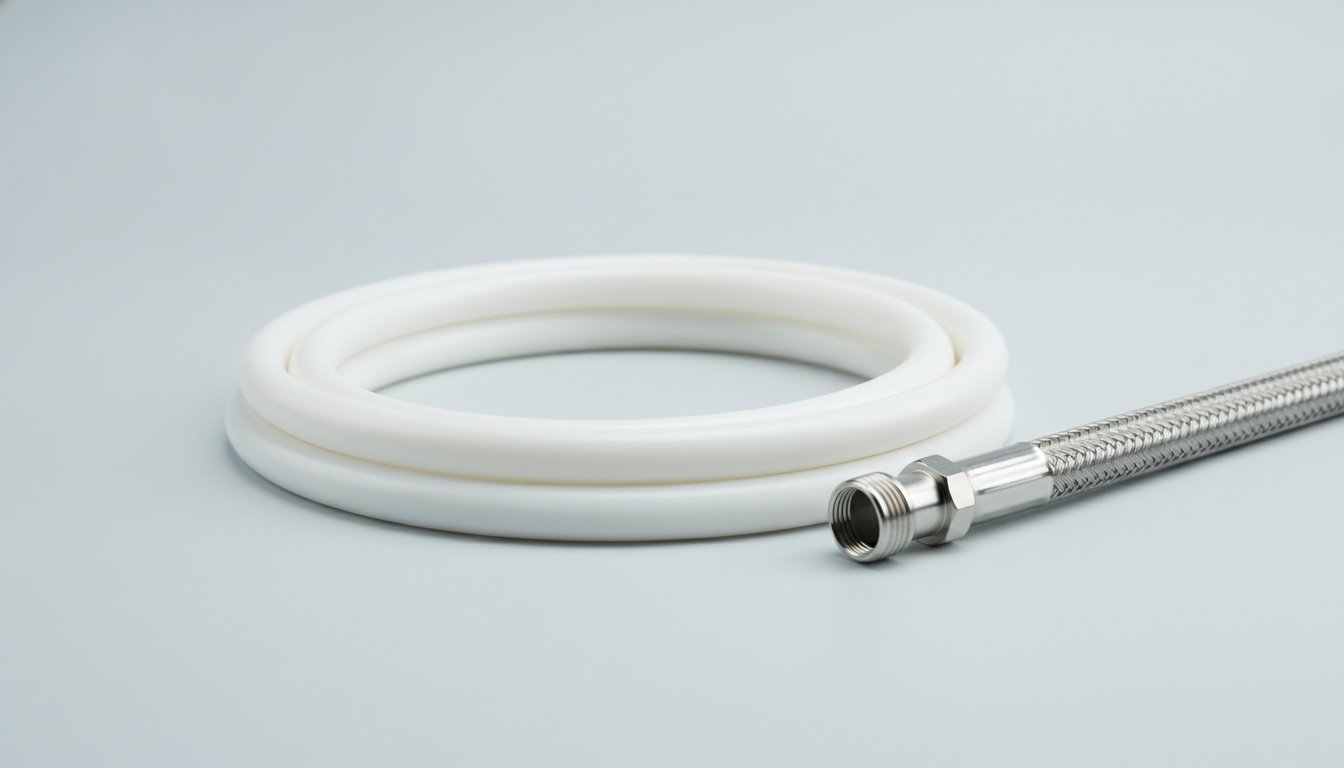
In applications involving external friction or dragging, a PTFE abrasion resistant tube provides the necessary durability to withstand surface wear. When the system requires high internal pressure combined with external protection against physical impact, an SS304 braided PTFE hose is the preferred solution. The stainless steel over-braid acts as a mechanical shield while significantly increasing the assembly's burst pressure rating, making it suitable for hydraulic and steam applications.
Flexibility vs. Rigidity: Corrugated Solutions
Standard fluoropolymer tubes are relatively rigid, which can complicate installation in confined equipment housings. When your system design requires a tight bend radius without kinking, a PTFE corrugated tube offers the necessary flexibility. These convoluted designs allow the tube to bend around obstacles while maintaining a consistent internal volume. This is particularly useful in laboratory settings or compact analytical instruments where space is at a premium.
Corrugated configurations are also superior for applications involving significant vibration damping. Rigid tubing often transmits mechanical stress to the fittings, leading to leaks over time. By contrast, the bellows-like structure of corrugated tubing absorbs these oscillations, protecting the integrity of the entire fluid circuit. Choosing the correct convolution profile ensures that the system remains flexible without sacrificing the chemical resistance inherent to the fluoropolymer resin.
Sourcing Precision Fluoropolymer Solutions: The Advanced Fluro Advantage
Advanced Fluro Private Limited serves as a disciplined manufacturing partner for industries requiring precision fluoropolymer tubing that exceeds standard market offerings. While understanding material science is the first step, the final performance of a fluid system depends on the manufacturer's ability to hold tight tolerances across high-volume production. As an ISO 9001:2015 certified entity, Advanced Fluro provides the institutional trust necessary for high-stakes sectors like semiconductor manufacturing and pharmaceutical processing. The company's expertise in virgin-grade PTFE, FEP, and PFA ensures that every component is engineered for maximum durability and chemical resistance in demanding Indian industrial environments.
Technical support is a core component of the service model, moving beyond simple vendor transactions to provide genuine engineering collaboration. Engineers are invited to collaborate on specialized fluoropolymer product development, ensuring that the final tubing assembly integrates seamlessly with complex system architectures. This methodical approach to manufacturing excellence ensures that no technical detail is overlooked, from the initial resin selection to the final dimensional verification of the extruded product.
Custom Engineering and Dimensional Flexibility
Manufacturers often face challenges when bespoke machinery requires non-standard dimensions that aren't available in off-the-shelf catalogs. Advanced Fluro addresses this gap by offering custom dimension PTFE tubes tailored to exact internal and outer diameter requirements. Beyond sizing, line identification is a critical safety protocol in complex fluid circuits. The availability of colored PTFE tubing allows engineers to implement visual coding systems that prevent cross-contamination or maintenance errors. For systems requiring even stricter safety documentation, PTFE lined and marked tubes provide clear identification of the fluid type and pressure rating directly on the conduit surface.
National Supply and Procurement Reliability
Procurement reliability is a cornerstone of the Advanced Fluro supply chain, designed to meet the rigorous benchmarks of global industrial players. Operating with national delivery capabilities, the firm ensures that bulk industrial orders are fulfilled with consistent precision, regardless of the project's scale. This steady supply is backed by a commitment to quality through ISO 9001:2015 certified processes, ensuring that batch traceability and material purity are never compromised. The procurement process is designed for professional efficiency; technical consultants and procurement specialists can easily obtain detailed quotations for large-scale national projects to keep their timelines on track.
Securing System Integrity through Engineered Material Selection
Achieving operational excellence in high-stakes fluid transfer requires a disciplined approach to component engineering. The transition from standard industrial conduits to precision fluoropolymer tubing involves rigorous material analysis and a commitment to tight dimensional tolerances. Selecting the correct polymer grade, whether it's the high-temperature resilience of PTFE or the ultra-pure clarity of PFA, remains the most critical factor in preventing premature system failure and ensuring long-term reliability.
Reliability is further anchored by international manufacturing standards. Advanced Fluro Private Limited operates as an ISO 9001:2015 certified manufacturer, specializing in virgin-grade PTFE, FEP, and PFA to meet the exact requirements of India's semiconductor and pharmaceutical sectors. With national bulk supply capabilities and a focus on custom dimensional flexibility, we provide the technical depth necessary for your most demanding engineering projects.
Our technical team is ready to assist you in developing specialized solutions that align with your specific pressure, temperature, and purity benchmarks. We look forward to supporting your next industrial innovation with components engineered for safety and exact performance.
Frequently Asked Questions
What is the difference between precision and standard fluoropolymer tubing?
Precision fluoropolymer tubing is distinguished by dimensional tolerances as tight as +/- 0.05mm and superior concentricity across the entire extrusion length. Standard tubing often permits higher variance, which can lead to fitting leaks and inconsistent flow rates in analytical chemistry. This precision ensures that high-pressure systems maintain their integrity during thermal cycling by providing a uniform seal surface for compression fittings.
Why is PFA tubing preferred for semiconductor manufacturing over PTFE?
PFA is preferred for semiconductor manufacturing because its melt-processable nature results in a significantly smoother internal surface finish compared to paste-extruded PTFE. This smoothness reduces the risk of particle entrapment and metallic ion leaching into ultra-pure chemicals. It's essential for maintaining the sub-ppb purity levels required in modern wafer fabrication processes where surface-level contamination can ruin sensitive electronic components.
Can precision fluoropolymer tubing be used for high-pressure steam applications?
Precision tubing can be utilized for high-pressure steam applications when reinforced with an SS304 stainless steel braid. While virgin PTFE and PFA naturally withstand temperatures up to 260°C, the external braid provides the mechanical strength necessary to prevent wall expansion or bursting under steam pressure. This combination ensures that the assembly remains chemically inert while handling the mechanical stressors of industrial steam lines.
How do I calculate the correct wall thickness for my pressure requirements?
Wall thickness is typically calculated using Barlow's Formula, where the required thickness depends on the design pressure, outer diameter, and the material's allowable stress at operating temperature. Engineers should always apply a safety factor of at least 4:1 to account for pressure spikes and material fatigue. It's vital to adjust these calculations based on the maximum temperature the system will reach during operation.
What are the benefits of using virgin-grade PTFE for precision tubing?
Virgin-grade PTFE offers superior molecular stability and dielectric strength compared to reprocessed or recycled alternatives. Because it contains no pre-consumer waste or contaminants, it maintains the highest level of chemical inertness and predictable mechanical performance. This is mandatory for pharmaceutical and semiconductor systems where fluid purity is a non-negotiable requirement and recycled materials might leach unknown impurities.
Is FEP tubing suitable for outdoor applications with high UV exposure?
FEP tubing is exceptionally suitable for outdoor applications due to its inherent resistance to ultraviolet radiation and weather-related degradation. Unlike standard polymers that become brittle or yellow when exposed to sunlight, FEP maintains its mechanical properties and transparency over long periods of environmental exposure. This makes it an ideal choice for environmental monitoring and outdoor chemical sampling systems in India's harsh sunlight.
How does ISO 9001:2015 certification affect the quality of my tubing order?
ISO 9001:2015 certification ensures that every tubing order is manufactured under a rigorous quality management system with full batch traceability. This means that every extrusion run is documented, tested, and verified against international engineering standards before dispatch. It provides industrial clients with the institutional trust that their custom components will perform as specified, ensuring consistency across bulk procurement orders.
Can I order precision tubing in custom colors for system identification?
Yes, precision tubing can be manufactured in a variety of custom colors to facilitate system identification and safety protocols. Colored PTFE and FEP are often used to distinguish between different fluid lines, such as hazardous chemicals versus inert gases, helping to prevent maintenance errors. This visual coding is a standard requirement in complex industrial facilities where multiple fluid streams are managed simultaneously.

Article by
AFTubes Team
Savio Pereira is a Chemical Engineer who has held leadership roles in companies like IBM. A passionate problem solver who thrives at finding solutions to engineering and business problems alike using simple innovative ideas. He believes in doing things differently rather than doing different things. His vision is to make Advanced Fluro (P) Ltd the most valuable company in the fluouro polymer industry.